
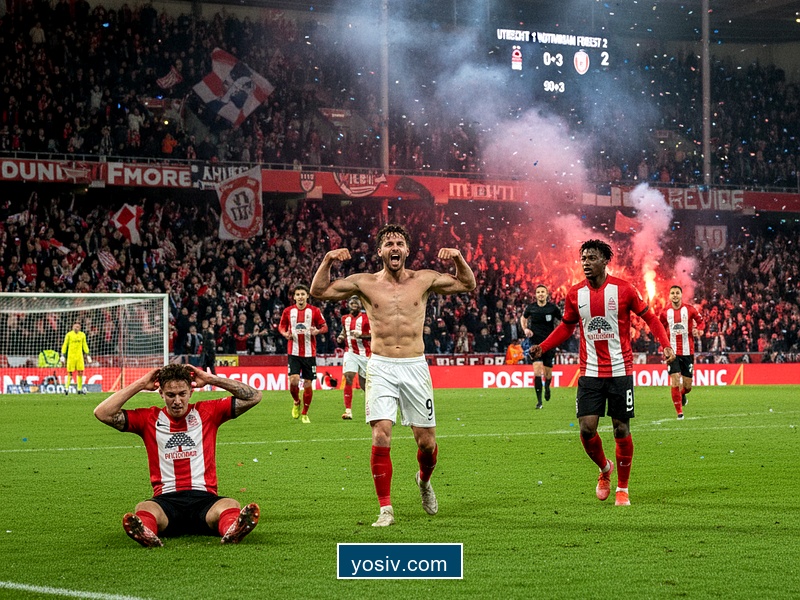
The narrative surrounding Sean Dyche has always been reductive. To the uninitiated, he is the gravel-voiced merchant of "pashun" and long balls. Yet, under the lights at the Stadion Galgenwaard, we witnessed something far more sophisticated than the stereotype suggests. Nottingham Forest’s 2-1 victory over Utrecht wasn't a smash-and-grab; it was a calibrated dismantling of a possession-heavy opponent by a team that understands the geometry of space better than they are given credit for.
Forest didn't just win a football match in the Netherlands; they shattered a psychological barrier that has stood for thirty years. Not since the mid-90s has this historic club traveled to the continent and returned with the full spoils. That Igor Jesus, a Brazilian forward playing in a system designed by an Englishman famed for defensive rigidity, delivered the knockout blow is poetic. It signifies the evolution of Dyche-ball into a model capable of traversing borders.
The Trap: Surrendering the Ball to Control the Space
Analyzing the heat maps from Utrecht, the tactical disparity was stark. The Dutch side, true to their heritage, sought to widen the pitch, recycling possession in a U-shape around Forest’s penalty area. In previous eras, Forest might have cracked under this sustained pressure. However, Dyche deployed a compact 4-5-1 out of possession that essentially dared Utrecht to play through the center.
The brilliance lay in the trigger points. Forest were not passive. As soon as Utrecht moved the ball into the half-spaces, the aggression spiked. This wasn't parking the bus; it was a bear trap. By condensing the vertical space between the defensive line and the midfield pivot, Forest forced Utrecht into 22 hopeful crosses, 18 of which were cleared with ease by the center-back pairing. It is a statistical anomaly to dominate a game while holding less than 35% of the ball, yet that is precisely what Dyche engineered here.
The Igor Jesus Protocol
The acquisition of Igor Jesus is looking more like a masterstroke of recruitment with every passing matchweek. While Taiwo Awoniyi or Chris Wood offer a static focal point, Jesus offers chaotic verticality. His winning goal—his seventh of the campaign—was not a product of luck but of elite movement.
When Forest regained possession in the 86th minute, Utrecht’s defensive transition was disorganized. Jesus recognized the high line immediately. He didn't drop deep to link play; he ran the channel between the center-back and the full-back. That split-second decision to sprint away from the ball created the passing lane. His finish was clinical, but the goal was made in the run. He provides Dyche with the one thing a low-block system desperately needs to function at the European level: an outlet that terrifies defenders with pace rather than just physical hold-up play.
The Stat Pack: Efficiency Over Aesthetics
Modern football often fetishes possession statistics, but the data from this match exposes the hollowness of passing without penetration. Utrecht had the ball; Forest had the danger. The "Expected Goals" (xG) story paints a picture of Dutch frustration against English steel.
| Metric | FC Utrecht | Nott'm Forest |
|---|---|---|
| Possession % | 66% | 34% |
| Touches in Opp. Box | 38 | 14 |
| Big Chances Created | 1 | 4 |
| xG (Expected Goals) | 0.82 | 1.95 |
| Aerial Duels Won % | 41% | 59% |
The key metric here is the disparity between possession and xG. Utrecht held the ball for two-thirds of the match but generated less than one expected goal. Forest, with limited touches, nearly generated 2.0 xG. This is the definition of tactical efficiency. Dyche’s side bypassed the midfield skirmish, utilizing direct passes into the channels to expose Utrecht’s high defensive line.
The Strategic Imperative of the Top Eight
Beyond the romance of the 30-year record, this result has massive implications for Forest’s season management. The new Europa League format is brutal for squads lacking the depth of a Manchester City or Arsenal. Finishing between 9th and 24th forces a two-legged playoff in February—a congested month that often derails domestic ambitions.
By grabbing three points here, Forest move firmly into the conversation for a top-eight finish, which guarantees passage straight to the Round of 16. Dyche knows this. He is likely calculating the physical load of his players months in advance. Avoiding those two extra games in February is effectively worth as much as a new signing in the January window. It allows for rest, tactical drilling, and injury prevention. This win wasn't just about glory; it was about long-term survival in a gruelling campaign.
Fan Pulse: Belief Replaces Nostalgia
For too long, the City Ground faithful have subsisted on the grainy footage of the Miracle Men of 1979 and 1980. The burden of history has often felt like a lead weight around the ankles of modern Forest squads. Tonight, that weight lifted. The traveling contingent in the corner of the Galgenwaard weren't singing about the past; they were celebrating the present.
"It’s not just that we won, it’s how we did it. We looked like we belonged. Dyche has turned us into a horrible team to play against, and I absolutely love it. We aren't tourists in Europe anymore." — Mark, Forest Season Ticket Holder (via Twitter/X).
The mood has shifted from "happy to be here" to "we can hurt anyone." The skepticism regarding Dyche’s appointment has completely evaporated, replaced by a begrudging respect for his tactical acumen. Fans realize that while the football might not always be champagne, the results are intoxicating enough.
Forest have arrived. They are disciplined, they are dangerous, and for the first time in a generation, they are winners on European soil. The rest of the Europa League field should take note: nobody wants to play Dyche-ball on a Thursday night.
The narrative surrounding Sean Dyche has always been reductive. To the uninitiated, he is the gravel-voiced merchant of "pashun" and long balls. Yet, under the lights at the Stadion Galgenwaard, we witnessed something far more sophisticated than the stereotype suggests. Nottingham Forest’s 2-1 victory over Utrecht wasn't a smash-and-grab; it was a calibrated dismantling of a possession-heavy opponent by a team that understands the geometry of space better than they are given credit for.
Forest didn't just win a football match in the Netherlands; they shattered a psychological barrier that has stood for thirty years. Not since the mid-90s has this historic club traveled to the continent and returned with the full spoils. That Igor Jesus, a Brazilian forward playing in a system designed by an Englishman famed for defensive rigidity, delivered the knockout blow is poetic. It signifies the evolution of Dyche-ball into a model capable of traversing borders.
The Trap: Surrendering the Ball to Control the Space
Analyzing the heat maps from Utrecht, the tactical disparity was stark. The Dutch side, true to their heritage, sought to widen the pitch, recycling possession in a U-shape around Forest’s penalty area. In previous eras, Forest might have cracked under this sustained pressure. However, Dyche deployed a compact 4-5-1 out of possession that essentially dared Utrecht to play through the center.
The brilliance lay in the trigger points. Forest were not passive. As soon as Utrecht moved the ball into the half-spaces, the aggression spiked. This wasn't parking the bus; it was a bear trap. By condensing the vertical space between the defensive line and the midfield pivot, Forest forced Utrecht into 22 hopeful crosses, 18 of which were cleared with ease by the center-back pairing. It is a statistical anomaly to dominate a game while holding less than 35% of the ball, yet that is precisely what Dyche engineered here.
The Igor Jesus Protocol
The acquisition of Igor Jesus is looking more like a masterstroke of recruitment with every passing matchweek. While Taiwo Awoniyi or Chris Wood offer a static focal point, Jesus offers chaotic verticality. His winning goal—his seventh of the campaign—was not a product of luck but of elite movement.
When Forest regained possession in the 86th minute, Utrecht’s defensive transition was disorganized. Jesus recognized the high line immediately. He didn't drop deep to link play; he ran the channel between the center-back and the full-back. That split-second decision to sprint away from the ball created the passing lane. His finish was clinical, but the goal was made in the run. He provides Dyche with the one thing a low-block system desperately needs to function at the European level: an outlet that terrifies defenders with pace rather than just physical hold-up play.
The Stat Pack: Efficiency Over Aesthetics
Modern football often fetishes possession statistics, but the data from this match exposes the hollowness of passing without penetration. Utrecht had the ball; Forest had the danger. The "Expected Goals" (xG) story paints a picture of Dutch frustration against English steel.
| Metric | FC Utrecht | Nott'm Forest |
|---|---|---|
| Possession % | 66% | 34% |
| Touches in Opp. Box | 38 | 14 |
| Big Chances Created | 1 | 4 |
| xG (Expected Goals) | 0.82 | 1.95 |
| Aerial Duels Won % | 41% | 59% |
The key metric here is the disparity between possession and xG. Utrecht held the ball for two-thirds of the match but generated less than one expected goal. Forest, with limited touches, nearly generated 2.0 xG. This is the definition of tactical efficiency. Dyche’s side bypassed the midfield skirmish, utilizing direct passes into the channels to expose Utrecht’s high defensive line.
The Strategic Imperative of the Top Eight
Beyond the romance of the 30-year record, this result has massive implications for Forest’s season management. The new Europa League format is brutal for squads lacking the depth of a Manchester City or Arsenal. Finishing between 9th and 24th forces a two-legged playoff in February—a congested month that often derails domestic ambitions.
By grabbing three points here, Forest move firmly into the conversation for a top-eight finish, which guarantees passage straight to the Round of 16. Dyche knows this. He is likely calculating the physical load of his players months in advance. Avoiding those two extra games in February is effectively worth as much as a new signing in the January window. It allows for rest, tactical drilling, and injury prevention. This win wasn't just about glory; it was about long-term survival in a gruelling campaign.
Fan Pulse: Belief Replaces Nostalgia
For too long, the City Ground faithful have subsisted on the grainy footage of the Miracle Men of 1979 and 1980. The burden of history has often felt like a lead weight around the ankles of modern Forest squads. Tonight, that weight lifted. The traveling contingent in the corner of the Galgenwaard weren't singing about the past; they were celebrating the present.
"It’s not just that we won, it’s how we did it. We looked like we belonged. Dyche has turned us into a horrible team to play against, and I absolutely love it. We aren't tourists in Europe anymore." — Mark, Forest Season Ticket Holder (via Twitter/X).
The mood has shifted from "happy to be here" to "we can hurt anyone." The skepticism regarding Dyche’s appointment has completely evaporated, replaced by a begrudging respect for his tactical acumen. Fans realize that while the football might not always be champagne, the results are intoxicating enough.
Forest have arrived. They are disciplined, they are dangerous, and for the first time in a generation, they are winners on European soil. The rest of the Europa League field should take note: nobody wants to play Dyche-ball on a Thursday night.