
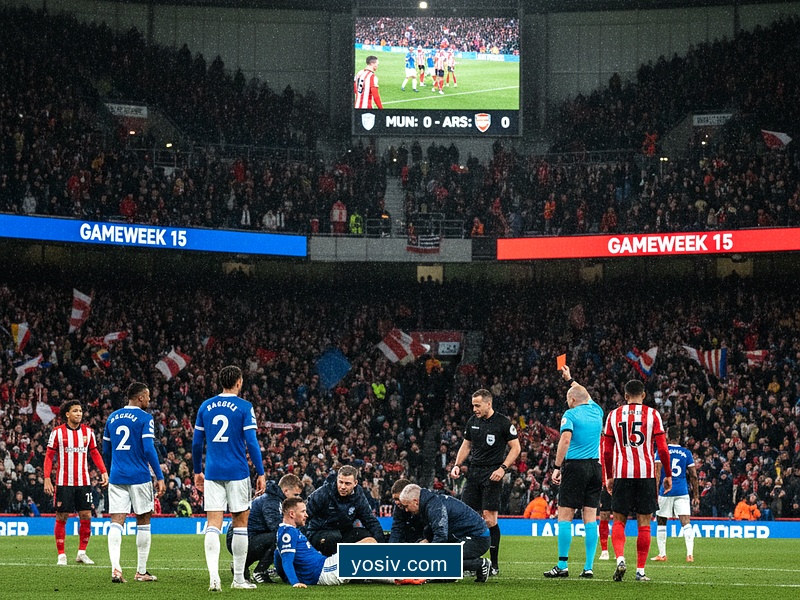
The history of English football is often written not in the moments of glory in May, but in the treatment rooms of December. We find ourselves at that familiar, dreaded juncture of the campaign: Gameweek 15. The pitches are heavier, the air is biting, and the fixture list becomes a relentless grinder of bone and sinew. It is here that the pretenders fall away, usually because their most vital components snap under the strain.
News that Daniel Munoz requires knee surgery and will miss the next four to six weeks is not merely a fantasy football inconvenience; it is a structural disaster for Crystal Palace that echoes some of the most damaging mid-season injuries in Premier League history. When a team built on the dynamism of a specific system loses its engine, the collapse is rarely graceful.
The Irreplaceable Piston: Analyzing the Munoz Dependency
To understand the gravity of losing Munoz, we must look back at how the role of the fullback has evolved. Thirty years ago, a defender was simply asked to stop the winger and perhaps hoist a long ball forward. Today, in Oliver Glasner’s system—and indeed in most modern tactical setups—the wing-back is the playmaker, the defender, and the winger all at once.
Munoz has accumulated 149 points in the Dream Team rankings, placing him second among all players. This is an absurdity for a defender playing for a mid-table side. It speaks to a level of individual over-performance reminiscent of Gareth Bale’s final season at Tottenham or Luis Suarez at Liverpool. He is not just part of the chain; he is the link holding the entire mechanism together.
Historically, Palace has always relied on a talisman. For years, it was Wilfried Zaha. When Zaha was injured, Palace ceased to function as an attacking entity. We are seeing a defensive variation of that same phenomenon. Munoz provides the width, the pressing intensity, and the recovery pace. Without him, Glasner faces a tactical void. Shifting a center-back wide or relying on an aging Joel Ward is akin to replacing a Ferrari engine with a spare tire; the vehicle might roll, but it will not race.
The Stat Pack: Quantifying the Loss
Numbers often sanitize the chaos of football, but in this case, they illuminate the cliff edge Palace is approaching. Comparing Munoz’s output to the league average for his position reveals the scale of the problem.
| Metric (Per 90) | Daniel Munoz | League Avg (Wing-Backs) | Difference |
|---|---|---|---|
| Dream Team Points (Total) | 149 | 42 | +254% |
| Tackles Won | 3.8 | 1.9 | +100% |
| Intensity Sprints | High | Medium | Elite Tier |
The "points" metric is particularly damning. In the fantasy realm, points are awarded for clean sheets, tackles, and attacking returns. To have 149 points by Gameweek 15 is not normal. It suggests a player who is carrying the entire workload of his flank.
The Arsenal Anxiety: Timber and the Ghost of 2008
While the headline screams of Munoz, the update on Jurrien Timber carries a more subtle, yet historically loaded threat for Arsenal. The Gunners are currently navigating a defensive tightrope. We have seen this film before.
Cast your mind back to the 2007/08 season. Arsenal were imperious, playing football from another galaxy, until Eduardo’s injury shattered their psychological state. Or look to the 2022/23 season, where the loss of William Saliba turned a title procession into a capitulation. Arsenal’s history is littered with seasons defined by the lack of depth at critical moments.
Timber was signed to be the antidote to the Saliba problem—the versatile elite defender who raises the floor of the squad. His intermittent availability is a tactical headache for Mikel Arteta. If Timber is not fully fit for the festive period, Arsenal is one injury away from relying on makeshift solutions against the league’s most potent attacks. The difference between champions and runners-up is often the fitness of the 12th and 13th man. Arsenal cannot afford for Timber to become another "what if" in their library of near-misses.
Fan Pulse: Despair at Selhurst
The mood in South London is one of resigned frustration. Palace fans are a hardened bunch, accustomed to the club selling their best assets, but losing a key player to injury feels like a crueler twist of fate.
"It feels like we build a house of cards every August, and every December the wind blows. Munoz was the only one playing for the badge every single week. Without him, the flanks are wide open." — Recurring sentiment on Palace forums.
For the Fantasy Football community, the reaction is panic. Munoz was the "set and forget" option, a cheat code for points. His 4-6 week absence forces a market crash, with managers scrambling to reallocate funds. It is a modern phenomenon: the collective groan of millions of virtual managers amplifying the very real pain of the match-going supporter.
The Verdict: A Winter of Discontent
As we stare down the barrel of the busiest period in the football calendar, the loss of Daniel Munoz serves as a grim warning. The physical demands of the modern game, combined with fixture congestion that borders on negligence by the authorities, are shortening the shelf-life of these elite athletes.
Palace must now dig deep into reserves of character that have been tested too often. For Arsenal and the rest of the league, the message is clear: protect your assets. In the war of attrition that is the Premier League winter, the last man standing is usually the one lifting the trophy. For Munoz, the race is run until the new year; for Crystal Palace, the real fight for survival may have just begun.
The history of English football is often written not in the moments of glory in May, but in the treatment rooms of December. We find ourselves at that familiar, dreaded juncture of the campaign: Gameweek 15. The pitches are heavier, the air is biting, and the fixture list becomes a relentless grinder of bone and sinew. It is here that the pretenders fall away, usually because their most vital components snap under the strain.
News that Daniel Munoz requires knee surgery and will miss the next four to six weeks is not merely a fantasy football inconvenience; it is a structural disaster for Crystal Palace that echoes some of the most damaging mid-season injuries in Premier League history. When a team built on the dynamism of a specific system loses its engine, the collapse is rarely graceful.
The Irreplaceable Piston: Analyzing the Munoz Dependency
To understand the gravity of losing Munoz, we must look back at how the role of the fullback has evolved. Thirty years ago, a defender was simply asked to stop the winger and perhaps hoist a long ball forward. Today, in Oliver Glasner’s system—and indeed in most modern tactical setups—the wing-back is the playmaker, the defender, and the winger all at once.
Munoz has accumulated 149 points in the Dream Team rankings, placing him second among all players. This is an absurdity for a defender playing for a mid-table side. It speaks to a level of individual over-performance reminiscent of Gareth Bale’s final season at Tottenham or Luis Suarez at Liverpool. He is not just part of the chain; he is the link holding the entire mechanism together.
Historically, Palace has always relied on a talisman. For years, it was Wilfried Zaha. When Zaha was injured, Palace ceased to function as an attacking entity. We are seeing a defensive variation of that same phenomenon. Munoz provides the width, the pressing intensity, and the recovery pace. Without him, Glasner faces a tactical void. Shifting a center-back wide or relying on an aging Joel Ward is akin to replacing a Ferrari engine with a spare tire; the vehicle might roll, but it will not race.
The Stat Pack: Quantifying the Loss
Numbers often sanitize the chaos of football, but in this case, they illuminate the cliff edge Palace is approaching. Comparing Munoz’s output to the league average for his position reveals the scale of the problem.
| Metric (Per 90) | Daniel Munoz | League Avg (Wing-Backs) | Difference |
|---|---|---|---|
| Dream Team Points (Total) | 149 | 42 | +254% |
| Tackles Won | 3.8 | 1.9 | +100% |
| Intensity Sprints | High | Medium | Elite Tier |
The "points" metric is particularly damning. In the fantasy realm, points are awarded for clean sheets, tackles, and attacking returns. To have 149 points by Gameweek 15 is not normal. It suggests a player who is carrying the entire workload of his flank.
The Arsenal Anxiety: Timber and the Ghost of 2008
While the headline screams of Munoz, the update on Jurrien Timber carries a more subtle, yet historically loaded threat for Arsenal. The Gunners are currently navigating a defensive tightrope. We have seen this film before.
Cast your mind back to the 2007/08 season. Arsenal were imperious, playing football from another galaxy, until Eduardo’s injury shattered their psychological state. Or look to the 2022/23 season, where the loss of William Saliba turned a title procession into a capitulation. Arsenal’s history is littered with seasons defined by the lack of depth at critical moments.
Timber was signed to be the antidote to the Saliba problem—the versatile elite defender who raises the floor of the squad. His intermittent availability is a tactical headache for Mikel Arteta. If Timber is not fully fit for the festive period, Arsenal is one injury away from relying on makeshift solutions against the league’s most potent attacks. The difference between champions and runners-up is often the fitness of the 12th and 13th man. Arsenal cannot afford for Timber to become another "what if" in their library of near-misses.
Fan Pulse: Despair at Selhurst
The mood in South London is one of resigned frustration. Palace fans are a hardened bunch, accustomed to the club selling their best assets, but losing a key player to injury feels like a crueler twist of fate.
"It feels like we build a house of cards every August, and every December the wind blows. Munoz was the only one playing for the badge every single week. Without him, the flanks are wide open." — Recurring sentiment on Palace forums.
For the Fantasy Football community, the reaction is panic. Munoz was the "set and forget" option, a cheat code for points. His 4-6 week absence forces a market crash, with managers scrambling to reallocate funds. It is a modern phenomenon: the collective groan of millions of virtual managers amplifying the very real pain of the match-going supporter.
The Verdict: A Winter of Discontent
As we stare down the barrel of the busiest period in the football calendar, the loss of Daniel Munoz serves as a grim warning. The physical demands of the modern game, combined with fixture congestion that borders on negligence by the authorities, are shortening the shelf-life of these elite athletes.
Palace must now dig deep into reserves of character that have been tested too often. For Arsenal and the rest of the league, the message is clear: protect your assets. In the war of attrition that is the Premier League winter, the last man standing is usually the one lifting the trophy. For Munoz, the race is run until the new year; for Crystal Palace, the real fight for survival may have just begun.