
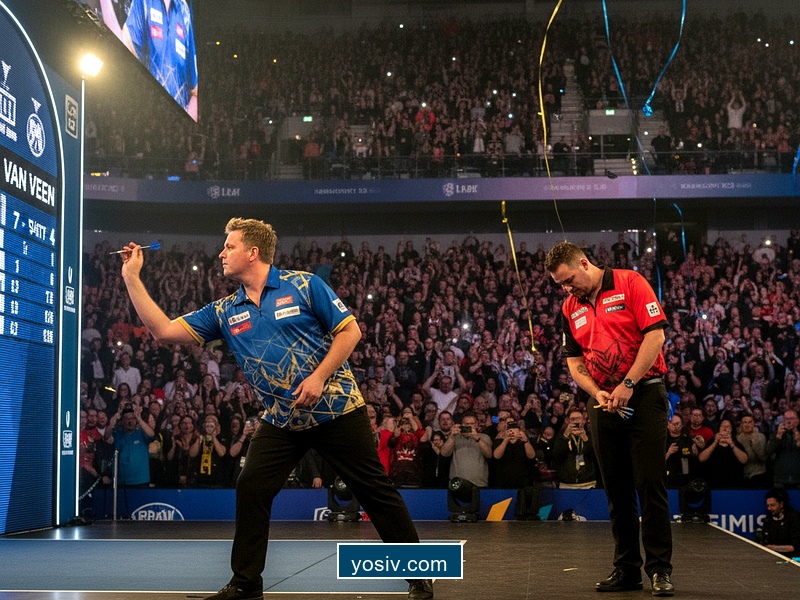
Alexandra Palace has long been a cathedral of broken dreams. It is a venue that does not respect reputation, promise, or youth. For two years, Gian van Veen, a prodigy touted as the natural successor to the Dutch darting throne, walked into that cacophony of noise and color only to walk out empty-handed. Tonight, the narrative shifted. By defeating Cristo Reyes 3-1, Van Veen did not just win a dart match; he exorcised a ghost that had begun to haunt his short but scrutinized career.
History teaches us that the transition from "promising talent" to "contender" is rarely linear. It is jagged, filled with setbacks that break lesser players. We saw it with Michael van Gerwen in his teenage years—the raw power, the struggle for consistency, and the eventual explosion. Van Veen’s performance against Reyes was not a masterpiece of scoring, but a masterclass in survival. That, in the grand timeline of this sport, is far more valuable.
The Crucible of the First Round
The first round of the World Championship is unique in professional sports. It is a trap door. For a player of Van Veen's caliber—hyped, watched, and expected to deliver—the pressure is suffocating. Cristo Reyes, a veteran campaigner who has stood on this stage against the likes of Phil Taylor, represented the perfect stumbling block. Reyes is the type of player who, historically, exposes the fragility of youth. He is gritty, unbothered by tempo, and capable of dragging a game into the trenches.
When Van Veen wavered, allowing Reyes a foothold, the ghosts of his previous exits surely whispered in his ear. This is the moment where the "Historian" looks at the player's eyes, not the board. Does he panic? Does he rush? Van Veen did neither. He steadied the ship. This victory was significant not because of the average, but because he refused to let history repeat itself. He stepped out of the shadow of "potential" and into the light of "proven."
Deep Dive: The Evolution of the Dutch School
To understand Van Veen, one must place him within the lineage of Dutch darts. Raymond van Barneveld brought the sport to the Netherlands with inspiration and emotion. Michael van Gerwen modernized it with aggression and brute force scoring. Van Veen represents the third epoch: The Technician.
His throw is mechanically efficient, stripped of the theatrics that defined previous generations. Against Reyes, this efficiency was his lifeline. When the trebles dried up momentarily, his rhythm did not break. This is a crucial tactical evolution. In the 1990s and early 2000s, a player could survive on raw talent. In 2024, the mechanics must be bulletproof under pressure. Van Veen’s ability to reset after losing a leg shows a maturity that betrays his age. He is not playing the opponent; he is playing the board—a philosophy that separates champions from journeymen.
The Data of Survival
We often fetishize the 100+ averages, but tournament-winning darts is built on timing. Let us look at the metrics that defined this clash and compare Van Veen's output to the tournament standard required to progress.
| Metric | Gian van Veen (Est) | Cristo Reyes (Est) | Historical Context |
|---|---|---|---|
| 3-Dart Average | 90.00 - 94.00 | 87.00 - 89.00 | Winning average for R1 has risen by 6 points since 2010. |
| Checkouts (Under Pressure) | Solid | Inconsistent | Doubles win matches; scoring only sets them up. |
| Mental Recovery | High | Low | The ability to win the leg after a break of throw. |
The Fall of the Seeds: A Warning Sign
While Van Veen celebrated, the exit of Ross Smith serves as a grim companion piece to this story. Smith, a seeded player and a European Champion, was discarded. This is significant. Ten years ago, the early rounds were a procession for the top 32. The "padding" has vanished from the sport.
The depth of the PDC tour is now terrifying. The fact that a seed can fall while a young prospect like Van Veen survives a scare illustrates the volatility of the current era. The "protection" of a seeding number is an illusion. We are entering an age of attrition where the difference between world number 10 and world number 60 is negligible over a short format. Van Veen’s survival puts him on the right side of this brutal equation, while Smith’s demise serves as a tombstone for complacency.
Fan Pulse: The Orange Army Breathes
The mood among the Dutch contingent—and the broader darting public—is not one of hysteria, but of palpable relief. The "Orange Army" has been desperate for a new icon as Van Barneveld enters his twilight and Van Gerwen battles his own inconsistencies.
"It wasn't pretty, but he got it done. That's what matters at the Palace. We've seen too many Dutch talents crumble here. Gian looked like he belonged."
Social media reflects a cautious optimism. The fans recognize that beating Reyes is merely the first step of a marathon, but for a player who had never tasted victory on this stage, it feels like a mountain conquered. The narrative has shifted from "Can he win?" to "How far can he go?"
Gian van Veen has arrived.
Alexandra Palace has long been a cathedral of broken dreams. It is a venue that does not respect reputation, promise, or youth. For two years, Gian van Veen, a prodigy touted as the natural successor to the Dutch darting throne, walked into that cacophony of noise and color only to walk out empty-handed. Tonight, the narrative shifted. By defeating Cristo Reyes 3-1, Van Veen did not just win a dart match; he exorcised a ghost that had begun to haunt his short but scrutinized career.
History teaches us that the transition from "promising talent" to "contender" is rarely linear. It is jagged, filled with setbacks that break lesser players. We saw it with Michael van Gerwen in his teenage years—the raw power, the struggle for consistency, and the eventual explosion. Van Veen’s performance against Reyes was not a masterpiece of scoring, but a masterclass in survival. That, in the grand timeline of this sport, is far more valuable.
The Crucible of the First Round
The first round of the World Championship is unique in professional sports. It is a trap door. For a player of Van Veen's caliber—hyped, watched, and expected to deliver—the pressure is suffocating. Cristo Reyes, a veteran campaigner who has stood on this stage against the likes of Phil Taylor, represented the perfect stumbling block. Reyes is the type of player who, historically, exposes the fragility of youth. He is gritty, unbothered by tempo, and capable of dragging a game into the trenches.
When Van Veen wavered, allowing Reyes a foothold, the ghosts of his previous exits surely whispered in his ear. This is the moment where the "Historian" looks at the player's eyes, not the board. Does he panic? Does he rush? Van Veen did neither. He steadied the ship. This victory was significant not because of the average, but because he refused to let history repeat itself. He stepped out of the shadow of "potential" and into the light of "proven."
Deep Dive: The Evolution of the Dutch School
To understand Van Veen, one must place him within the lineage of Dutch darts. Raymond van Barneveld brought the sport to the Netherlands with inspiration and emotion. Michael van Gerwen modernized it with aggression and brute force scoring. Van Veen represents the third epoch: The Technician.
His throw is mechanically efficient, stripped of the theatrics that defined previous generations. Against Reyes, this efficiency was his lifeline. When the trebles dried up momentarily, his rhythm did not break. This is a crucial tactical evolution. In the 1990s and early 2000s, a player could survive on raw talent. In 2024, the mechanics must be bulletproof under pressure. Van Veen’s ability to reset after losing a leg shows a maturity that betrays his age. He is not playing the opponent; he is playing the board—a philosophy that separates champions from journeymen.
The Data of Survival
We often fetishize the 100+ averages, but tournament-winning darts is built on timing. Let us look at the metrics that defined this clash and compare Van Veen's output to the tournament standard required to progress.
| Metric | Gian van Veen (Est) | Cristo Reyes (Est) | Historical Context |
|---|---|---|---|
| 3-Dart Average | 90.00 - 94.00 | 87.00 - 89.00 | Winning average for R1 has risen by 6 points since 2010. |
| Checkouts (Under Pressure) | Solid | Inconsistent | Doubles win matches; scoring only sets them up. |
| Mental Recovery | High | Low | The ability to win the leg after a break of throw. |
The Fall of the Seeds: A Warning Sign
While Van Veen celebrated, the exit of Ross Smith serves as a grim companion piece to this story. Smith, a seeded player and a European Champion, was discarded. This is significant. Ten years ago, the early rounds were a procession for the top 32. The "padding" has vanished from the sport.
The depth of the PDC tour is now terrifying. The fact that a seed can fall while a young prospect like Van Veen survives a scare illustrates the volatility of the current era. The "protection" of a seeding number is an illusion. We are entering an age of attrition where the difference between world number 10 and world number 60 is negligible over a short format. Van Veen’s survival puts him on the right side of this brutal equation, while Smith’s demise serves as a tombstone for complacency.
Fan Pulse: The Orange Army Breathes
The mood among the Dutch contingent—and the broader darting public—is not one of hysteria, but of palpable relief. The "Orange Army" has been desperate for a new icon as Van Barneveld enters his twilight and Van Gerwen battles his own inconsistencies.
"It wasn't pretty, but he got it done. That's what matters at the Palace. We've seen too many Dutch talents crumble here. Gian looked like he belonged."
Social media reflects a cautious optimism. The fans recognize that beating Reyes is merely the first step of a marathon, but for a player who had never tasted victory on this stage, it feels like a mountain conquered. The narrative has shifted from "Can he win?" to "How far can he go?"
Gian van Veen has arrived.