
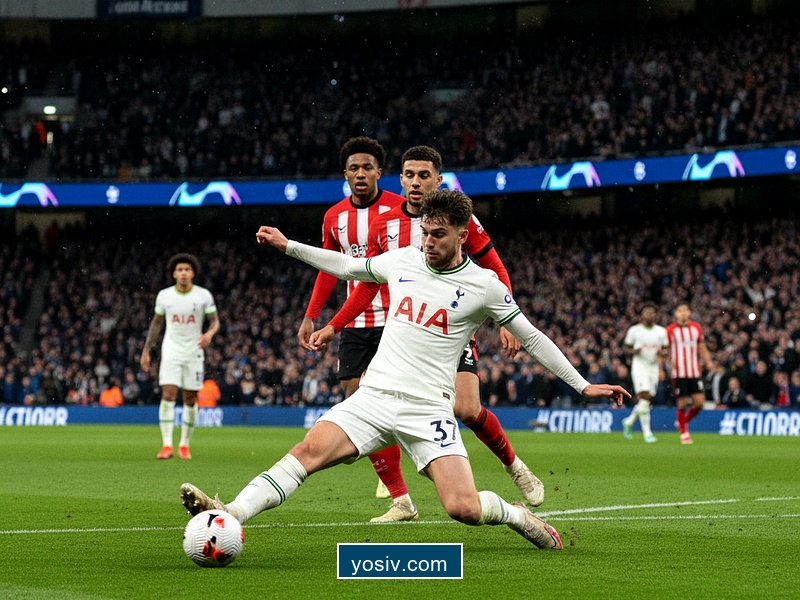
Modern football management is often portrayed as a dictatorship of philosophy. Pep Guardiola moves chess pieces; Jurgen Klopp demands heavy metal chaos. Ange Postecoglou arrived at Tottenham Hotspur with a reputation for dogmatic adherence to "Angeball"—a system predicated on a suicidal high defensive line, inverted fullbacks, and relentless verticality. The prevailing narrative suggests this system is non-negotiable. However, the revelation that Micky van de Ven actively intervened to alter defensive protocols, leaving pundits like Gary Neville stunned, points to a far more nuanced tactical reality in North London.
This is not a story about player power. It is a case study in functional tactical evolution. When a center-back possesses the recovery pace of a sprinter, the geometry of the pitch changes. But raw speed is useless without structural coordination. Van de Ven’s request to adjust the defensive tactics wasn't a plea for caution; it was a demand for structural efficiency that Postecoglou’s initial blueprint lacked. We need to dissect exactly what changed in the Spurs' rest defense and why a 22-year-old defender held the keys to stabilizing the Premier League’s most volatile backline.
The Analysis: The Flaw in the Inverted System
To understand why Van de Ven felt compelled to speak up, we must first audit the default state of Postecoglou’s possession phase. Spurs typically build in a 2-3-5 or a 2-3-2-3 shape. Destiny Udogie and Pedro Porro invert into the midfield pivot or advance as auxiliary 10s. This leaves the two center-backs, Cristian Romero and Van de Ven, covering the entire width of the pitch—roughly 68 meters—on their own.
In the early iteration of this system, the directive was absolute: compress the space. Even when the press was beaten, the back line was instructed to hold the halfway line to play offside traps aggressively. This created a massive disconnect. If the opponent’s transition pass bypassed the midfield press, the center-backs were forced to turn and sprint from a standing start against attackers already at full velocity.
Van de Ven’s intervention likely targeted the trigger mechanism for the drop. The "fix" he requested involves the recognition of "open ball" situations. In tactical theory, an open ball is when an opposing ball-carrier has time, space, and head up to pick a pass. In these moments, holding a high line is suicide. Van de Ven seemingly instituted a protocol where, if the midfield screen (usually Bissouma or Sarr) is bypassed, the defensive line must drop five to ten yards before the pass is played, rather than reacting after.
Rest Defense and the 'Sweeper-Hybrid' Role
The modification creates a sophisticated "Rest Defense" (Restverteidigung). While Spurs attack, Van de Ven is no longer just a static defender on the halfway line; he acts as a proactive sweeper. Heat map analysis of recent matches shows Van de Ven taking up positions slightly deeper than Romero. This staggered alignment is crucial.
| Tactical Variable | Standard Angeball | The VdV Adjustment |
|---|---|---|
| CB Alignment | Flat Linear (Offside Trap Focus) | Staggered (Cover & Stopper) |
| Transition Response | Step Up / Compress | Early Drop on 'Open Ball' |
| Fullback Cover | Relies on Recovery Runs | VDV Covers Wide Left Channel |
This staggering allows Romero to maintain his aggression—stepping out to intercept passes into strikers—while Van de Ven utilizes his pace to manage the space behind. The Dutch defender realized that with Udogie inverted centrally, the left channel was the primary kill zone for opposition counter-attacks. By adjusting his starting position, Van de Ven effectively zones off the left half-space, challenging wingers to a footrace he knows he will win.
It is a pragmatic concession. Pure Angeball demands uniformity. Van de Ven introduced asymmetry. He recognized that the system's theoretical perfection did not account for the practical reality of 2v2 isolation in the Premier League.
The Psychological Component of Tactical Trust
Gary Neville’s shock stems from the industry perception that managers like Postecoglou are unyielding. However, looking at the data, the collaboration makes perfect sense. Postecoglou creates the environment (the high line), but the player dictates the execution (the spacing).
This adjustment has tangible effects on the team's Expected Goals Against (xGA) from counter-attacks. In matches where Van de Ven manages the line height more conservatively, Spurs concede fewer "big chances" from direct through-balls. The opposition is forced to play in front of the defense or attempt complex wide combinations, allowing the inverted fu