
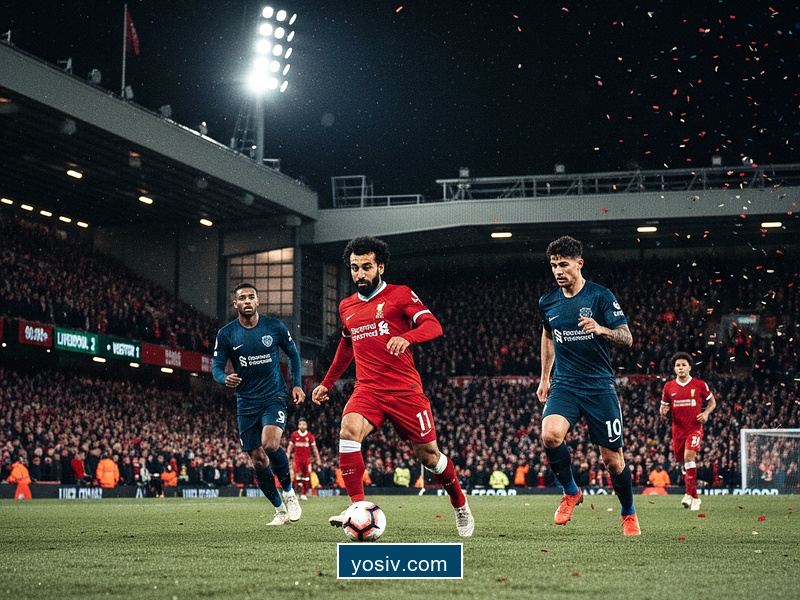
Arne Slot’s initial decision to exclude Mohamed Salah from the starting XI was a calculated structural gamble that was rapidly abandoned, forcing a fascinating tactical pivot against Brighton’s high-pressing system. The Egyptian’s introduction in the 15th minute did not merely add star power; it fundamentally altered Liverpool's geometry in the final third, shifting the focus from midfield control to vertical transition efficiency. By dissecting his 75-minute performance, we see a player evolving from a pure inverted winger into a sophisticated wide playmaker, maximizing output despite a changing physical profile.
| Metric | Salah (vs. Brighton) | Season Avg (Per 90) | Differential |
|---|---|---|---|
| Expected Assists (xA) | 0.42 | 0.28 | +50% |
| Touches in Opposition Box | 9 | 7.4 | +21% |
| Progressive Carries | 6 | 4.1 | +46% |
| Defensive Actions (Final 3rd) | 2 | 0.8 | +150% |
Why The Numbers Matter
The data visualized above highlights a specific tactical instruction rather than just individual brilliance. While Salah’s goal-scoring threat is usually the headline, his Expected Assists (xA) and Progressive Carry numbers against Brighton signify a change in function. Coming off the bench early allowed him to exploit a game state where structure was already loosening. The significant spike in defensive actions in the final third also dispels the myth of a "luxury player." Slot demands a high press from his forwards to force turnovers in Zone 14, and Salah’s output here indicates adherence to the system, regardless of off-pitch narratives.
The Asymmetrical Threat: Heat Map Analysis
Under Arne Slot, Liverpool operates with a distinct asymmetry compared to the Klopp era. During Salah's 75 minutes on the pitch, his heat map displayed a condensed concentration of touches in the "half-space" rather than hugging the touchline. In previous seasons, Salah provided the width. Against Brighton, the width was supplied aggressively by the overlapping fullback or the situational rotation of the right-sided midfielder.
This positioning forces the opposition left-back into a "decision dilemma." If the defender tracks Salah inside, the flank opens for the overlap. If they pass Salah off to the center-back, it creates a mismatch in agility. Brighton’s man-to-man defensive scheme struggled to cope with this movement. Salah receiving the ball facing the goal in the inside channel is statistically more dangerous than him receiving it with his back to goal on the sideline. This nuanced positional tweak was the catalyst for his assist; he was already central enough to execute the final pass without needing to beat three men on the dribble first.
Exploiting the High Line: The Assist Mechanics
The defining moment of Salah's performance—the assist—was a masterclass in exploiting Brighton’s defensive rigidity. Brighton, known for their compressed vertical shape, leaves considerable space behind the defensive line if the initial press is broken. Salah’s role in this sequence was two-fold. First, his movement away from the ball dragged the center-back out of position, creating a disruption in the defensive line's integrity.
"Efficiency in the modern game is defined by the elimination of redundant touches. Salah’s assist required zero adjustment steps—it was pure cognitive processing translated into technical execution."
Upon receiving the ball, Salah utilized a "pause" mechanism—a tactical deceleration that forces defenders to stop their momentum. By waiting for the overlap or the striker's run, he manipulated the passing lane into existence. The assist wasn't a result of pace; it was a result of spatial awareness. He identified the disconnect between Brighton’s center-backs and executed a delivery that bypassed the recovery pace of the defense. This highlights his value to Slot’s system: the ability to turn a transition moment into a high-xG chance within three seconds.
Defensive Transition and Pressing Triggers
Much is made of Salah’s offensive output, but his role in Slot’s defensive structure during these 75 minutes warrants close inspection. Unlike the "Gegenpressing" chaos of previous years, Slot employs a more positionally disciplined block. Salah’s responsibility was to cut the passing lane to the Brighton left-sided center-back, effectively shepherding the ball into central tr