
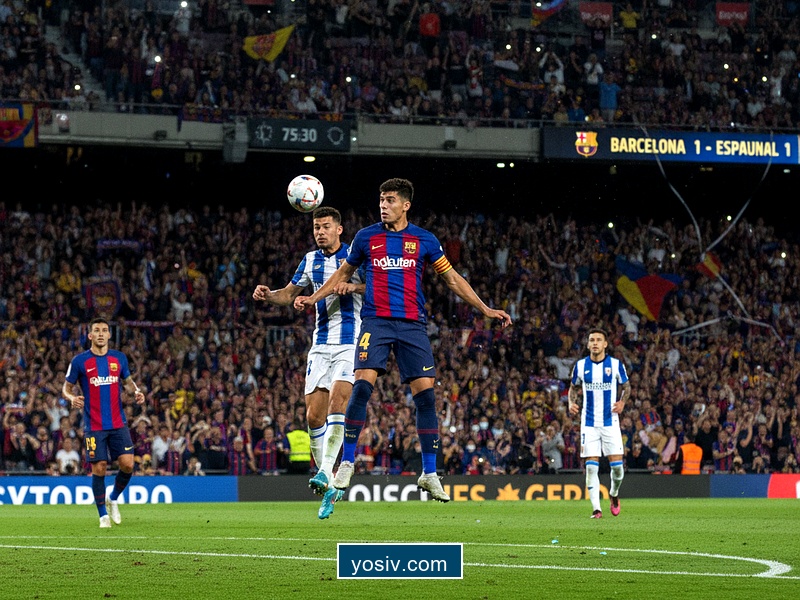
The silence in the Sant Joan Despí medical wing is about to be broken by the roar of a derby. Reports surfacing from the Catalan capital suggest Ronald Araujo has circled the clash against Espanyol as his definitive return date. While the fanbase rejoices at the prospect of their defensive gladiator returning to the arena, those looking at the long-term trajectory of this Barcelona project see something far more ominous. This is not merely a player returning from injury; it is a roll of the dice that could define the remainder of Hansi Flick’s debut season and potentially the financial future of the institution.
We stand at a precipice. The decision to integrate Araujo back into the fold for a match of such volatility—the Catalan Derby is rarely played; it is fought—suggests a shift in risk appetite within the club. Looking forward, this single fixture serves as a watershed moment. If his hamstring holds, Barcelona gains the one attribute their defense currently lacks: elite recovery speed. If it snaps, the consequences will ripple through the January transfer window and into the boardroom.
The Fragility of the High Line
Hansi Flick’s system requires bravery, bordering on arrogance. We have seen Pau Cubarsí and Iñigo Martínez operate with remarkable intelligence, stepping up to catch opponents offside with surgical precision. However, looking ahead to the business end of the season—the knockout stages of the Champions League and the Clasicos—intelligence is not enough. You need raw athleticism to mitigate disaster.
Araujo’s return against Espanyol is the stress test for this tactical evolution. The future of Flick's defensive strategy hinges on this integration. Without Araujo, the high line remains a glass cannon—potent but shatter-prone. With a fully fit Araujo, it becomes concrete. But the operative phrase is "fully fit."
"The modern game does not forgive the half-fit. Rushing a sprinter back into a derby is like driving a Formula 1 car on a gravel track. You might finish, or you might destroy the engine."
If Araujo returns and struggles to replicate his explosive recovery runs, Flick faces a tactical crisis. He will have to decide whether to persist with a high line that exposes a slower Araujo or drop the block deeper, which neutralizes the pressing intensity that has defined his tenure so far. The Espanyol match will provide the first data point in this critical analysis.
The Financial Domino Effect
Let us peel back the layers and look at the ledger. Barcelona remains in a precarious financial state. Every major asset must be evaluated not just for sporting merit, but for liquidity potential. Araujo has long been viewed as one of the few "untouchables" who could commanded a fee north of €80 million. However, availability is the best ability.
The consequences of a relapse against Espanyol would be catastrophic for his market value. A player with a recurring injury history, sidelined again after a rushed return, ceases to be a premium asset. He becomes a liability on high wages. European giants like Bayern Munich or Manchester United watch these developments like hawks. They will not pay a premium for damaged goods.
| Scenario | Immediate Impact | Long-Term Consequence |
|---|---|---|
| Successful Return | Defense stabilizes; Flick's system unlocks max potential. | Value skyrockets; Extension or massive sale becomes viable. |
| Re-Injury | Crisis at center-back; Morale collapses. | Market value tanks; "Injury prone" label sticks permanently. |
| Mediocre Performance | Questions raised about compatibility. | Flick seeks alternatives; Summer transfer likely. |
Conversely, if Araujo dominates the derby, shuts down the Espanyol attack, and proves his body can handle the torque of elite football again, Barcelona holds all the cards. They can either build the next five years around him or solve their financial headache with one signature in July. The Espanyol game acts as the opening bell for this negotiation.
The Espanyol Trap
Choosing Espanyol as the return fixture reveals a dangerous level of bravado. Derbies obliterate the concept of a "gentle return." Espanyol players will not care about Araujo’s rehabilitation timeline. They will target him. They will press him physically, engage in aerial duels, and test the structural integrity of that repaired muscle with every challenge.
From a forecasting perspective, this match creates a binary timeline. In one future, Araujo weathers the storm, hardening himself for the rest of the campaign. The psychological boost to the squad would be immeasurable. Seeing their captain figure emerge unscathed from the trenches of a derby would galvanize the dressing room for the title charge.
However, the darker timeline looms. A setback here destroys the trust between player and medical staff. It forces the technical director, Deco, to scramble for emergency defensive cover in January—a notoriously difficult market where desperation breeds inflation. The club would essentially be back to square one, but with less time and less money.
The Verdict on the Horizon
We must stop viewing injury returns as isolated good news. In the context of modern football, they are strategic maneuvers with massive downside risk. Ronald Araujo aiming for the Espanyol match is a statement of intent, but it is also a gamble of the highest order.
Success means Barcelona has their "cheat code" back—the player who allows them to squeeze the pitch and suffocate opponents. Failure means the architecture of the season requires a complete redrafting. As the derby approaches, the eyes of the world should not be on the scoreboard, but on the hamstrings of the number 4. The result of the match matters for three points; the fitness of Araujo matters for the next three years.