
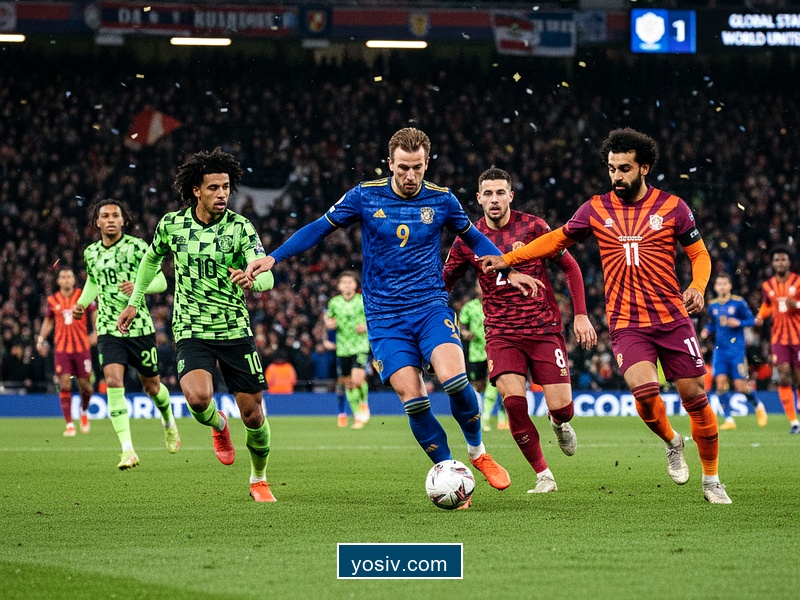
The announcement of any "World XI" inevitably sparks debate regarding popularity versus performance. However, the emergence of the "Alternative World Team"—featuring Harry Kane, Raphinha, Scott McTominay, and Mohamed Salah—offers something far more interesting than a popularity contest. It presents a fascinating tactical puzzle.
Mainstream selections often jam four Number 10s into a midfield, ignoring the physical realities of the modern game. This specific quartet, however, implies a distinct, high-energy tactical identity. We are not looking at a balanced Guardiola-esque control system. We are looking at a heavy-metal, transition-based 4-2-3-1 that relies on specific biomechanics and spatial manipulation. By analyzing the unique profiles of McTominay’s verticality, Kane’s withdrawal, and the inverted width of Salah and Raphinha, we uncover a blueprint for devastating counter-attacking football.
The Structural Spine: Kane’s Gravity
To understand how this eclectic mix of players functions, we must start with the focal point: Harry Kane. In this hypothetical system, Kane does not operate as a striker in the Haaland mold, pinning center-backs against their own goal line. Instead, he functions as the tactical fulcrum.
When Kane drops into the "Zone 14" (the space between the opposition midfield and defense), he creates a structural dilemma for the opponent. If a center-back follows him, the defensive line fractures, leaving gaps for the wingers. If the center-back stays put, Kane has the time and elite passing range to act as a quarterback.
This movement is critical for Mohamed Salah and Raphinha. Neither winger wants to hug the touchline and cross; they want to attack the box diagonally. Kane’s withdrawal acts as the trigger mechanism. As he vacates the center, he effectively clears the runway for Salah to invert from the right and Raphinha to drive from the left (or right, depending on the specific setup, though Raphinha’s versatility allows for fluid interchange).
The McTominay Anomaly: Weaponizing the "Crash"
The inclusion of Scott McTominay is the most tactically significant variable in this alternative list. A traditional "Best XI" usually features a pure controller like Rodri or a creator like De Bruyne. McTominay offers neither of those profiles. He offers chaos.
In this system, McTominay operates as a "Box-Crasher." His heat maps rarely show lateral passing dominance. Instead, they show vertical surges. When Kane drops deep to receive the ball, the opposition defensive line naturally steps up to compress the space. This is where McTominay becomes lethal. He executes blind-side runs from deep midfield into the space Kane just vacated.
This creates a tactical overload. The opposition center-backs are occupied by the threat of Salah and Raphinha cutting inside, and suddenly a 6ft 4in midfielder is sprinting full speed into the penalty area. It is a nightmare to track because the run originates from outside the peripheral vision of the defenders. McTominay isn't there to build play; he is there to finish moves that break down or to win the second ball in the red zone.
| Player | Tactical Role | Primary Objective |
|---|---|---|
| Harry Kane | False 9 / Playmaker | Vacate space, distribute to runners. |
| Mohamed Salah | Inside Forward | Primary goal threat, diagonal penetration. |
| Raphinha | Wide Presser / Creator | Ball recovery, transition speed, chance creation. |
| Scott McTominay | Shadow Striker / B2B | Box entry, physical disruption, aerial threat. |
Wing Dynamics: The Pressing Engine
While Salah provides the goal output, Raphinha provides the engine that makes the system viable against elite opposition. Raphinha’s tactical profile is unique among elite wingers due to his defensive work rate and intensity in the high press.
In a team containing Kane (who lacks high-speed pressing mobility) and Salah (who is often conserved for attacking transitions), the third forward must do the heavy lifting. Raphinha fulfills this role perfectly. His data consistently shows high numbers in "possession won in the final third."
Tactically, this allows the team to employ an asymmetric press. The team can funnel opposition build-up toward Raphinha’s side, where he aggressively engages the full-back. If he wins the ball, the transition is immediate: a cross-field switch to Salah or a through-ball to the onrushing McTominay. Raphinha is the battery that powers the offensive weaponry of the other three.
Defensive Vulnerability and Shape
Every tactical system has a cost. The inclusion of McTominay alongside a creator like Kane suggests a potential weakness in the "Rest Defense" (the structure maintained while in possession). McTominay’s instinct is to go forward. If the ball is lost while he is crashing the box, the midfield is left with a single pivot to cover the entire width of the pitch.
To mitigate this, this "Alternative XI" would require a compact 4-4-2 defensive block when possession is lost. Raphinha would tuck in next to the midfield pivot, and Salah would stay higher alongside Kane. This preserves Salah’s energy for the counter-attack while utilizing Raphinha’s defensive diligence to shore up the midfield numbers.
The success of this unit relies on efficient finishing. They will not dominate 70% of the possession against top-tier midfields. Instead, they rely on "high-quality chances" generated through vertical speed and the manipulation of defensive lines. Kane drags them out, Salah stretches them wide, and McTominay punches through the middle.
The selection of these four players highlights a shift in modern football appreciation. We are moving away from purely aesthetic passing metrics toward an appreciation of impact. McTominay’s clutch goals, Raphinha’s relentless pressing, and the telepathic link-up potential between Kane and Salah represent a tactical coherence that is often missing from the actual FIFA World XI galactico-style selections. This is a team built to win football matches, not just sell shirts.