
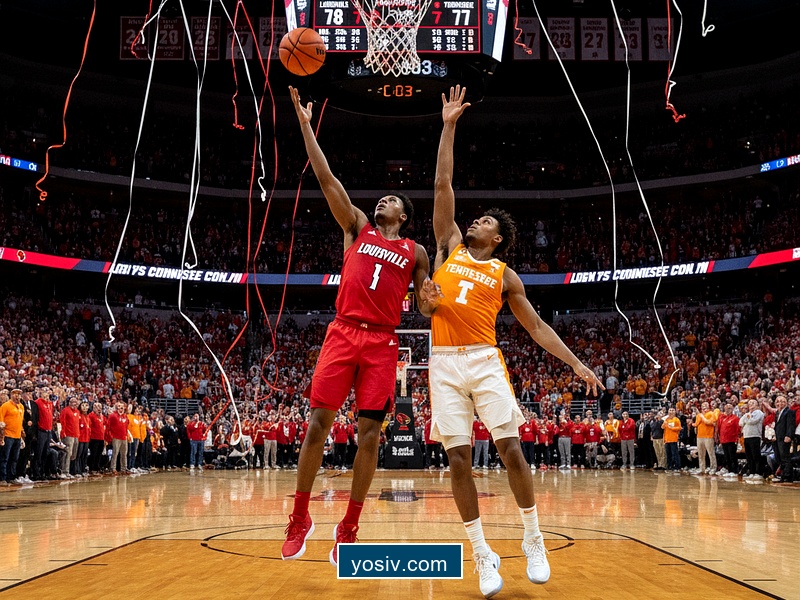
The air inside Thompson-Boling Arena on Tuesday night did not smell like popcorn or floor wax. It smelled of sulfur and sweat, the distinct aroma of a reckoning. The scoreboard read 83-62, a number that suggests a comfortable victory, but the reality was far more violent. This was not a basketball game; it was a public dismantling. And standing at the center of the wreckage, holding the sledgehammer, was Chaz Lanier.
For weeks, the narrative surrounding the No. 11 Louisville Cardinals had been one of resurrection. They were the blue bloods returning to the throne, tough, gritty, and ready to reclaim their status among the elite. They arrived in Knoxville treating this fixture as a coronation, a "toughness test" they expected to pass. But narratives are fragile things when faced with the cold, hard reality of a scorer who has decided he will not be denied. Lanier, often criticized for his oscillating intensity earlier in the season, found a gear that simply does not exist for mortal athletes.
This was supposed to be a chess match between two tactical defenses. Instead, Lanier turned the board over and set the pieces on fire. From the opening tip, his eyes carried a predatory glint. The Cardinals tried to switch on him. He blew past them. They tried to go under screens. He buried them from deep. They tried to trap him. He split the double team and found the rim. By the time the final buzzer sounded, the No. 20 Volunteers hadn't just beaten a higher-ranked SEC rival; they had stripped Louisville of its identity.
The Analysis
To understand the magnitude of what Lanier accomplished, one must first appreciate the weight of expectation. Tennessee entered this game ranked No. 20, respectable but dangerous, hovering on the periphery of true greatness. Louisville, at No. 11, represented the establishment. The script dictated that the Cardinals would use their celebrated defense to stifle the Volunteers. The early minutes threatened to follow this plot. The paint was clogged, elbows were thrown, and the rhythm was disjointed.
Then came the pivot point. With twelve minutes left in the first half and the game mired in a defensive sludge, Lanier demanded the ball. He isolated on the wing against Louisville’s premier perimeter defender. A hesitation dribble, a crossover that nearly buckled knees, and a step-back three that hit nothing but net. The arena detonated. That shot was not just three points; it was a declaration of war.
What followed was a clinic in offensive efficiency and defensive suffocation. Lanier became the axis upon which the game spun. When he wasn't scoring, his gravity pulled the Louisville defense apart, leaving lanes wide open for his teammates. But the spotlight remained firmly on him because he refused to let it wander. Every time Louisville threatened a run, every time they cut the lead to single digits, Lanier answered. A floater in the lane. A transition dunk. A contested jumper. He was inevitable.
| Metric | Louisville (No. 11) | Tennessee (No. 20) |
|---|---|---|
| Final Score | 62 | 83 |
| Narrative Arc | Collapsed under pressure | Ruthless Execution |
| Key Factor | Stifled Offense | Lanier's Dominance |
The Tragic Collapse of the Cardinals
While this is Lanier’s story of glory, it is inextricably linked to the tragedy of the opposition. Louisville did not just lose; they were broken. The "toughness test" touted by pundits became a mirror revealing their own fragility. You could see the belief drain from their eyes in real-time. The Cardinals entered the second half hoping to reset, to rely on their pedigree. Tennessee, led by Lanier’s relentless energy, slammed the door in their faces.
The stats will show a 21-point blowout, but the emotional damage was far severe. For a team ranked 11th in the nation to be stifled so thoroughly speaks to a systemic failure to adapt to the intensity Lanier brought to the floor. They looked for foul calls that never came. They looked to their bench for answers that didn't exist. They were a team prepared for a basketball game, unprepared for a street fight.
Lanier exploited this hesitation. He sensed the fear. In sports, there is a distinct difference between beating an opponent and dominating them. Beating them is about the score; dominating them is about the spirit. Lanier took the Cardinals' spirit, crumpled it up, and tossed it into the stands. His performance turned a highly anticipated clash of titans into a lecture on humility.
A Legacy Cemented in Knoxville
Redemption is a powerful drug in sports. For Lanier, this night served as the ultimate validation of his transfer to Tennessee. He came here for moments like this—to stand under the bright lights against a storied program and say, "I am the best player on this floor." There is no debate left. The critics who questioned his consistency must now find a new target.
The broader implication for the Volunteers is massive. Beating another SEC-caliber team (though Louisville is ACC, the intensity matched conference warfare) serves notice to the rest of the league. If Tennessee can dismantle the No. 11 team in the country with such disdain, the ceiling for this squad is nonexistent. But everything hinges on Lanier. He is the engine, the spark, and the dynamite.
As the final seconds ticked away, Lanier didn't celebrate wildly. He walked to the bench, high-fived his teammates, and wore a look of stoic satisfaction. It was the look of a man who knew the outcome before the game even started. Louisville learned a hard lesson in Knoxville: rankings are paper, but toughness is blood and bone. Chaz Lanier brought the toughness, and in doing so, he buried the Cardinals alive.