
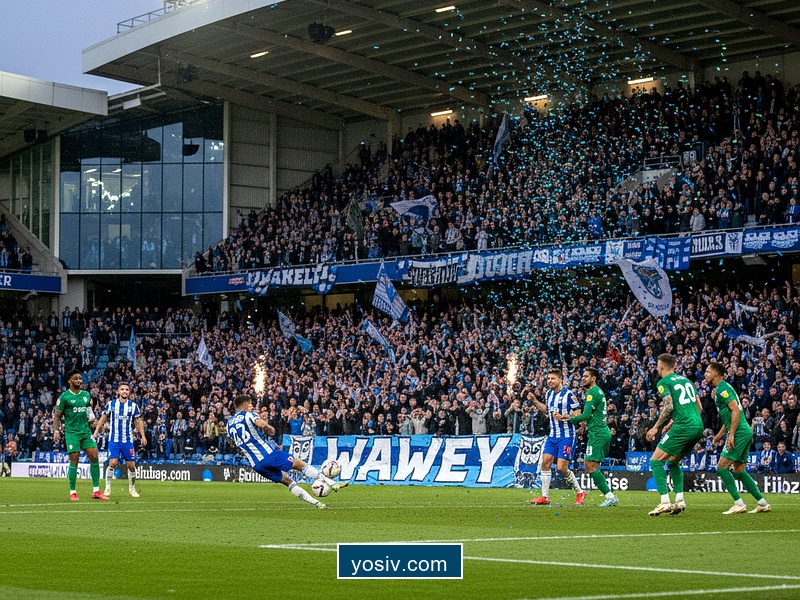
Danny Rohl’s tactical imprint on Rangers is no longer a theoretical concept; it has become a suffocating reality for Scottish Premiership opposition. The 1-0 victory over Hibernian was less about offensive fireworks and more about absolute spatial domination through calculated pressing triggers. We dissect the geometric constraints Rangers placed on the visitors to secure third place.
| Metric | Rangers (Rohl) | Hibernian |
|---|---|---|
| Expected Goals (xG) | 1.42 | 0.28 |
| PPDA (Press Intensity) | 6.8 | 15.4 |
| Field Tilt | 72% | 28% |
| Defensive Line Height (Avg) | 48m | 34m |
Why The Numbers Matter
The statistic that defines this match is not the scoreline, but the PPDA (Passes Allowed Per Defensive Action). Rohl’s Rangers recorded a 6.8, indicating a ferocious high press that engaged Hibernian immediately upon possession loss. This forced Hibernian into a direct, low-percentage passing game, evident in their dismal 28% Field Tilt (possession in the final third). The data suggests that while the margin of victory was slender, the control was absolute. Rangers did not merely beat Hibernian; they denied them the oxygen to play.
Tactical Anatomy: The 3-2-5 Build-Up
Danny Rohl has implemented a clear deviation from the traditional 4-2-3-1 often associated with Rangers' recent history. Against Hibernian, the shape in possession morphed distinctly into a 3-2-5 asymmetric structure. This system relies heavily on the rotation of the backline. When Rangers hold the ball, one full-back inverts to join the defensive midfielder, creating a double pivot, while the other provides width high up the pitch.
This structural shift explains the role of Emmanuel Fernandez. Although nominally a defender, his heat map for this fixture resembles that of a deep-lying playmaker operating in the left half-space. Rohl utilized Fernandez not just as a stopper, but as the primary ball progressor. By having Fernandez step out of the defensive line with the ball, Rangers created a numerical overload in the midfield zone (4v3 against Hibs' central block).
Hibernian’s defensive unit, sitting in a compact 5-4-1 low block, struggled to identify who should pick up Fernandez. If their winger stepped up to press him, it opened the passing lane to the Rangers wide man. If they sat off, Fernandez had the time to drive into the final third—a freedom that ultimately contributed to his goal-scoring opportunity. The goal was a product of structural confusion; Fernandez was the "spare man" generated by the tactical schematic.
Suffocation via Counter-Pressing
The "Rohl Revolution" is predicated on what happens the moment possession is lost. Against Hibernian, Rangers displayed a textbook execution of Gegenpressing. The average distance between the Rangers' forward line and their defensive line was compressed to roughly 25 meters. This vertical compactness is risky, as it leaves space behind for long balls, but it is devastatingly effective against teams lacking pace in transition.
When Hibernian attempted to clear their lines, they found themselves in a "rondo" against the Rangers recovery unit. Rohl instructed his number 8s to jump aggressively onto Hibernian’s double pivot. This forced the visitors to play predictable channels down the wings, where Rangers' full-backs were already positioned high to intercept. The heat map shows a heavy concentration of actions just inside the Hibernian half, proving that Rangers treated the halfway line as their defensive baseline.
"It is about determination over style... we need to be efficient." – Danny Rohl
Rohl’s post-match comments regarding "determination over style" act as a smokescreen for the tactical reality. The "determination" he speaks of is actually tactical discipline. The system requires immense physical output to maintain the high line and the immediate press. The "lack of style" simply refers to the difficulty of breaking down a 10-man low block. When an opponent parks the bus, aesthetic football often dies; what remains is the grinding mechanics of positional play.
The xG Underperformance Issue
Despite the structural dominance, the 1-0 scoreline indicates a recurring issue in the final phase: the conversion of territory into high-quality chances. While Fernandez provided the breakthrough, the forward line struggled to disrupt the Hibernian central defenders. The data highlights a lack of "Zone 14" penetration (the area just outside the penalty box).
Rangers circulated the ball effectively in a U-shape around the Hibs block but lacked the diagonal runners to dismantle it. The wingers often received the ball static, allowing Hibernian’s full-backs to double up. For Rohl’s system to evolve from controlling games to dominating scorelines, the movement in the final third must become more chaotic. Predictable structure aids control, but unpredictable movement creates goals.
Rest Defense and the Upcoming Hearts Test
The clean sheet against Hibernian owes much to Rangers' "Rest Defense"—the structure maintained by the defenders while the team is attacking. With Fernandez often joining the attack, the remaining defenders formed a staggered 2-1 or 3-1 shape to safeguard against counters. They positioned themselves not to mark players, but to control the spaces into which Hibernian would likely clear the ball.
This proactive positioning neutralized Hibs, but Hearts will present a different geometric puzzle. Hearts possess greater verticality and transition speed. If Rangers maintain the same ultra-high line without increasing the pressure on the ball carrier, they risk exposure. Rohl must adjust the pressing triggers; against Hearts, the press cannot just be about intensity, it must be about cutting off passing lanes to the transition threats.
The victory over Hibernian was a triumph of system implementation. Rohl has installed a sophisticated positional grid that minimizes defensive variance while maximizing control. The challenge now lies in sharpening the cutting edge within that grid. The upcoming week will test whether this tactical rigidity can withstand a more dynamic offensive threat, but the blueprint for Rangers’ resurgence is undeniably visible in the data.