
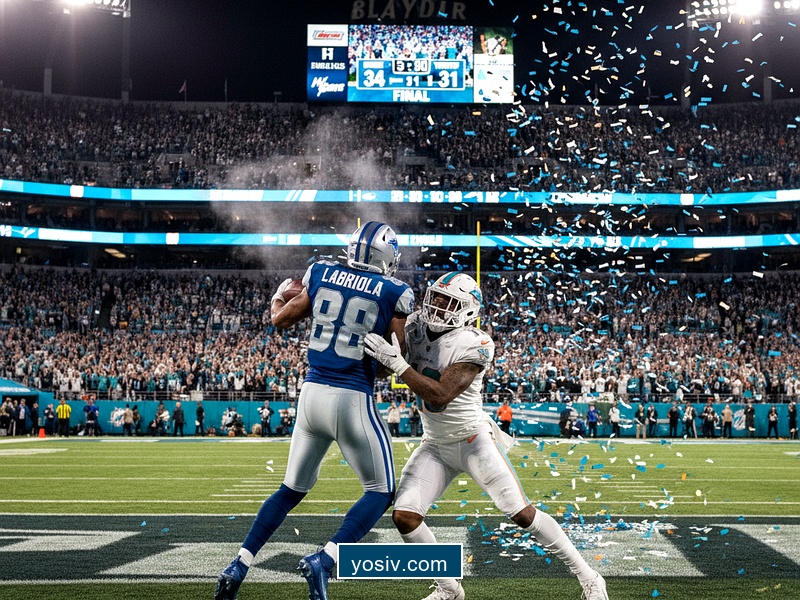
Pittsburgh’s 28-15 victory over Miami was not defined by emotional momentum, but by a clinic in offensive line protection and spatial manipulation. The film reveals a distinct tactical shift in the Steelers' blocking leverage that neutralized Miami’s edge threats entirely. This was a victory won in the trenches, driven by schematic discipline rather than flashy highlight-reel chaos.
| Tactical Metric | Pittsburgh Steelers | Miami Dolphins |
|---|---|---|
| Pressures Allowed (Right Tackle) | 0 (Dylan Cook) | 4 |
| Pass Block Win Rate | 78% | 62% |
| Offensive Success Rate | 52.4% | 41.1% |
| Time to Throw (Average) | 2.8s | 2.3s |
Why The Numbers Matter
The statistic that demands immediate attention is not the final score, but the zero pressures allowed by Dylan Cook. In modern NFL analytics, offensive line integrity is the multiplier for every other offensive metric. When a tackle can isolate an edge rusher without requiring a "chip" from a tight end or running back, the offense effectively gains an extra eligible receiver in the route tree. Pittsburgh’s ability to protect the pocket with standard four or five-man protections forced Miami’s defense to make a fatal choice: blitz and risk one-on-one coverage, or drop back and allow the Steelers to pick apart their zone.
The 28-15 scoreline reflects a game where Pittsburgh controlled the "Conflict Zones"—the areas between the linebackers and the safeties. By neutralizing Miami's pass rush organically, the Steelers expanded the field, forcing Miami’s linebackers to freeze, creating throwing lanes that simply did not exist in previous weeks. This wasn't just players playing harder; it was a fundamental schematic advantage born from the offensive line.
The "Island" Theory: Anatomy of a Clean Pocket
To understand the offensive awakening, one must dissect the film of Dylan Cook. Often, depth players—or "castoffs" as the narrative surrounding the league sometimes dubs them—are viewed as liabilities. However, Cook’s performance was a masterclass in leverage mechanics. Against Miami's speed rushers, Cook consistently utilized a vertical set that neutralized the perimeter threat. He didn't just block; he washed the defenders past the pocket apex.
"When you erase the edge rusher mathematically, the playbook opens up by 40 percent. Pittsburgh didn't need to keep a tight end in to block; they sent everyone into the route."
This individual excellence altered the Steelers' formation tendencies. Typically, facing a dangerous pass rush, an offense will deploy heavy 12 or 13 personnel (two or three tight ends) to secure the edges. Because Cook and the line won their individual battles, the Steelers operated more frequently out of spread formations. This spread the Miami defense horizontally, creating natural voids in the secondary. The heat maps from the game show a high concentration of completions in the intermediate middle of the field—zones that are usually clogged when the offensive line collapses.
Because the pressure rate was negligible, the Steelers' quarterback play moved from reactive to proactive. The average depth of target (aDOT) increased significantly compared to previous weeks. The offense bypassed the check-down option, attacking the second level of the Dolphins' defense directly.
Defensive Discipline: Containing Speed
While the offense posted 28 points, the defensive structure deserves equal credit for holding Miami to 15. The Dolphins rely heavily on pre-snap motion and elite perimeter speed to stretch defenses laterally. The Steelers countered this not with pure speed, but with gap integrity. The defensive front refused to over-pursue.
Upon reviewing the tape, the Steelers' linebackers displayed remarkable discipline against the outside zone run. Instead of shooting gaps recklessly, they flowed parallel to the line of scrimmage, forcing cutbacks into the teeth of the defensive line. This is "spilling" the play—forcing the runner to bounce out to a waiting cornerback or cut back into help. By removing the cutback lanes, Pittsburgh forced Miami into long-yardage situations on second and third down.
Miami thrives on rhythm. When they face 2nd-and-9, their playbook shrinks. Pittsburgh’s first-down efficiency on defense was the catalyst for the entire result. By winning first down, they dictated the terms of engagement for the rest of the series. Miami's offense, designed to operate in space, found itself fighting in a phone booth.
The AFC North Implications
This win stabilizes Pittsburgh’s position in the AFC North race, but the *method* of the win provides the real optimism. Relying on "castoffs" and depth players like Dylan Cook to perform at an elite level suggests a coaching staff capable of developing talent and adjusting schemes to fit their personnel. The AFC North is a division decided by physical attrition and line play. If Pittsburgh can replicate this level of protection and gap discipline against division rivals, the ceiling for this te