
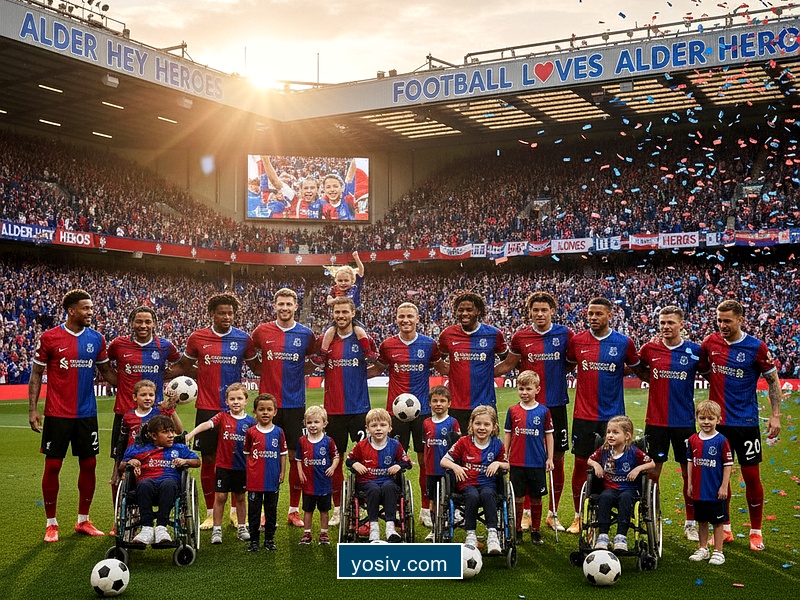
He stands six-foot-four, a sculpture of modern athletic perfection carved from Dutch granite. On the manicured lawns of the Premier League, Virgil van Dijk operates with an air of imperious detachment. He creates an aura that suggests the chaotic swirling of a football match is merely a mild inconvenience to his day. Attackers bounce off him; high balls are plucked from the sky with the nonchalance of a man checking his mail. He is the Colossus of Anfield, the captain, the unshakeable pillar upon which Jurgen Klopp’s empire was fortified and Arne Slot’s new era now rests. Yet, on a crisp winter morning in West Derby, the armor vanished. The Colossus shrank, not in stature, but in spirit, bowing his head before giants who barely reached his kneecaps.
The annual Christmas visit to Alder Hey Children's Hospital is a tradition woven into the fabric of Merseyside football, shared by both Liverpool and Everton. It is a time when the tribal warfare of the derby dissolves into something profoundly human. But for Van Dijk, this year feels different. It carries the weight of a man who has stared into the abyss of his own physical fragility and clawed his way back. We often speak of footballers as heroes, but as Van Dijk walked the sterile corridors of the oncology wards, the irony of that label seemed to hang heavy in the air.
The Myth of Invincibility Shattered
To understand the emotional resonance of this visit for Liverpool's captain, one must rewind the clock. Before that fateful afternoon at Goodison Park in October 2020, Van Dijk was not just a player; he was an inevitability. He played every minute. He never broke. Then came the collision, the snap of the anterior cruciate ligament, and the sudden, violent intrusion of mortality. The Colossus crumbled.
For nine months, he lived in the shadow world of rehabilitation. The roar of the Kop was replaced by the hum of MRI machines and the lonely squeak of sneakers on a gym floor. He learned the agonizing patience required to make a body do what it once did effortlessly. That period was his tragedy, a descent from the pantheon of gods to the realm of broken men.
Now, fully restored and wearing the captain’s armband, he walks into Alder Hey not with the swagger of a champion, but with the empathy of a survivor. He looks at children hooked up to machines, children fighting battles that make a Champions League final look like a playground skirmish, and he recognizes the look in their eyes. It is the look of endurance.
"This place is full of heroes. It gives you a reality check. We have a job that is very public, and we are looked at as heroes, but the real heroes are the people working here and the kids fighting every day." — Virgil van Dijk
A Perspective Reset
The visit serves as a jarring recalibration of values. Throughout the season, Van Dijk exists in a pressure cooker. A misplaced pass draws the ire of millions; a defensive slip is dissected by pundits for days. The mental toll of elite performance is relentless. Yet, as he handed out gifts wrapped in Liverpool red, the noise of the outside world fell silent.
He spent the morning away from football, alongside the women’s team and even rivals from Everton, united by a cause that renders league tables irrelevant. Witnesses described a man completely present. He did not check his watch. He did not glance at his phone. He sat on the edge of hospital beds, folding his massive frame to eye-level with patients, listening to stories of chemotherapy and surgeries with the same intensity he applies to studying opposition strikers.
It is in these moments that the redemption arc of Virgil van Dijk truly completes itself. The redemption is not in his return to the Team of the Year, nor in his reclaiming of his aerial dominance. It is in the maturity of his character. The injury stripped away the arrogance of youth and replaced it with the wisdom of experience. He understands now that his platform is a privilege, and his presence in that hospital room is worth more than any goal-line clearance.
Better Than Christmas
The phrase "better than Christmas" floated through the wards, a sentiment echoed by staff and families alike. For a child confined to a room while the world outside lights up with festive joy, the arrival of their idols brings a specific kind of magic. It breaks the monotony of clinical routine.
| The Two Worlds of Virgil van Dijk | The Reality |
|---|---|
| The Anfield Stage | Controlled aggression, intense scrutiny, physical dominance, millions of dollars at stake. |
| The Alder Hey Ward | Gentle humility, anonymity of status, emotional vulnerability, the simple value of a smile. |
| The Shared Link | Resilience. The refusal to stay down when life—or an opponent—knocks you over. |
Van Dijk moved through the rooms not as a celebrity granting an audience, but as a father. He has children of his own, and one could see the flicker of parental anxiety behind his eyes—the universal fear of "what if this were mine?" That vulnerability makes him accessible. It strips away the superstar veneer and reveals the beating heart beneath the red jersey.
The Weight of the Armband
Being the captain of Liverpool Football Club demands more than tactical acumen. It requires carrying the emotional state of a city on your shoulders. Steven Gerrard did it with local passion; Jordan Henderson did it with tireless community work. Virgil van Dijk does it with a quiet, commanding dignity.
This visit to Alder Hey defines his captaincy as much as lifting the Carabao Cup did. In the modern game, players are often accused of being out of touch, mercenaries living in gated communities. Van Dijk challenges that narrative. He leans into the community. He understands that the club is an institution that belongs to the people, and when the people are suffering, the captain must show up.
As the squad boarded the bus to leave, returning to the tactical briefings and the high-performance diets, Van Dijk left a piece of himself behind. The photos will circulate on social media—the giant Dutchman grinning beside a brave toddler—but the internal impact is invisible. He returns to the pitch with a renewed sense of purpose. The petty frustrations of a refereeing decision or a missed tackle shrink in comparison to the bravery he witnessed.
Virgil van Dijk entered Alder Hey as a footballing hero, a tag bestowed upon him by fans and media. He left knowing that he is merely a spectator to true heroism. His downfall was a knee injury; their downfall is life itself threatening to expire too soon. In recognizing this, the Colossus stands taller than ever before. He plays the game beautiful, but he knows now, with absolute clarity, that it is just a game. The real victory is waking up to fight another day, a lesson taught to the captain by the smallest soldiers in Liverpool.