
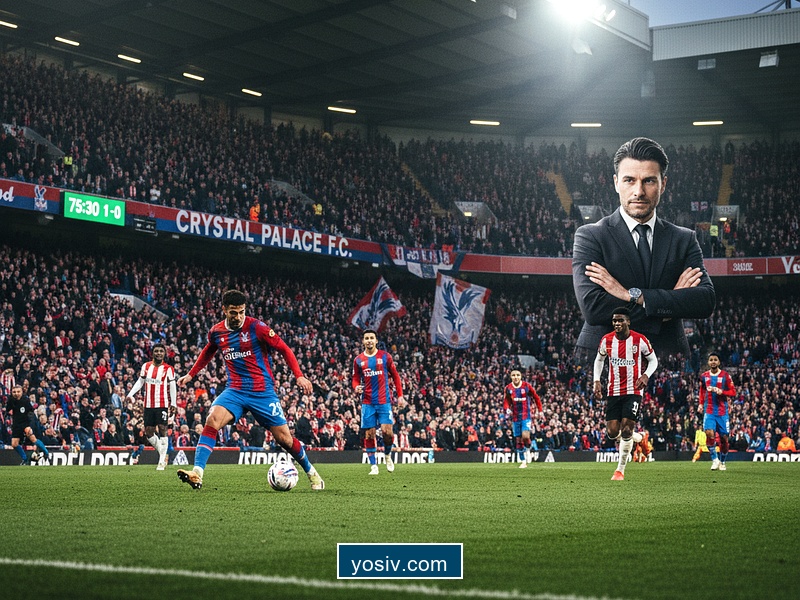
The link between Crystal Palace and a manager from La Liga represents more than a mere change in personnel; it signals a fundamental ideological schism at Selhurst Park. For years, the South London club has operated under the guise of pragmatic solidity—the low block, the rigid banks of four, and the reliance on individual brilliance in transition. This approach, while stabilizing, has placed a tactical ceiling on a squad possessing elite technical profiles. The pursuit of a Spanish tactician suggests the board is finally ready to shatter that ceiling. We are not discussing a simple formation swap; we are analyzing the imposition of Juego de Posición (Positional Play) onto a squad drilled in reactive containment.
To understand why this profile is being targeted, one must dissect the inefficiency of Palace's current spatial occupation. The data is damning: Palace frequently ranks in the bottom quintile for field tilt (dominance of territory). A manager schooled in the modern Spanish methodology—prioritizing ball circulation, high defensive lines, and structured pressing—addresses the root cause of this passivity. The target is not just a coach; the target is control.
Deconstructing the Low Block vs. The High Line
The most jarring adjustment facing Crystal Palace under a Spanish regime concerns the vertical compactness of the team. Under previous management, the defensive line often dropped into the penalty area, compressing space near the goalkeeper but leaving the midfield zone (Zone 14) exposed to late runners. This is the antithesis of the La Liga model.
A Spanish tactical setup demands a high defensive line, often pushing center-backs to the halfway line during possession phases. Joachim Andersen and Marc Guéhi possess the requisite ball-playing ability (progressive passing statistics for both are in the upper percentiles for Premier League defenders), but the system demands psychological bravery. The objective is to shrink the effective playing area to 30-40 meters, suffocating the opponent and forcing turnovers in the opposition half.
"The modern Spanish methodology does not view defense and attack as separate phases. The high line is an attacking weapon—it shortens the distance to the opponent's goal upon recovery."
Currently, Palace’s PPDA (Passes Allowed Per Defensive Action) creates a picture of passivity. They allow opponents to build rhythm. A La Liga manager, typically influenced by the schools of intense pressing seen at clubs like Real Sociedad or Girona, will drastically lower this number. The trigger points for the press will move from the defensive third to the attacking third, utilizing the wingers not as retreat options, but as the first line of defense.
The Geometry of Possession: The 3-2-5 Build-Up
The aesthetic shift is secondary to the geometric shift. English pragmatism often relies on a flat 4-4-2 or 4-5-1 out of possession that transitions into a loose attacking structure. The Spanish model is dogmatic about shape. We should expect the implementation of a "Rest Defense" structure, typically a 3-2 or 2-3 shape at the base of the midfield, allowing five players to attack the defensive line.
| Tactical Metric | Current Palace Profile (Avg) | Target La Liga Profile (Avg) |
|---|---|---|
| Defensive Line Depth | Low / Deep Block (Own Box) | High Line (Halfway Line) |
| Fullback Role | Linear / Overlapping | Inverted / Underlapping Pivot |
| Midfield Shape | Flat / Double Pivot | Staggered / Box Midfield |
| Winger Isolation | Reactive / Counter | Systematic / 1v1 Creation |
In this setup, the fullbacks—likely Tyrick Mitchell and Daniel Muñoz—face a steep learning curve. The La Liga blueprint often demands one fullback to tuck inside, becoming an auxiliary central midfielder alongside the pivot (Cheick Doucouré or Adam Wharton). This creates a numerical overload in the center of the park (4v3 or 4v2 against opposition midfields).
Why is this vital for Palace? It liberates the "Interiors" (the number 8s or 10s). By securing central control with an inverted fullback and a pivot, players like Eberechi Eze receive the ball higher up the pitch in the "half-spaces"—the vertical channels between the opposition fullback and center-back. Currently, Eze often drops deep to collect the ball from the defenders. A structured build-up removes this burden, delivering the ball to him in dangerous areas where his dribbling translates directly to goal threat rather than progression.
The Isolation Principle: Maximizing Olise and Eze
Critics of positional play argue it stifles creativity. The reality, particularly in the La Liga interpretation, is that the structure exists solely to create chaos in specific zones. The tactical instruction is simple: overload one side to isolate the other.
Imagine Palace building up heavily on the left. The opposition shifts their block to compensate. A Spanish tactician drills the team to execute a rapid switch of play—the cambio de juego—to the isolated winger on the right. Michael Olise thrives in these 1v1 isolation scenarios. Under a reactive system, Olise often receives the ball while outnumbered 1v2 or 1v3 because the support play is slow to arrive.
In a structured positional system, the spacing is precise. The winger stays on the touchline until the last moment, stretching the opposition defense horizontally. This creates gaps in the defensive line—the "channels"—for underlapping runs from midfielders. Palace has the personnel for this; they simply lack the geometric discipline to execute it consistently. The arrival of a manager versed in this philosophy forces the squad to value space as much as they value the ball.
The Physical Cost of Tactical Evolution
Tactics do not exist in a vacuum; they require physical output. The transition from a low block to a high-pressing system creates a distinct physiological load. In a low block, bursts of speed are sporadic—used primarily for counter-attacks. In a Spanish high-press system, the "sprints per game" metric for forward players increases drastically, but the distance of those sprints decreases.
It requires constant, high-intensity shuttling to close passing lanes. Palace’s midfield engine room must adapt to this aerobic demand. The "Rest Defense" requires immediate counter-pressing (losing the ball and trying to win it back within 5 seconds). If the first wave of pressure fails, the high defensive line is vulnerable to balls over the top—a weakness exploited by pacey Premier League attacks.
The pursuit of a La Liga manager validates the board's desire to modernize. They see a squad of internationals playing football from a bygone era. The tactical shift will be painful; the high line will concede goals, and the intricate build-up will lead to errors in dangerous areas initially. However, the ceiling of a possession-based Palace, utilizing the technical superiority of their star wingers within a coherent structure, far exceeds the safety of mid-table obscurity. This is a gamble on geometry, pressing triggers, and tactical intellect.