
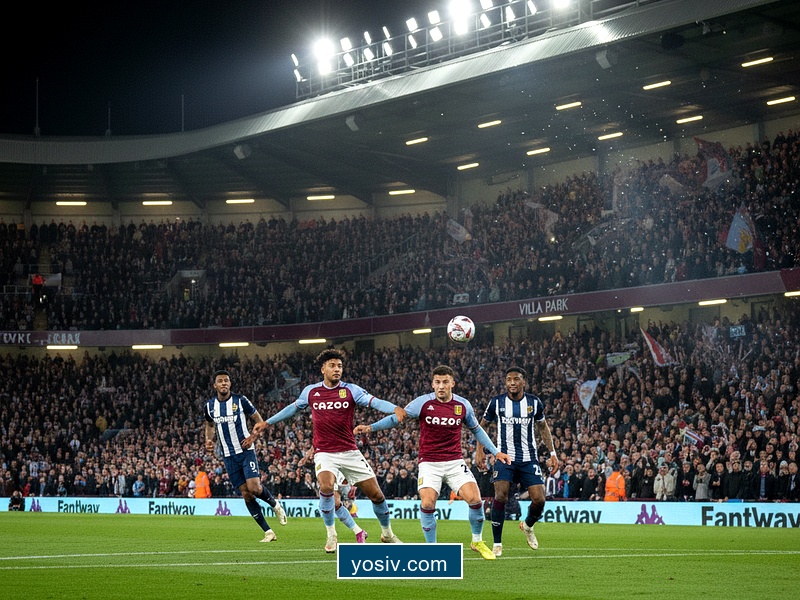
The confirmation from the Premier League regarding the rescheduling of the Aston Villa versus Wolves fixture to a Friday night slot is more than a logistical adjustment for television audiences; it fundamentally alters the tactical preparation window for two of the league’s most system-dependent managers. While the narrative will inevitably drift toward local rivalry and atmosphere, the analyst’s eye must focus on the compression of the micro-cycle.
Unai Emery and Gary O'Neil represent opposite ends of the possession spectrum, yet both rely heavily on trigger-based pressing systems that require immaculate physical freshness. Moving this fixture forward strips away 24 hours of recovery and tactical drilling. This article dissects the strategic collision course set for Villa Park, focusing on the geometric vulnerabilities of Emery’s high line against the vertical thrust of O’Neil’s transition mechanics.
The Geometry of the High Line
To understand why this specific Friday night matchup holds such intrigue, one must dissect the risk-reward calculus of Emery’s defensive structure. Villa does not simply play with a high defensive line; they play with a compressed vertical unit. The distance between Ollie Watkins (pressing the goalkeeper) and Ezri Konsa (holding the defensive line) often shrinks to fewer than 25 meters.
This compression chokes the opposition’s midfield build-up. By shrinking the playing area, Villa forces opponents to play precise, rapid combinations in tight spaces—a difficult task for most teams. However, this creates a massive expanse of green grass behind the back four, known tactically as "the kill zone." Emery bets that his back four can coordinate their step-up movements faster than the opponent can release a pass.
The rescheduling of this match impacts this specific mechanic. The offside trap requires mental sharpness and synchronized movements. Fatigue leads to a ragged line. If one center-back is a fraction of a second slow in stepping up, the trap fails, and the striker is through on goal. Friday night fixtures, often following short recovery weeks, historically show a spike in defensive errors due to cognitive fatigue.
Wolves’ Transitional Blueprint
Gary O'Neil has engineered Wolves into one of the most efficient counter-attacking units in the division. Unlike teams that look to possess the ball to rest, Wolves utilize a "coiled spring" low block. They invite pressure, compressing their own defensive third, only to explode vertically the moment possession turns over.
The tactical interaction here is clear. Villa wants to compress the pitch; Wolves want to expand it rapidly. When Villa loses the ball in the attacking third, their immediate reaction is a counter-press. If Wolves bypass that first wave of pressure—usually via a ball-carrying midfielder like Mario Lemina or João Gomes—they are instantly running at an exposed Villa backline that is retreating from the halfway line.
| Metric | Aston Villa (Possession Phase) | Wolves (Transition Phase) |
|---|---|---|
| Avg Line Height | 52.4 meters (High) | 38.1 meters (Low/Mid) |
| Speed of Attack | 1.4 m/s (Patient) | 3.8 m/s (Direct) |
| PPDA (Press Intensity) | 10.2 (Aggressive) | 14.5 (Passive/contain) |
Zone 14 and the Half-Spaces
The match will likely be decided in the half-spaces—the vertical channels between the opposition's full-back and center-back. Emery utilizes a distinct 4-2-2-2 build-up shape where the wide midfielders tuck inside to act as dual number 10s. This creates an overload in the center, forcing the Wolves wing-backs to make a critical decision: stay wide to cover Villa’s advancing full-backs or pinch in to help the midfield.
If Wolves pinch in, Villa circulates wide to Lucas Digne or Matty Cash, who then have uncontested crossing opportunities. If Wolves stay wide, Villa’s midfielders (often McGinn or Tielemans) have time to turn in "Zone 14" (the area just outside the penalty box) and slide through-balls to Watkins.
However, this aggression is a double-edged sword. When Villa commits their full-backs high to provide width, they leave their two center-backs isolated. Wolves specifically target the space vacated by the attacking full-backs. Heat maps from O’Neil’s previous tactical setups against "Top 6" structures show a heavy concentration of activity in these wide, deep channels. They do not look to possess the ball; they look to exploit the void.
The 'Artificial Transition' Concept
A fascinating evolution in Emery’s tactics is the "Artificial Transition." Villa often slows the game down, inviting the opponent to press them deep in their own box. Martinez will hold the ball, waiting for a Wolves forward to jump. Once that pressure arrives, Villa executes a pre-planned vertical passing combination to break the first line.
This effectively creates a counter-attack opportunity despite Villa having had possession the entire time. They manufacture space by baiting the press. Against a disciplined Wolves side that prefers a mid-block, this becomes a game of chicken. If Wolves refuse to press Martinez, the game stagnates. If they take the bait, Villa can slice through the center.
The Friday night scheduling adds volatility to this dynamic. Teams are generally less patient under the lights with a raucous crowd. The atmosphere encourages pressing, even when the tactical instruction is to hold shape. If the Villa Park crowd roars, Wolves players may instinctively step up to press, falling directly into Emery's trap.
Conclusion: The Efficiency of the Breakdown
Ultimately, this rescheduled fixture presents a laboratory for modern Premier League tactics. It is not merely about form or momentum; it is about spatial dominance. Villa seeks to control space by condensing it; Wolves seek to control space by exploiting it rapidly.
The reduction in preparation time favors the reactive team over the proactive one. Defensive structures (Villa's high line) require more coordination and mental energy to maintain than reactive counter-attacking patterns (Wolves). Therefore, the rescheduling levels the playing field, turning the match into a raw test of tactical discipline versus athletic verticality. The winner will be the side that best manages the chaos of the transition moments, specifically in the 5-second windows following a turnover in the middle third.