
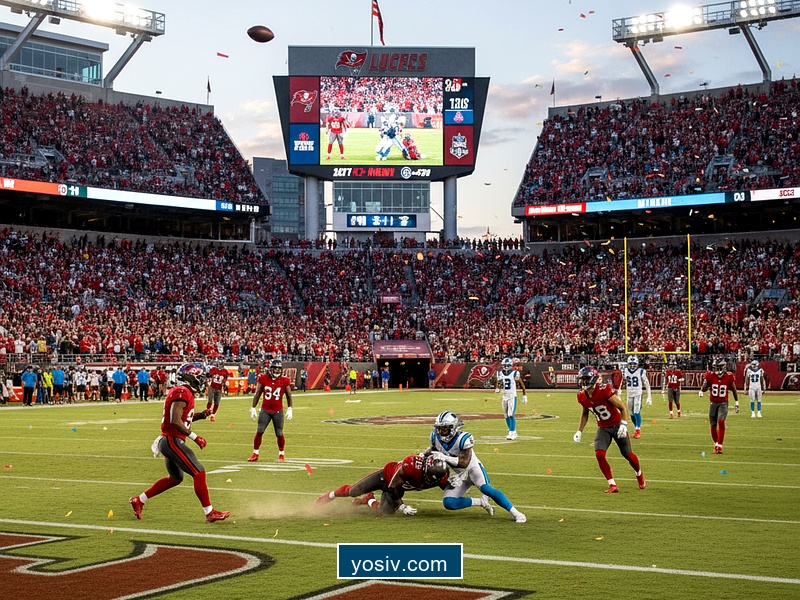
"It’s not about how many you send; it’s about who they think is coming. If the quarterback has to verify the coverage post-snap, the pass rush has already won." – Defensive Coordinator Insight
Forget the divisional standings and ignore the emotional weight of an NFC South rivalry. To understand what occurred between the Tampa Bay Buccaneers and the Carolina Panthers, one must strip away the narrative and examine the geometry of the field. This was not a game decided by passion; it was decided by spatial manipulation and protection schematics. Todd Bowles did not simply call plays; he engineered a structural collapse of the Carolina offensive line, while Liam Coen’s offense utilized horizontal spacing to stretch a disciplined Ejiro Evero defense until it snapped.
The result hinged on two specific tactical battles: the Buccaneers' use of "creepers" (simulated pressures) to overload the Panthers' interior protection rules, and Tampa's offensive utilization of condensed formations to create leverage in the flats. The scoreboard reflected a discrepancy in execution, but the film reveals a discrepancy in design.
The Analysis: Weaponizing the A-Gap
Todd Bowles remains the premier architect of the double A-gap mug look in the modern NFL. Against Carolina, this alignment was the catalyst for offensive paralysis. By placing two linebackers directly over the center—the "A" gaps—Bowles forced the Carolina offensive line into a specific protection check, usually a "squeeze" or a "fan" call depending on the center's slide.
The genius lay not in sending both linebackers, but in sending neither. On crucial third downs, Tampa Bay frequently showed a six-man pressure look. Carolina’s protection scheme accounted for the interior threat, sliding the protection inward to solidify the middle. At the snap, both linebackers dropped into underneath coverage "rat" zones, cutting off the hot slant routes. Simultaneously, a slot corner or safety blitzed from the edge—the very area the protection had slid away from.
This is a classic "Replace" blitz concept. You rush four, but not the four defensive linemen. By dropping a lineman or linebacker and replacing them with a defensive back, Bowles changed the geometry of the rush lanes. The heat map of the quarterback’s pocket presence shows a forced drift. He could not step up (fear of the A-gap mug) and could not escape laterally (edge pressure). The result was a pocket collapse that occurred without sacrificing coverage integrity on the back end.
| Defensive Concept | Carolina Response | Tactical Outcome |
|---|---|---|
| Double A-Gap Mug | Center Slide / Full Slide | 1-on-1 isolation for Edge Rushers |
| Creeper Pressures | Hot Reads | Turnovers / Punted drives (Coverage drops masked lanes) |
| Cover 3 Buzz | Seam Routes | Safety rotation negated vertical threats |
Offensive Spacing: The Condensed Formation
While Bowles deconstructed the opposing protection, Buccaneers Offensive Coordinator Liam Coen provided a masterclass in utilizing condensed formations. Modern defenses, including Ejiro Evero’s unit, rely heavily on matching patterns. When receivers align wide, pattern matching is straightforward. When the offense compresses into a "tight bunch" or "stack" alignment near the offensive tackles, defensive responsibilities blur.
The Buccaneers repeatedly deployed "Snug" formations. This forced the Panthers' cornerbacks to play off-leverage to avoid getting picked (rubbed) in traffic. Coen exploited this soft cushion with "Out" and "Corner" routes.
Consider the specific usage of the "Mesh" concept. Tampa ran shallow crossing routes from these condensed sets. Because the Panthers were playing a soft zone shell to prevent the deep ball, the underneath linebackers were stressed horizontally. They had to chase the crossers through traffic. By the time the linebackers navigated the wash of bodies in the middle of the field, the ball was already in the hands of the playmaker in space. This is a simple physics equation: increasing the distance a defender must traverse laterally increases the separation window for the receiver.
Neutralizing the Run Through Gap Discipline
The final pillar of this tactical dismantling occurred in the run game. Carolina attempted to establish the outside zone to slow down the Tampa pass rush. The goal of the outside zone is to stretch the defense laterally until a running lane creates itself via a cutback.
Tampa Bay countered this with "Gap Exchange" principles. Instead of purely shooting gaps, the defensive ends engaged the offensive tackles and held the edge, forcing the run back inside. The linebackers, reading the flow, scraped over the top with patience.
A distinct pattern emerged in the second quarter: Tampa’s interior defensive line stopped penetrating upfield. They occupied blocks. Vita Vea, in particular, utilized "Lag" technique—striking the center and waiting for the ball carrier to commit before shedding the block. This two-gapping philosophy turned the line of scrimmage into a brick wall. The Panthers' running backs found no cutback lanes because the interior defensive line refused to be displaced vertically. Without a viable run game to balance the ledger, Carolina became one-dimensional, feeding directly back into the hands of Bowles' simulated pressure packages.
Ultimately, the Buccaneers won because they controlled the "mental clock" of the game. Defensively, they sped up the opponent's clock with disguised pressure. Offensively, they slowed the game down with high-percentage throws born from superior spacing concepts. The physical talent dictated the highlights, but the whiteboard dictated the outcome.