
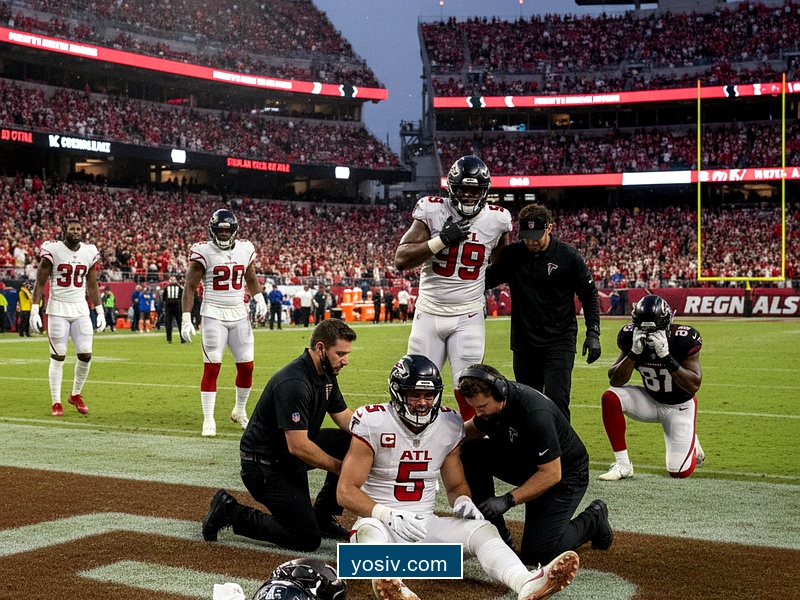
The latest casualty report out of Flowery Branch reads less like a strategic update and more like a grim indictment of organizational depth. With Drake London carrying a "questionable" tag into the desert to face the Arizona Cardinals—and two defensive starters hovering in limbo—we are witnessing the structural fragility of the Atlanta Falcons’ current project. While ESPN and the NFL Network chirp optimistically about London being "expected to play," they miss the forest for the trees. The story isn't about whether London can suit up; it is about a franchise that has constructed a roster so top-heavy that it feels compelled to wheel out its compromised Ferrari because it doesn't trust the sedans in the garage.
This Week 16 scenario (as indicated by league reports) against Arizona puts the philosophy of head coach Raheem Morris and GM Terry Fontenot under the microscope. We are deep enough into this regime to stop blaming the ghosts of the previous administration. The desperate reliance on a banged-up London highlights a failure to insulate the team's core assets, threatening to turn a "culture of toughness" into a cycle of diminishing returns.
The Julio Jones Corollary: Repeating History?
Long-time observers of Atlanta football will feel a phantom ache reading this week's injury report. For a decade, the franchise operated under the "Julio Jones Protocol"—a perpetual state where the team’s best player didn't practice all week, was listed as questionable, and then played 60 snaps on Sunday. It was heroic, yes. But it was also sustainable only until it wasn't. Jones’ body eventually broke down under the sheer volume of usage and the lack of a secondary threat to alleviate the physical punishment.
Drake London is currently being pushed into that same hazardous lane. Since his arrival as a top-10 pick, London hasn't just been a wide receiver; he has been the entire perimeter blocking scheme and the sole bail-out option for erratic quarterback play. When a coaching staff pushes a player to the line of scrimmage despite lingering injuries in a non-playoff or marginal leverage situation, they aren't displaying grit. They are admitting that their scheme cannot function without specific personnel. That is not a system; that is a dependency.
Kyle Shanahan’s coaching tree—from which offensive coordinator Zac Robinson extends—often treats skill players as interchangeable cogs in a high-speed machine. However, the Falcons have inverted this. They drafted "unicorns" (London, Kyle Pitts, Bijan Robinson) but lack the systematic floor to protect them. If the scheme requires a hobbled London to beat a rebuilding Arizona defense, the scheme is flawed.
Tactical Implications: The Shrinking Field
Beyond the philosophical malpractice, playing a compromised Drake London against Jonathan Gannon’s Cardinals defense alters the tactical reality of the game. London’s primary asset is not elite separation speed; it is his physicality at the catch point and his ability to cut sharply on dig routes and posts. A lower-body issue neutralizes the violent cuts required to create windows in the intermediate zones.
If London plays at 80% capacity, he becomes a possession receiver rather than a playmaker. This allows the Cardinals to compress the field. Arizona’s defensive philosophy relies on keeping everything in front of them. If they know London cannot threaten the deep third or explode out of a break, they will sit in Cover 3 or Quarters, squat on the short routes, and dare the Falcons to beat them with depth options who have largely failed to materialize this season.
This creates a domino effect. The running game faces heavier boxes because the safeties aren't respecting the vertical threat. The offensive line, already dealing with the attrition of a long season, has to hold blocks longer as receivers struggle to separate. It is a tactical cascading failure triggered by the stubborn refusal to rest a star player.
The Defensive Thinning: A Crisis of Depth
While the headlines focus on London and the marquee matchup potentially involving Marvin Harrison Jr., the whisper in the injury report regarding "two defensive starters" is arguably more alarming. Raheem Morris is a defensive mind. His hiring was supposed to raise the floor of that unit. Yet, late in the season, we are seeing the unit fray.
The modern NFL defense requires rotation. The Philadelphia Eagles and San Francisco 49ers build their defensive fronts like hockey lines—constant shifts to keep legs fresh. Atlanta has relied heavily on a starting 11 playing a massive percentage of snaps. This "iron man" approach works in September. By December, it results in soft tissue injuries and fourth-quarter collapses.
If Atlanta is missing key starters in the secondary or at linebacker against a mobile quarterback like Kyler Murray, the result is predictable. Murray thrives on "second-reaction" plays. When the play breaks down, tired or backup defenders lose gap integrity. The discipline required to contain a scrambler is mental as much as physical, and fatigue is the enemy of discipline.
The Sunk Cost Fallacy of the Fontenot Era
We must pivot back to the front office. General Manager Terry Fontenot has been praised for his "Best Player Available" draft strategy. But this injury report reveals the dark side of that strategy: a lack of cohesive depth. By pouring premium resources into tight ends, running backs, and receivers in the top 10, the Falcons neglected the volume drafting required to build a resilient middle class of the roster.
Great teams survive injuries because their third-round picks and veteran minimum signings are competent system fits. The Falcons survive injuries by asking their stars to play through pain. This is the hallmark of a roster that is still, despite years of rebuilding, functionally thin. The "Project" was supposed to be about sustainable winning. Instead, it looks like a week-to-week scramble for survival.
The Verdict: A Gamble with No Upside
If Drake London takes the field against Arizona, catches six passes for 70 yards, and the Falcons win, the local press will praise his toughness. They will write puff pieces about the "culture change" under Morris. I will see it differently.
I will see a management team willing to redline their most valuable long-term asset to salvage a single Sunday against a non-conference opponent. In the modern NFL, availability is a skill, but durability is a resource that coaches must manage. The Falcons are spending London’s durability like a drunken sailor in a port town.
The smart move—the move of a confident franchise with a clear vision—would be to sit London if he is truly questionable, lean on the offensive scheme to manufacture touches for others, and trust the 53-man roster construction. Playing him is an admission of fear. It signals that despite the coaching changes, the free agent signings, and the bravado, the Atlanta Falcons are still a team that lives on the razor's edge, terrified that one pulled hamstring will bring the whole house of cards tumbling down.