
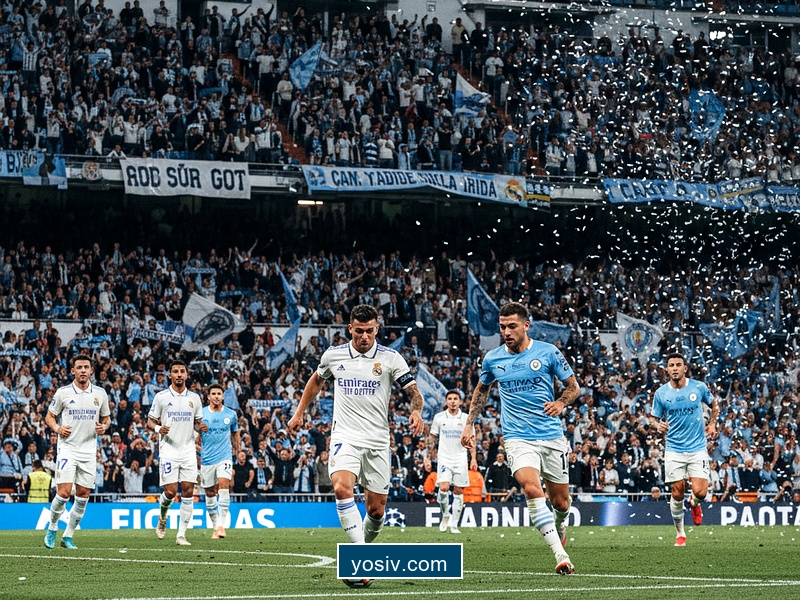
We are witnessing the liquidation of the old European order. For the better part of two decades, the continent’s footballing narrative was dictated by the Messi-Ronaldo axis, a binary star system that warped the gravity of everything around it. But that is ancient history now. The axis has shifted. The modern Champions League does not truly begin until Real Madrid and Manchester City stare one another down in the tunnel. It has become the fixture that swallows the season whole.
To view their latest collision merely as a collection of goals and aggregate scores is to miss the tectonic shifts occurring beneath the Bernabéu turf. This is not just a match; it is a referendum on two opposing philosophies of football existence. It is the cold, industrial perfection of Pep Guardiola’s systems colliding with the mystical, terrifying inevitability of Carlo Ancelotti’s aristocracy.
The Galactico Reborn: Bellingham vs. The Ghost of Zidane
The lazy analysis is to look at Jude Bellingham wearing the number 5 shirt for Los Blancos and simply nod at the symbolism. But the comparison requires forensic interrogation. Twenty years ago, Zinedine Zidane patrolled the midfield with a kind of languid arrogance that suggested running was beneath him. Zidane moved through spaces that didn't exist until he created them. His game was art, often inefficient, but always devastating.
Bellingham represents the mutation of that role into something more terrifyingly athletic. He is Zidane with the lungs of a box-to-box Premier League engine. In the early 2000s, the "Galacticos" were a collection of soloists; the 2024 iteration of Real Madrid utilizes Bellingham not as a luxury playmaker, but as a battering ram draped in silk. Watching him drive at the City defense evokes memories not of Zidane, but of a young Steven Gerrard transplanted into the body of a devastating second striker.
Conversely, look at Kevin De Bruyne. If Madrid is built on individual heroism, De Bruyne is the ultimate algorithm. He is the spiritual successor to Paul Scholes, yet stripped of Scholes’ defensive liabilities and engineered with a GPS tracker in his right boot. Scholes dictated tempo; De Bruyne dictates probability. When these two number fives clash—the emotional leader of Madrid versus the robotic architect of Manchester—we see the divergence of 20 years of midfield evolution.
Rodri and the Evolution of the "Makelele Role"
History is written by the victors, but tactics are defined by the anchors. In 2003, Florentino Pérez famously sold Claude Makelele, claiming he wouldn't miss a player who didn't pass the ball more than three meters. It was the error that plunged Madrid into a barren spell. Makelele was the destroyer, a singular entity designed to disrupt.
Look at Rodri now. To call him a defensive midfielder is an insult to his agency. He is the hybrid of Makelele’s defensive anticipation and Xavi Hernandez’s distribution. This is the "Information Gain" that modern pundits often miss: City’s dominance isn't just about possession; it is about Rodri’s ability to compress the pitch. In the 2000s, teams played with a destroyers and creators. Rodri is both.
"To compare the Madrid of the early 2000s to this City team is to compare a jazz band to a metronome. One relies on improvisation and the genius of the individual; the other relies on the terrifying certainty of the beat."
When Real Madrid faces City, they are attempting to solve a mathematical equation with poetry. Historically, the "Makelele Role" was about stopping the opponent. Rodri’s role is about ensuring the opponent never gets the ball in the first place. This tactical suffocation is what forces Madrid into their shell, relying on the counter-attack—a strategy that would have been considered heresy for the Galacticos of Figo and Raul.
Haaland, Vinicius, and the Death of the False Nine
For a decade, largely due to Guardiola’s Barcelona, the world was obsessed with the "False Nine." Strikers who dropped deep were the vogue. Karim Benzema mastered this, becoming the glue that held Ronaldo and Bale together. But the pendulum has swung back with violent force.
Erling Haaland is a throwback to a pre-modern era, a Nordic iteration of Christian Vieri or a raw Ruud van Nistelrooy. He offers almost nothing in the build-up, a stark contrast to the Harry Kanes of the world. Yet, his existence forces defenses to drop ten yards deeper. He is a tactical deterrent.
However, the true evolution lies on the wing. Vinicius Junior is not a winger in the 1990s sense—he is not Ryan Giggs hugging the touchline to cross. He is the primary goal threat, the Cristiano Ronaldo of 2008 reloaded. In the historic rivalry of Manchester United vs. Arsenal (1998-2004), the threat was through the middle (Henry, Van Nistelrooy). In this new European Classic, the center is a decoy. City controls the center to create width; Madrid bypasses the center to unleash Vinicius.
The Weight of the Badge: Chaos vs. Control
There is a psychological component here that defies analytics. Real Madrid operates on "Chaos Theory." They are the only team in sports history that seems more dangerous when they are losing. This is the heritage of *La Remontada*. When they went down against City in previous semi-finals, only to resurrect themselves in stoppage time, it wasn't luck. It was institutional memory.
Compare this to the Manchester United teams of Alex Ferguson, specifically the 1999 treble winners. They had that same aura of inevitability. City, for all their billions and tactical brilliance, are still fighting for that spiritual legitimacy. They have the superior system, but Madrid has the superior soul. When the anthem plays, City players think about their instructions; Madrid players think about their ancestors.
The Ancelotti Paradox
Carlo Ancelotti remains the greatest anomaly in modern management. In an era dominated by the high press, positional play, and micro-management (Ten Hag, Arteta, Guardiola), Ancelotti manages like a vibe-based CEO from the 1980s. He empowers individuals.
His approach mirrors the AC Milan team of 2007—an aging, disjointed squad that somehow lifted the trophy because Kaka, Seedorf, and Pirlo were trusted to solve problems on the fly. Guardiola treats football as a science to be solved; Ancelotti treats it as a relationship to be managed. This dichotomy is why this fixture is so compelling. It is the cold logic of a supercomputer versus the gut instinct of a gambler.
A New Hegemony
We must stop looking for the next Messi vs. Ronaldo rivalry in terms of individuals. The rivalry is now institutional. It is the State Project (City) versus the Royal Establishment (Madrid). The Premier League’s financial dominance has turned the Champions League into "The Premier League vs. Real Madrid."
Ten years ago, the Bundesliga (Bayern) and Serie A (Juve) were genuine co-protagonists. Today, they are supporting actors. The tactical trends of the next decade—the utilization of hybrid defenders like Gvardiol, the return of the classic number 9, and the box midfield—are being defined exclusively in these matchups.
If you want to know where football is going, do not look at the World Cup. International football is a nostalgic relic, slow and disorganized. The bleeding edge is here. City squeezes the life out of the game until it submits; Madrid waits for the game to blink and then strikes. One is the future of systems; the other is the guardian of moments. Long may the war continue.