
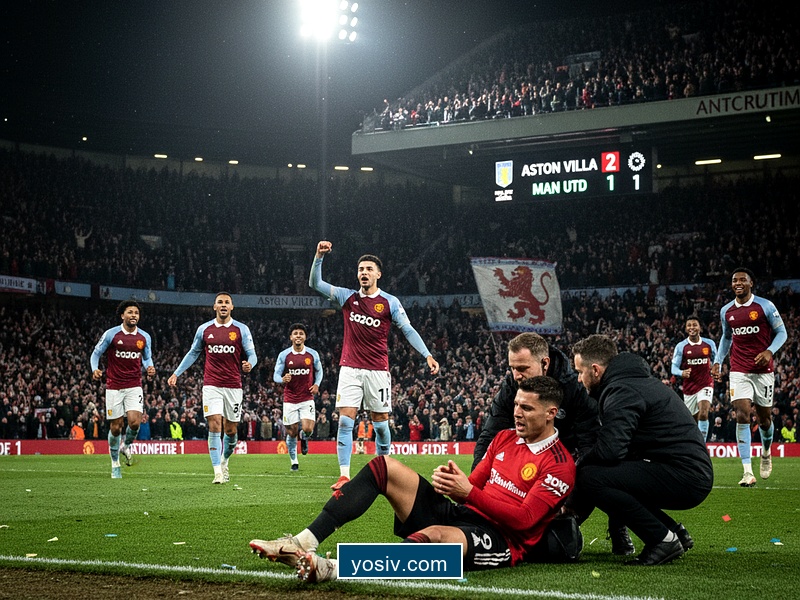
There is a specific frequency of noise that Old Trafford used to generate, a low rumble of inevitability that usually peaked in "Fergie Time." On Sunday, that sound was nowhere to be found in Manchester, because it has migrated south to the Midlands. Aston Villa’s 2-1 dismantling of Manchester United was not merely a result; it was a generational handover of status.
For twenty years, I have watched the Premier League hierarchy calcify, break, and reform. We are currently witnessing a shift as significant as the rise of Manchester City. Unai Emery has not just coached a football team; he has resurrected a sleeping giant that has spent the better part of a decade in a coma. To understand the gravity of this 2-1 victory, we must look beyond the expected goals maps and look at the ghosts of 2008.
The Ghost of Martin O'Neill
The lazy comparison for this Aston Villa side is Leicester City in 2016. That is incorrect. Leicester was a miracle born of momentum and chaos. Emery’s Villa is a machine born of architectural precision. A far more accurate historical touchstone is Martin O'Neill’s Villa side of 2008-2010.
That squad, featuring the blistering pace of Gabriel Agbonlahor and the crossing precision of Ashley Young, threatened to break the "Big Four" hegemony. They sat third in February 2009, looking down on Arsenal. Yet, O’Neill’s side was built on counter-attacking adrenaline. They were a heavyweight boxer with a knockout punch but no jab. Once teams sat deep, that Villa side crumbled, eventually finishing 6th.
Emery has solved the riddle that baffled O'Neill. Where Agbonlahor was a sprinter who played football, Ollie Watkins is a complete forward in the mold of a young Dwight Yorke—capable of linking play, drifting wide, and finishing with surgical intent. Tactically, Emery’s utilization of the high line is not just brave; it is a mathematical constriction of the pitch that O'Neill never attempted.
Against United, Villa squeezed the play into a 30-meter band. In 2008, Villa relied on Gareth Barry to cover ground; today, Douglas Luiz and Boubacar Kamara (when fit) and John McGinn control space. This is not a team riding a wave of luck. This is a team that has won 15 consecutive home league matches, a feat that rivals the great Liverpool sides of the 1980s. The Holte End knows the difference between hope and expectation. Under O'Neill, they hoped. Under Emery, they expect.
United: The Fragility of a Hollow Empire
Conversely, Manchester United has become a tribute act to their former selves. The narrative following this match will likely center on the injury to Bruno Fernandes. When the Portuguese captain left the field, United’s creativity evaporated. But to blame the loss on the absence of one man is to admit that the club is no longer an elite institution.
Cast your mind back to the United squad of 2007-08. That team, a double-winning juggernaut, did not collapse when a cog was removed. If Paul Scholes was absent, Michael Carrick dictated the tempo. If Roy Keane was missing in the years prior, Darren Fletcher or Owen Hargreaves offered industrial resilience. There was a systemic arrogance—a structural integrity that Erik ten Hag has failed to instill.
Current United plays "moments" football. They rely on individual brilliance to paper over tactical chasms. Without Fernandes, they looked like a mid-table side trying to nick a point away from home. The contrast with the 2008 defense is stark. Rio Ferdinand and Nemanja Vidić defended the halfway line with the same comfort they defended the six-yard box. On Sunday, Harry Maguire and Raphaël Varane looked terrified of the space behind them, retreating deeper and inviting Villa to dictate the game.
The Bruno Dependency vs. The Rooney adaptability
The reliance on Fernandes highlights a flaw in squad construction that has persisted since Sir Alex Ferguson retired. Fernandes is a "hero ball" player—high risk, high reward. He is the modern Eric Cantona without the surrounding cast of gladiators.
In 2009, Wayne Rooney was often shifted to the left wing to accommodate Cristiano Ronaldo, or played as a lone striker. The system adapted to the personnel. Ten Hag’s system seems brittle; if the number 10 is removed, the pressing triggers fail, the transition game halts, and the midfield becomes a transit zone for the opposition.
Villa exploited this ruthlessly. Once Fernandes departed, McGinn and Tielemans bypassed United’s midfield with embarrassing ease. It was reminiscent of how Barcelona dismantled United in the 2009 and 2011 Champions League finals—not through physical dominance, but by denying them the ball and making them chase shadows.
Can Emery Actually Win It?
The question posed is whether Emery can dream of the title. The skepticism comes from a lack of recent history, but history is written by the victors of the present.
Statistically, Villa is tracking alongside the pace of champions. But the hurdle is not ability; it is depth. The 1995-96 Newcastle United "Entertainers" blew a 12-point lead because they ran out of steam and mental fortitude. Villa faces the same danger. They are competing against Manchester City and Liverpool—teams that are essentially nation-state projects or decades-long analytics experiments.
However, Emery possesses a tactical acumen that Kevin Keegan lacked. Keegan played on emotion; Emery plays on geometry. His 4-2-2-2 box midfield creates overloads that confuse modern pressing structures. It is a level of sophistication Villa Park has arguably never seen, surpassing even the Ron Saunders era in terms of tactical complexity.
"The table doesn't lie in December. It might lie in August, but not now. Villa are not gatecrashers at the party; they own the venue."
The Verdict
Sunday’s result was a correction of the natural order. Aston Villa is a club operating with a coherent strategy, elite coaching, and a unified squad. Manchester United is a brand relying on nostalgia and individual bailouts.
If we compare player for player, how many United stars get into this Villa XI? Martinez over Onana? Certainly. Watkins over Hojlund? Every day of the week. McGinn over McTominay? It isn't even a conversation.
Emery may not win the title this year. The grinding attrition of the spring months favors the deep squads of City and Arsenal. But he has achieved something arguably more difficult: he has turned Old Trafford into just another away ground, and Villa Park into the most feared destination in Europe. The aura has moved. And looking at the tactical disparity on Sunday, it isn't moving back anytime soon.