
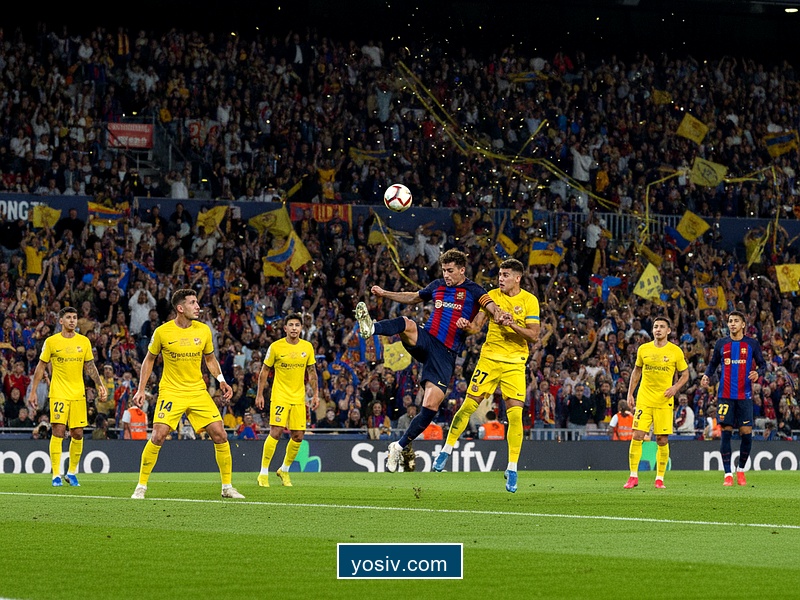
The Estadio de la Cerámica has never been a place for the faint-hearted. It is a compact, hostile cauldron where tactical idealism often goes to die, usually at the hands of a relentless counter-attack. As we approach Matchday 17, with Hansi Flick’s Barcelona preparing to face Villarreal, the narrative isn't simply about three points. It is a litmus test for the sustainability of a project that feels precariously balanced between brilliance and burnout.
I have covered this league long enough to remember when Frank Rijkaard’s "galactic" ambitions unraveled in away fixtures just like this one. There is a specific scent to a Barcelona collapse—it usually smells like defensive arrogance mixed with midfield fatigue. Looking at the talking points emerging from Catalonia this week, the parallels to the 2006-07 season—where a brilliant team forgot how to suffer—are becoming impossible to ignore.
The Lamine Yamal Paradox: Chasing the Ghost of 2005
The first and loudest talking point concerns Lamine Yamal. The reliance on this teenager has shifted from "heartwarming story" to "tactical negligence." We are witnessing a singular talent carrying the creative burden of a billion-dollar institution. But to understand the gravity of this, we must look back to August 24, 2005. That was the night Fabio Capello, then managing Juventus, asked Rijkaard if he could borrow a tiny Argentine named Lionel Messi after watching him for 20 minutes.
However, there is a distinct, terrifying difference between the Messi of 2005 and the Yamal of 2024. Messi was a luxury weapon used sparingly by Rijkaard initially to break ankles and low blocks. He was protected by the physical menace of Deco, Mark van Bommel, and Edmílson. Lamine Yamal has no such Praetorian Guard. He is being asked to play the role of Messi, but without the protection, and with the minutes load of a prime Dani Alves.
"To play a 17-year-old as the primary outlet is not a strategy; it is a gamble with biology. We saw the bill come due for Ansu Fati. We saw it for Pedri. History does not whisper in Barcelona; it screams."
Against Villarreal, who possess one of the most physically imposing low blocks in La Liga under Marcelino, Lamine will be isolated. The comparison here isn't Messi’s glory years; it’s the 2007 season where Messi, still growing, suffered repeated muscular injuries because the team relied on his dribbling to mask a systemic lack of fluidity. If Flick does not rotate him here, he is gambling the spring campaign for a winter win.
The Suicide High Line vs. The Memory of Abidal
The second critical discussion point is the defensive high line. Flick has implemented a Germanic Gegenpress that requires the back four to sit on the halfway line. It is thrilling. It is also, historically speaking, suicidal at La Cerámica.
Let us contextualize this with the 2010-11 vintage under Pep Guardiola. That team also played a high line, arguably higher. But look at the personnel. They had Eric Abidal—a left-back with the recovery pace of a sprinter and the tactical brain of a center-back. They had Carles Puyol, who treated every counter-attack as a personal insult. When possession was lost, the transition defense was violent and immediate.
Current Barcelona relies on Pau Cubarsí and Iñigo Martinez. Cubarsí is a generational ball-playing talent, evoking memories of a young Gerard Piqué, but he lacks the raw recovery pace of Abidal or the cynical physicality of Javier Mascherano. Villarreal’s attackers, specifically the likes of Álex Baena feeding the channels, are designed to exploit this specific arrogance.
Historical Defensive Metrics: MD17 Comparison
| Metric | 2010-11 (Guardiola) | 2024-25 (Flick) | Analysis |
|---|---|---|---|
| Goals Conceded | 9 | 16 (Est.) | The current defense leaks nearly double the goals. |
| Offside Traps | 2.4 per game | 6.8 per game | Flick relies on the linesman; Pep relied on the tackle. |
| Possession % | 71% | 58% | Less control means more exposure to transitions. |
The numbers clarify the danger. Flick’s offside trap is a magic trick. It works until it doesn't. Against a team like Villarreal that times runs from deep, one mistimed step by Jules Koundé doesn't just mean a chance; it means a 1-on-1 situation. In 2011, Victor Valdés faced perhaps one breakaway a game. Iñaki Peña or Ter Stegen are facing three or four. That is not sustainable for a title challenge.
The Midfield Engine: Pedri is Not Iniesta (Yet)
The final point of contention is the engine room. With injuries plaguing the squad, the midfield battle will be decided by technical superiority versus physical imposition. The talk is of Pedri controlling the tempo, but we must stop the lazy comparisons to Andrés Iniesta. At this stage of the season in 2012, Iniesta was part of a ecosystem that included Xavi Hernandez and Sergio Busquets. The ball moved faster than the players.
Today, Pedri often has to hold the ball, dribble past two markers, and find the pass because the positional play (Juego de Posición) has degraded into reliance on individual brilliance. The current double pivot, likely involving Marc Casadó or a makeshift Frenkie de Jong, lacks the robotic consistency of Busquets. Busquets didn't need to tackle because he was already standing where the ball was going to land.
Villarreal’s midfield, often characterized by the duality of Dani Parejo’s vision and physicality around him, will aim to turn this into a street fight. If the game becomes end-to-end, Barcelona loses. They won the 2009 Treble not because they could run faster, but because they killed the game with a thousand cuts. Flick’s team seems content to trade punches. That is entertaining for the neutral, but it is poor game management for a team chasing a title.
The Verdict: A Test of Maturity
This match is not about formation. It is about emotional maturity. The great Barcelona sides—the 2006 Champions League winners, the 2011 artists, the 2015 MSN treble winners—all shared a trait: they knew when to be boring. They knew when to keep the ball for five minutes to silence the crowd at La Cerámica.
Hansi Flick’s team has shown they can score. They have shown they can press. But they have not shown they can control. If they go into Villarreal playing "Rock and Roll" football, they will likely find themselves out of tune by the 60th minute. This is the moment where we find out if this squad is a serious resurrection of the institution, or just another false dawn relying on teenagers to mask the cracks in the foundation.