
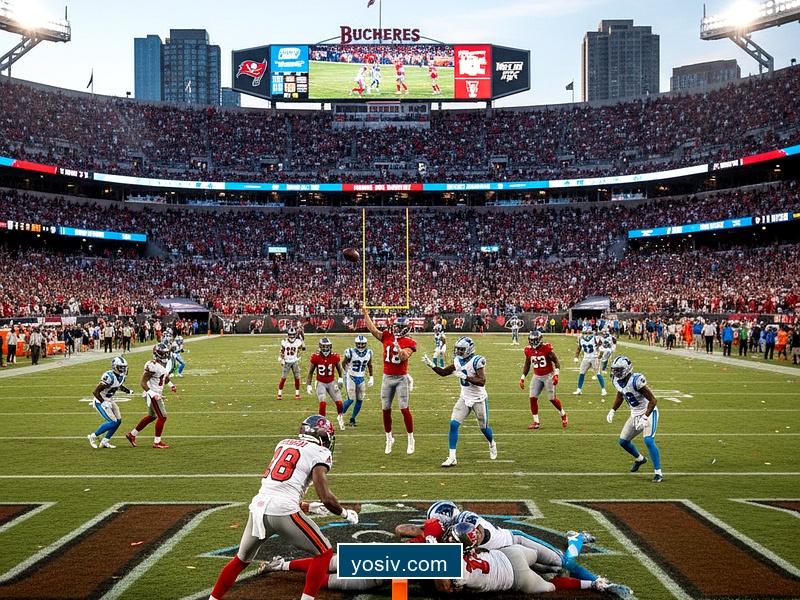
In the grand theater of the NFL, there are architects who build cathedrals and mechanics who keep the sedan running for one more pivotal week. Sunday’s clash between the Tampa Bay Buccaneers and the Carolina Panthers wasn't just a divisional scuffle; it was a collision of two diametrically opposed timelines. While the betting markets and prediction algorithms obsessed over spread coverage and injury reports, the real story lay in the sideline demeanor of Todd Bowles. The result—a validation of Tampa’s superiority—masks a deeper, more uncomfortable truth about the franchise’s direction. We are witnessing the apotheosis of "Competitive Retooling," a managerial philosophy that prioritizes the illusion of contention over the pain of genuine reconstruction.
The Bowles Paradox: Survival is Not Strategy
To understand the Buccaneers’ current trajectory, one must look past the box score and dissect the philosophy of Todd Bowles. Bowles is a defensive savant, a man whose understanding of zone blitz concepts and disguised coverages borders on the academic. However, as a head coach, he governs with a profound risk aversion that defines the modern Buccaneers. The victory over Carolina wasn't a step forward; it was a holding pattern.
Historically, defensive-minded head coaches fall into two categories: the Culture Builders (think Bill Belichick or Mike Tomlin) who impose an identity that transcends personnel, and the Schemers (think Vic Fangio or Wade Phillips) who elevate a unit but struggle to steer the ship. Bowles straddles this line precariously. His tenure in Tampa Bay, post-Bruce Arians, has been characterized by a refusal to bottom out. In a league designed to reward failure with high draft capital—the very mechanism Carolina is clumsily attempting to exploit—Bowles chooses the purgatory of the middle class.
"In the NFL, the worst place to live is 9-8. You aren't good enough to hoist the Lombardi, and you aren't bad enough to draft the savior. Todd Bowles has built a condominium in that neighborhood."
This approach relies heavily on veteran retention and stop-gap quarterback play. The resurrection of Baker Mayfield is a heartwarming narrative, but structurally, it reinforces Bowles’ philosophy: plug the leak, patch the hull, and pray the defense holds. It is sustainable only as long as the NFC South remains a crater of mediocrity. The moment the division elevates, the Bowles Doctrine collapses under the weight of its own ceiling.
Tactical Stasis vs. The Carolina Chaos
The contrast with the Panthers offers a stark relief. Carolina, under the erratic ownership of David Tepper and the fresh-faced optimism of Dave Canales, is in the throes of a violent exorcism. Canales, the former Bucs offensive coordinator, left Tampa to undertake a "Project" in the truest sense—stripping a franchise to the studs to rebuild around Bryce Young (or his eventual replacement). It is messy, ugly, and frequently embarrassing.
Yet, there is a theoretical upside to the Panthers’ chaos that Tampa lacks. Carolina is searching for a ceiling; Tampa is terrified of its floor. Tactically, Bowles’ game plan against Carolina highlighted this. His reliance on exotic simulated pressures—showing six rushers and dropping three—confused a young Panthers offensive line, as expected. But this is tactical candy, not nutritional sustenance. It wins games against inferior opponents but historically falters against elite processors like Patrick Mahomes or Jared Goff, who dissect the blitz with surgical indifference.
The data supports this stagnation. Since taking over, Bowles’ defenses have consistently ranked high in variance—dominating poor offenses while surrendering explosive plays to competent ones. This is the hallmark of a system dependent on chaos rather than structural integrity. When the opponent doesn't panic, the Bucs often fold.
The Mayfield Mirage
We cannot analyze the manager without analyzing his lieutenant on the field. Baker Mayfield is the perfect avatar for the Bowles era. He is gritty, emotional, and undeniably competent. He plays with a chip on his shoulder that mirrors Bowles’ defensive unit. But let’s be brutal about the long-term prospects here. The "Project" in Tampa isn't developing a franchise quarterback; it’s maximizing a bridge quarterback.
Comparing this to the philosophical approach of the Shanahan tree or the McVay disciples, who scheme open space to elevate efficiency, the Bucs operate on "hero ball" principles. Can Mike Evans win a contested catch? Can Mayfield escape a collapsing pocket? Can Antoine Winfield Jr. force a fumble? These are individual acts of brilliance, not systemic inevitabilities. A sustainable project creates easy wins; the Bowles philosophy makes every yard a street fight.
The Cost of "Winning Now"
The prediction models favoring Tampa Bay were correct, but they miss the existential cost of these victories. By refusing to tear down the roster after Tom Brady’s retirement, the Buccaneers have saddled themselves with an aging core and a salary cap situation that requires constant restructuring. This is "Kicking the Can" masquerading as competitive spirit.
Look at the roster composition. Lavonte David is a legend, but he is in the twilight. Mike Evans is a Hall of Famer, but wide receivers age like milk once they hit 31. By squeezing every last drop out of this veteran lemon, Bowles ensures that the eventual crash, when it comes, will be absolute. There is no soft landing in the NFL for teams that refuse to refresh.
Verdict: The Ceiling is Concrete
So, is the result sustainable? If sustainability is defined as hovering around .500 and hosting a Wild Card game you likely lose, then yes. Todd Bowles has mastered the art of being "good enough." But in a league governed by the salary cap and draft parity, "good enough" is a death sentence for championship aspirations.
Dave Canales and the Panthers may be the laughingstock of the moment, wandering through the desert of a rebuild. But they are walking toward something—a potential oasis of new identity. Todd Bowles and the Buccaneers are walking on a treadmill. They are sweating, they are working hard, and they are executing the game plan. But when the season ends, they will find themselves exactly where they started: too good to rebuild, too flawed to conquer.
Victories against the Panthers are mandatory for job security, but they are deceptive. They validate a process that has no endgame. The Buccaneers aren't building a project; they are maintaining a façade.