
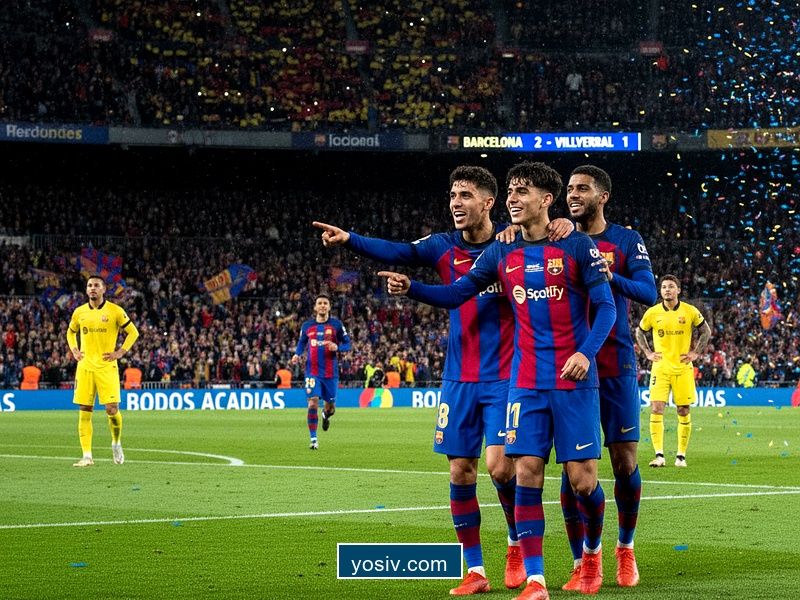
There is a distinct difference between winning a football match and tactically eviscerating an opponent. What we witnessed at the Estadio de la Cerámica was not merely Barcelona collecting three points; it was a manifesto of Hansi Flick’s "Vertical Tiki-Taka," a system that demands a level of physical and cognitive exhaustion that few squads can sustain. The headlines will laud Raphinha and Lamine Yamal for the goals, but as a scout, my eyes were drawn elsewhere. The scoreboard captures the event; the body language and off-ball mechanics explain the cause.
To understand why this 5-1 demolition happened, we must ignore the ball for a moment and look at the spaces between the players. Villarreal, managed by the astute Marcelino, usually sets up a rigid 4-4-2 mid-block designed to suffocate central channels. Against Xavi’s Barcelona, this often resulted in sterile possession—the infamous "horseshoe" passing map. Under Flick, the geometry has changed. The movement is no longer horizontal; it is violently vertical.
Raphinha: The Art of the Blindside Run
Raphinha’s evolution from a touchline-hugging winger to a half-space assassin is the single greatest coaching triumph of this season. In the past, the Brazilian relied on receiving the ball to feet and driving inward. Yesterday, his damage was done before the pass was even struck.
Watch the replay of his first goal. Freeze the frame three seconds prior. Raphinha is not looking at the ball carrier; he is scanning the hips of the Villarreal center-backs. This is elite "scanning frequency"—a metric top scouts prioritize. He identified that Logan Costa’s body weight was shifted onto his heels. Raphinha’s movement is a classic "double movement"—a check towards the ball to drag the defender out of the defensive line, followed immediately by a spin into the space created behind.
"Most wingers want the ball to beat a man. Raphinha has learned that movement beats the man, and the ball is merely the reward."
This is what we call "gravity" in scouting. Raphinha’s relentless sprinting in the transition phase forces the opposition defensive line to drop five yards deeper. That retreat opens the "Zone 14" (the space just outside the penalty box) for the midfielders. Even when Raphinha doesn't receive the ball, his aerobic capacity to make thirty high-intensity sprints per game is the catalyst for the entire offensive structure.
Lamine Yamal: Biomechanics of a Generational Talent
If Raphinha is the engine, Lamine Yamal is the lubricant that prevents the machine from seizing. It is frankly terrifying to analyze the biomechanics of a 17-year-old who understands La Pausa better than veterans with 400 caps.
The standout technical detail from this match wasn't his goal, but his reception mechanics. When receiving under pressure from the Villarreal fullback, Yamal rarely stops the ball dead. He uses a "rolling receive," allowing the ball to run across his body. This subtle detail forces the defender to commit to a tackle or back off.
Focus on his hips. Most wingers telegraph their intent by pointing their hips in the direction they wish to explode. Yamal possesses a deceptive pelvic rotation—he points his hips inside, freezing the defender, only to articulate his ankle and take the ball down the line. It is a neurological nightmare for a defender because the visual cues do not match the physical outcome. His assist for Raphinha—a trivela (outside of the boot) pass—wasn't showboating; it was the most efficient solution to the physics problem presented by the defensive block. It minimized the back-lift time, denying the defender the milliseconds needed to block the lane.
The High Line: A Calculated Suicide Pact
We cannot discuss this victory without addressing the elephant in the room: the sheer audacity of Barcelona’s defensive line. In coaching terminology, we call this "compressing the pitch." By keeping the back four nearly on the halfway line, Barcelona reduces the effective playing area to a 30-meter strip.
This requires a specific athletic profile for the center-backs. They must be comfortable defending big spaces with their backs to the goal. In the first half, Villarreal threatened to exploit this. There were moments of genuine terror where the timing of the offside trap—the synchronized step-up—was milliseconds away from disaster. This is the trade-off of the Flick system. It maximizes turnovers in the opposition half (high pressing efficiency) but leaves the team vulnerable to the simple long ball.
| Tactical Metric | Xavi's Barça (23/24 Avg) | Flick's Barça (vs Villarreal) |
|---|---|---|
| Defensive Line Height | 42.5m from own goal | 51.2m from own goal |
| Possession Purpose | Control/Rest | Vertical Penetration |
| Pressing Trigger | Loose touch | Goalkeeper/CB split |
Against Villarreal, the coordination of the offside trap was practically telepathic in the second half. This isn't luck; it's repetition. It’s the result of hours of "shadow play" on the training ground, where the back four move as a single unit tied together by an invisible rope.
The Pedri-Torre Axis: The Unseen Facilitators
While the forwards take the glory, the structural integrity of the team was maintained by the midfield. With injuries ravaging the squad, the adaptability of Pablo Torre and the command of Pedri were vital. We saw a shift from the traditional 4-3-3 to a fluid 4-2-3-1 hybrid.
Pedri’s role has shifted. He is no longer just a creator; he is a volume tackler. His "defensive duel" success rate has skyrocketed. He understands that in a vertical system, the ball will be lost more frequently. Therefore, the counter-press (Gegenpressing) must be immediate. Pedri’s first step after losing possession is always forward, choking the opponent before they can transition. This "rest defense"—the positioning of players while in possession to prepare for the inevitable turnover—was immaculate at La Cerámica.
The Verdict: Sustainable Intensity?
The skepticism surrounding this Barcelona team is usually focused on depth and fitness. Can they maintain this intensity? Watching Raphinha sprint 60 yards in the 85th minute to track a runner suggests that the conditioning regime has been completely overhauled. There is a Teutonic ruthlessness to their fitness levels now that was absent in previous years.
Villarreal is not a soft touch. They are a European-caliber side playing at home. To dismantle them with such kinetic violence sends a message not just to Madrid, but to Europe. The brilliance wasn't just in the goals of Yamal and Raphinha; it was in the spaces they created, the runs they made when they knew they wouldn't get the ball, and the psychological crushing of an opponent that realized, by the 60th minute, they were fighting a losing battle against geometry and physics.
This performance wasn't perfect—the defensive high wire act will eventually cause heart attacks—but it was undeniably elite. It signaled the death of sterile possession and the rebirth of killer instinct.