
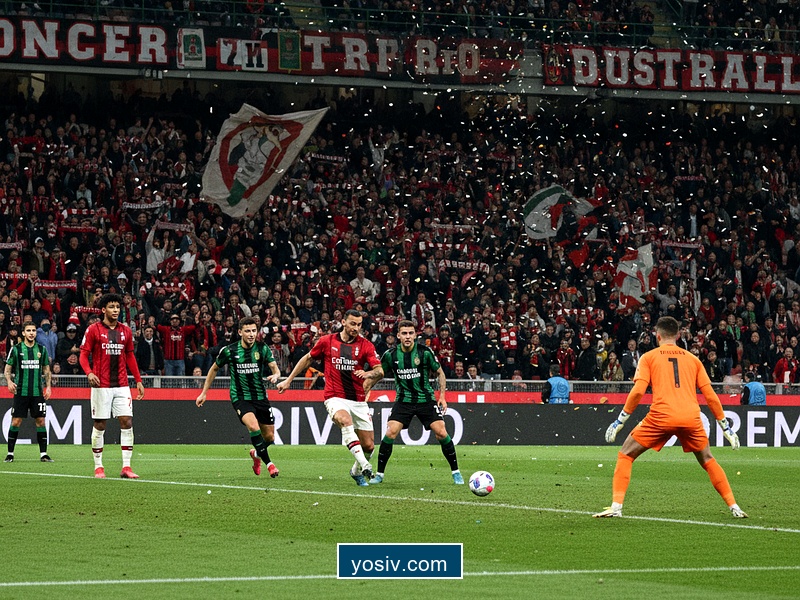
There is a specific silence that descends upon the San Siro when the faithful realize their team isn't just losing, but capitulating. It isn't the angry roar of injustice; it is the hush of collective embarrassment. Following AC Milan’s catastrophic dismantling by Sassuolo—a team currently residing in Serie B—we witnessed not just a defeat, but a forensic exposure of structural rot within Paulo Fonseca’s tactical framework.
To the casual observer, a 6-1 scoreline reads as a freak accident. To the trained scout’s eye, however, this result has been in the mail for months. It was the inevitable consequence of a system that demands intensity from players who are currently exhibiting the body language of passengers waiting for a connecting flight.
The Physiology of Apathy: Decoding the Non-Verbal
Professional scouting is 20% watching what a player does with the ball and 80% watching what they do the moment they lose it. In this fixture, Milan’s "negative transition" (the three seconds immediately following a turnover) was nonexistent.
Watch the footage of Sassuolo’s second and third goals. Focus exclusively on Rafael Leão and Tijjani Reijnders. When possession is lost, there is a physiological "tell" common in disjointed squads: the immediate dropping of the shoulders followed by a deceleration to a walking pace. In coaching terms, this is a failure of "mental reset."
Instead of an immediate counter-press—collapsing the space to suffocate the ball carrier—Milan’s midfield pivot stood upright, flat-footed, scanning not for the opponent, but for a teammate to blame. This is the unseen work that defines champions. When your double pivot fails to screen the backline because they are visually protesting a foul that wasn't given, you destroy the team's defensive integrity. Milan didn't just lose tactical battles; they lost the physiological war of reaction time.
Rest Defense and the Myth of the 4-2-3-1
Tactically, Fonseca’s setup was borderline suicidal against a team like Sassuolo, who, under Fabio Grosso, have mastered the art of vertical compactness. Milan ostensibly set up in a 4-2-3-1, but in possession, this morphed into a reckless 2-4-4. Both fullbacks, particularly Theo Hernandez, inverted or overlapped simultaneously, leaving the two center-backs isolated on an island spanning 50 meters of lateral space.
This is a violation of the fundamental principle of Restverteidigung (rest defense). A top-tier side always maintains a structure behind the ball while attacking to prevent exactly what Sassuolo did. Sassuolo’s Armand Laurienté and Nicholas Pierini didn't need to be brilliant; they just needed to be fast. They identified the "half-spaces"—the channels between Milan’s center-backs and the absent fullbacks—and exploited them with ruthless efficiency.
Grosso instructed his side to bypass the midfield press entirely. Sassuolo’s pass map shows a distinct lack of horizontal circulation. They played vertical, line-breaking passes directly into the feet of Samuele Mulattieri, who acted as a perfect wall-pass tactician, bouncing the ball into the path of onrushing runners. Milan’s center-backs were consistently caught in a "split focus" dilemma: step up to engage Mulattieri and leave space behind, or drop off and allow him to turn. They did neither effectively.
The Geometric superiority of the Underdog
Let’s strip away the "shock" narrative and look at the geometry. Sassuolo played a 4-5-1 out of possession that compressed the pitch to a length of 25 meters. This low block frustrated Milan, forcing them into "U-shape" circulation—passing endlessly from sideline to sideline without penetrating the central corridor.
The brilliance of Sassuolo’s performance was in the cover shadow. Their midfielders, particularly Kristian Thorstvedt, positioned themselves not to tackle, but to block the passing lanes to Milan’s creative hubs. By cutting off the supply line to Pulisic and Loftus-Cheek, they forced Milan’s center-backs to attempt risky, progressive passes. Every time Milan forced a pass through the center, Sassuolo’s "trap" snapped shut. Interception, vertical release, goal. It was clockwork.
Historical Echoes: The Ghost of the Banter Era
We must contextualize this within the broader history of Calcio. This performance bore a haunting resemblance to the Milan of the mid-2010s "Banter Era"—a collection of expensive individuals devoid of a collective soul. However, the tactical context is different. In 2015, Milan lacked quality. In 2025, they lack cohesion.
Comparing this to Arrigo Sacchi’s Milan is unfair, but compare it even to Stefano Pioli’s Scudetto-winning side. Pioli’s system relied on aggressive man-marking and high-intensity duels. If a player was beaten, a teammate was tracking the runner. Fonseca’s zonal system requires communication and spatial awareness, two attributes that were entirely absent against Sassuolo.
Furthermore, the data is damning. Sassuolo generated an Expected Goals (xG) figure that eclipsed their season average in Serie B. Allowing a second-division side to generate over 3.0 xG at the San Siro is not a bad day at the office; it is a resignation letter.
The Unseen Failure: Scanning and Orientation
The most alarming aspect for any scout watching this match was the poor "scanning" frequency of Milan’s back line. Scanning is the act of checking one’s shoulder to assess threats before receiving the ball or during defensive transitions.
On the fourth goal, observe the Milan center-back pairing. For six seconds during the build-up, neither defender checked their blind side. They were ball-watching, mesmerized by the carrier, completely oblivious to the runner peeling off the back shoulder. In elite academies, this behavior is corrected at the U-15 level. To see it in a Champions League-level squad suggests a training ground culture that prioritizes rondos and possession drills over the gritty, unglamorous mechanics of defensive awareness.
The Verdict
Sassuolo deserves immense credit for executing a perfect game plan, but let us be clear: they were aided by a host that laid down their arms. Fabio Grosso exposed that Milan is currently a team of moments, not a team of structure. When the individual brilliance of Leão or Pulisic fails to produce a miracle, there is no tactical floor to catch them.
This match was not an anomaly; it was a diagnostic image of a team with a broken spine. Unless Fonseca can instill the discipline of Restverteidigung and demand a physiological reset from his stars in transition, the San Siro will see more nights where the silence speaks louder than any whistle.