
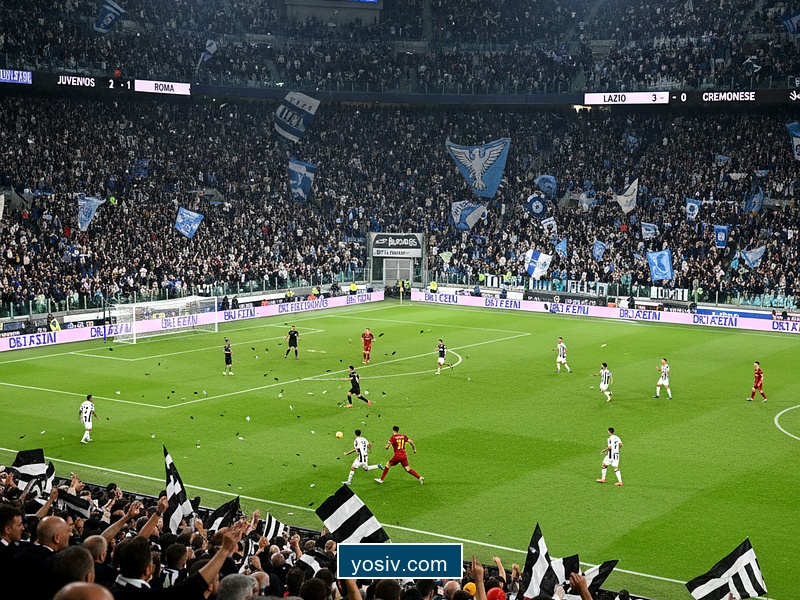
The scoreboard is often a liar. It tells you who got lucky with a deflection, who paid off the referee (a historical sensitivity in Turin, certainly), or who capitalized on a moment of individual brilliance. But in the clash between Juventus and Roma, and the peripheral noise of Lazio’s engagement with Cremonese, the numbers displayed at the final whistle are secondary. What we witnessed was not a mere accumulation of points, but a collision of conflicting timelines.
For twenty years, I have watched Serie A struggle between the romanticism of the bellezza and the cynicism of the result. Juventus, under the previous regime of Massimiliano Allegri, was the ultimate altar to cynicism. If they won 1-0 playing horrific football, it was hailed as a tactical masterclass. That era is dead. What Thiago Motta is attempting to construct at the Allianz Stadium is not just a tactical shift; it is an institutional exorcism.
The De-Allegri-fication of Turin
To understand the gravity of this Juventus project, one must look beyond the 90 minutes against Roma. We are witnessing the dismantling of the "Corto Muso" (winning by a nose) philosophy that plagued this club for years. Motta represents the most radical philosophical pivot in Italian football since Arrigo Sacchi arrived at Milan in the late 80s.
Critics focus on Motta’s proclaimed "2-7-2" formation, often dismissing it as numerological nonsense. They miss the point. Motta’s system isn't about where players stand at kickoff; it is about cognitive load. In his system, the pitch is read vertically, not horizontally. The goalkeeper is not a stopper; he is the first midfielder. The wings are not boundaries; they are corridors of interaction.
"The risk Motta takes is high. He is asking center-backs to possess the passing range of a regista and the spatial awareness of a winger. This is total football played on a jagged edge."
Against a team like Roma, this approach exposes the fundamental difference in squad architecture. Juventus is building a machine where the system elevates the individual. When Teun Koopmeiners or Khéphren Thuram step onto the field, they are cogs in a fluid, rotating engine. The result is sustainable because it relies on geometry, not adrenaline. Even if the scoreline against Roma was tight, the control metrics—field tilt, progressive passes, defensive line height—suggest that Juventus is playing a different sport than they were six months ago.
Roma and the Cult of Personality
Turn your gaze to the capital, and you see the inverse. Roma is a club perpetually trapped in a cycle of emotional volatility. Whether it is the ghost of Mourinho or the earnest passion of De Rossi (and the subsequent managerial turbulence), the Giallorossi project remains frighteningly fragile. The Friedkin ownership group has poured millions into the squad, yet the recruitment strategy feels like a fantasy football draft conducted by an algorithm with a personality disorder.
The reliance on individual saviors—first Lukaku, then Dybala, then Dovbyk—betrays a lack of structural identity. In this match, Roma looked like eleven talented mercenaries trying to solve a puzzle individually, whereas Juventus looked like a hive mind. The issue for Roma isn't the manager of the month; it's the absence of a Cristiano Giuntoli figure.
Giuntoli, the architect of Napoli’s Scudetto and now Juve’s Sporting Director, has aligned the recruitment perfectly with Motta’s demands. He sold the "stars" who didn't run (Chiesa) to fund the workers who do (Nico Gonzalez, Koopmeiners). Roma, conversely, is still buying names to sell shirts, hoping the tactical cohesion will magically manifest in the tunnel.
Lazio’s Quiet Pragmatism vs. The Cremonese Test
While the heavyweights traded blows, Lazio’s fixture against Cremonese offers a different lesson in sustainability. Under Marco Baroni, Lazio has become the antithesis of the "Sarriball" dogma that defined their recent past. Baroni is a pragmatist. He does not ask for philosophical purity; he asks for verticality and efficiency.
The juxtaposition is stark. While Motta is re-educating Juventus in high-concept positional play, Baroni is stripping Lazio down to the basics of transition football. Against a side like Cremonese—a lower-tier opponent that demands you break down a low block—the "Baroni method" faces its true audit. It is easy to counter-attack against giants; it is much harder to create against minnows without a complex system.
However, Lazio’s project feels capped. Claudio Lotito’s frugal management style ensures financial health but imposes a glass ceiling on sporting ambition. They will never implode like Roma, but they are unlikely to explode into dominance like Juventus might. They are the safe stock in a volatile market.
The Next Gen Pipeline: The Hidden Variable
The most terrifying aspect of the Juventus project for the rest of Serie A isn't the first team; it's the "Next Gen" squad (their U23s in Serie C). This is the secret weapon that makes the Motta experiment sustainable long-term.
Italian football is notoriously geriatric. We treat 23-year-olds as "young prospects" while Lamine Yamal conquers Europe at 16. Juventus is the only Italian club fully utilizing a B-team to bypass the disastrous loan system. Players like Nicolò Savona and Kenan Yildiz didn't just appear; they were manufactured in house to fit a specific tactical profile.
| Club | Youth Strategy | Outcome |
|---|---|---|
| Juventus | In-house B-Team (Serie C) | Tactical readiness, zero loan fees, instant impact. |
| Roma/Lazio | Primavera to Loans | Developmental stagnation, tactical disconnect. |
When Motta needs to rotate, he isn't dipping into a pool of disgruntled veterans; he is pulling up hungry, tactically indoctrinated youth players who have been playing his style in the lower divisions. This insulates the project from injuries and fatigue in a way Roma simply cannot match.
The Verdict: Evolution vs. Stagnation
We must stop analyzing these matches through the lens of who scored more goals on a Sunday night. That is short-termism, a disease that has killed the competitiveness of Serie A in Europe for a decade.
Thiago Motta’s Juventus is a volatile compound. There will be matches where the system fails, where the high line is exploited, and the passing out from the back leads to calamitous errors. But it is a movement toward modernity. It is a rejection of the idea that Italian teams must suffer to win.
Roma and Lazio represent the old way: relying on emotion, individual brilliance, or rigid pragmatism. Juventus has chosen the path of structural evolution. The points dropped or gained this weekend are statistical noise. The signal is clear: Juventus is building a dynasty based on a philosophy, while their rivals are still trying to build a starting eleven.