
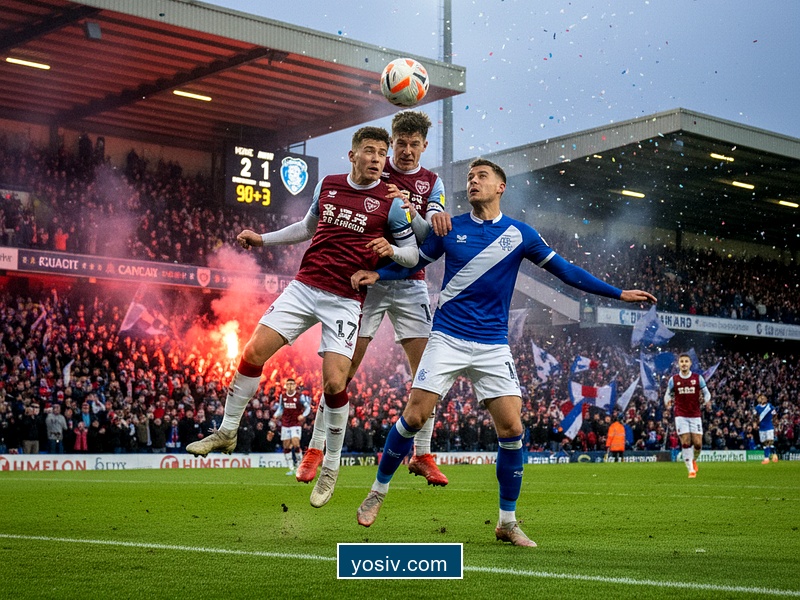
The scoreboard at Tynecastle read 2-1, but the story wasn't written in the goals. It was written in the hips of the Rangers center-halves and the scanning frequency of Lawrence Shankland. As a scout, you learn early on that the ball is a liar. It draws the eye, distracts the fan, and hides the real game being played in the pockets of empty grass. What transpired in Edinburgh wasn't just a defeat for the Ibrox side; it was a systemic failure of spatial management against a Hearts side that has finally learned how to weaponize their own claustrophobic architecture.
To understand why Rangers dropped three critical points in this title race, we have to look past the highlights package. We need to dissect the 'unseen' game: the body language in transition, the failure of the Restverteidigung (rest defense), and the predatory intelligence of a striker who plays the game at a different frame rate than his markers.
The Shankland Gravity Well
Lawrence Shankland does not fit the profile of the modern elite athlete. He doesn't possess blistering pace, and his aerial leap is functional rather than Olympic. Yet, his performance against Rangers was a masterclass in what scouts call "manipulative movement."
Throughout the first half, Shankland engaged in a subtle psychological war with the Rangers backline. Watch the tape from the 15th to the 20th minute. He stopped checking to the ball. Instead, he began drifting into the "blind side"—positioning himself precisely off the shoulder of the defender furthest from the ball. This is a nightmare for defenders. To see Shankland, they have to turn their heads away from play. To watch the play, they have to lose Shankland.
"The best strikers don't just occupy space; they occupy the defender's amygdala. Shankland created a state of constant cognitive load for the Rangers defense, forcing them to scan twice as often, slowing their reaction times by split seconds."
When the first goal came, it was a direct result of this pinning mechanic. Shankland used his body not as a battering ram, but as a fulcrum. He leans into the defender, waits for the physical resistance, and then spins off the contact. It’s a judo move, not a football one. The Rangers defense was guilty of "ball-watching"—a cardinal sin at this level. Their hips were square to the midfield, leaving them completely unable to turn and sprint when the vertical pass broke the line. This isn't just bad luck; it's a failure of defensive stance coaching.
The Collapse of Rangers' Rest Defense
The most damning aspect of Rangers' performance was their structural shape while in possession. In modern coaching theory, your attack is only as good as your "rest defense"—the structure you maintain to prevent counter-attacks before you even lose the ball. Rangers were structurally suicidal.
Whenever Rangers pushed their full-backs high into the final third to overload the wide areas—a standard tactic to break down a low block—their double pivot failed to screen the central channel. The distance between the Rangers midfield line and their defensive line (vertical compactness) stretched to 35-40 yards. In the Scottish Premiership, where the transition game is governed by chaos and second balls, that gap is a killing floor.
Hearts recognized this trigger immediately. Upon winning possession, their first look wasn't wide; it was vertical, straight into that vacated central pocket. A scout looking at the Rangers midfield could see the fatigue not in their legs, but in their recovery runs. There were moments of "fake pressing"—running towards the opponent without the genuine intent to win the ball, purely to look busy. That is a tell-tale sign of a team that has lost belief in the tactical plan.
Tynecastle’s Unique Geometry
We cannot ignore the venue. Tynecastle Park is unique in British football due to the steep gradient of the stands relative to the touchline. This creates a phenomenon known as "peripheral compression." For away players, the wall of noise and visual clutter feels physically closer, narrowing their field of vision.
Historically, Rangers teams of the Graeme Souness or Walter Smith eras dealt with this through arrogance and physical dominance. They slowed the game down. This current iteration, however, played right into the frantic rhythm the crowd demanded. When the score went 2-1, look at the somatic responses of the Rangers players. Shoulders slumped, heads dropped, and communication—pointing, shouting, organizing—ceased entirely. They went internal.
In high-performance psychology, this is known as "cortical inhibition." The pressure overrides the logical brain, and players revert to instinct. Unfortunately for Rangers, their instinct was to retreat rather than engage. They stopped compressing the pitch. They allowed Hearts to breathe.
The Historical Echo
This result is not an anomaly; it is part of a shifting trend in the SPL's "best of the rest" dynamic. For years, the gap between the Old Firm and the rest was defined by finance and fitness. Today, the gap is closing through tactical periodization. Hearts are no longer trying to out-fight Rangers; they are out-thinking them in transition.
Comparing this to the George Burley era at Hearts in 2005-06, that team relied on international quality (Fyssas, Skacel, Hartley). This current Hearts side relies on system efficiency. They understand that Rangers struggle against a mid-block that aggressively presses triggers in the half-spaces. It is a blueprint that Kilmarnock and Aberdeen have flirted with, but Hearts have executed with surgical precision.
The Unseen Work Off the Ball
Finally, credit must go to the Hearts midfield engine room for their "shadow cover." A specific detail that won’t show up on Opta stats: note how the Hearts midfielders positioned themselves to cut off passing lanes to the Rangers’ number 10. They didn't man-mark; they "zone-marked" the passing lanes.
This forced Rangers to cycle the ball wide, into the "U-shape" of death—useless possession around the perimeter of the defense without penetration. It is the most sterile form of dominance. Rangers had the ball, but Hearts had the control.
If this result tightens the grip on the top spot for Hearts—or merely dents Rangers' title hopes—it will be remembered as the day Tynecastle exposed a fragility in the Ibrox psyche. You can coach tactics, you can buy talent, but you cannot buy the courage to keep your head up and your hips open when 20,000 Jambos are screaming for your blood. Rangers failed the scout's eye test, not because they lacked skill, but because they lacked the geometric discipline to survive the chaos.