
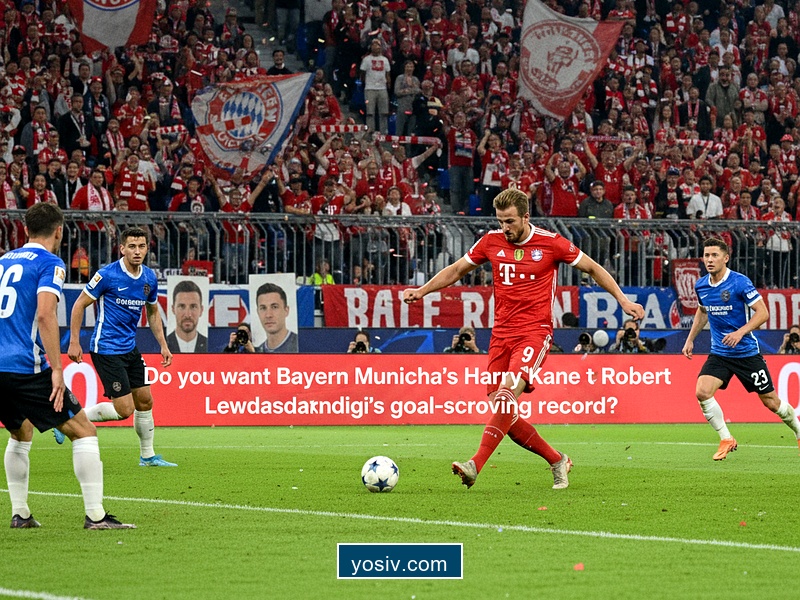
There is a specific kind of melancholy that accompanies the modernization of football, a sense that the sport is moving from the realm of the mythical to the mathematical. As we watch Harry Kane dissect Bundesliga defenses with the cold precision of a Boston Dynamics robot, a question circles the beer halls of Munich: Do we actually want him to shatter Robert Lewandowski’s 41-goal record?
The immediate, dopamine-fueled answer is yes. Records are made to be broken. But the romantics among us, those who remember the blood-and-thunder Bundesliga of the mid-2000s, should pause. If Kane erases Lewandowski’s mark—a record set merely four years ago, which itself took nearly half a century to wrestle away from Gerd Müller—it doesn't just elevate the Englishman. It devalues the currency of the goal itself.
The Phantom vs. The Playmaker
To understand the gravity of what Kane is attempting, we must look back twenty years. In the summer of 2003, Bayern Munich signed Roy Makaay from Deportivo La Coruña. "The Phantom," as he was christened, was the gold standard of striking in that era. He didn't touch the ball often, but when he did, the net rippled.
Makaay scored 23 goals in his debut season and 22 the next. These were considered Herculean numbers. The Bundesliga of the early 2000s was a tactical wasteland compared to today’s hyper-optimized pressing structures. It was a league of attrition, where defenders like Lucio and Valérien Ismaël engaged in physical warfare. Strikers didn't get five clear-cut chances per half; they got one, usually from a hopeful cross or a defensive error.
Comparing Kane’s environment to the one inhabited by Makaay or even Luca Toni (who won the Torjägerkanone with 24 goals in 2007/08) reveals the inflation of modern statistics. Kane is the spearhead of a system designed to manufacture Expected Goals (xG) at an industrial scale. Makaay and Toni were solitary hunters; Kane is the CEO of a goal-scoring corporation.
"Watching Luca Toni play was like watching a man try to carry a sofa up a flight of stairs by himself—awkward, heavy, but eventually, the job got done. Watching Kane is like watching a furniture lift. Efficient? Yes. But where is the struggle?"
The Sanctity of the Chase
When Robert Lewandowski scored his 41st goal in the 90th minute against Augsburg in May 2021, it felt like a seismic event. He had missed games due to injury. He was chasing a ghost—Der Bomber, Gerd Müller—whose 40-goal record from 1971/72 stood as the unbreakable monolith of German football. For 49 years, world-class strikers like Karl-Heinz Rummenigge, Jupp Heynckes, and Claudio Pizarro broke themselves against that wall and failed.
Lewandowski breaking it required a perfect storm: a team playing at the peak of Hansi Flick’s sextuple-winning powers, and a striker possessing a singular obsession. It felt earned because it took five decades. If Harry Kane walks in from North London and smashes that record within two or three seasons, it suggests that the Bundesliga has become too pliable, too subservient to the super-club dynamic.
Tactical Evolution: The Death of the Traditional 9
The argument for Kane involves his hybrid nature. He is not just a scorer; he is the evolution of the "False 9" and the "Target Man" combined. But this tactical versatility actually makes the goal-scoring record less romantic.
Consider the creative engines of the past. In 2010, Mario Gomez relied on the sheer individual brilliance of Franck Ribéry and Arjen Robben. "Robbery" were inverted wingers who looked to shoot first and pass second. Gomez cleaned up the scraps. He scored 28 goals in 2010/11 largely by positioning himself where the chaos occurred.
Today, with Jamal Musiala, Leroy Sané, and Michael Olise surrounding him, Kane operates in a "service industry" economy. The wingers today are coached to cut back, to recycle, to optimize the angle. The ball finds Kane not by accident, but by algorithm.
Statistical Context: The Inflation of the Striker
The table below illustrates the shifting baseline of what constitutes a "world-class" season in Munich over the last two decades.
| Striker | Season | League Goals | Games Played | Goals Per Game | Tactical Era |
|---|---|---|---|---|---|
| Roy Makaay | 2003/04 | 23 | 32 | 0.72 | Hitzfeld (Rigid/Direct) |
| Luca Toni | 2007/08 | 24 | 31 | 0.77 | Hitzfeld 2.0 (Target Man Focus) |
| Mario Gomez | 2010/11 | 28 | 32 | 0.88 | Van Gaal (Possession) |
| R. Lewandowski | 2020/21 | 41 | 29 | 1.41 | Flick (High Press/Vertical) |
| Harry Kane | Current Era | -- | -- | 1.0+ (Proj) | Modern Fluidity |
The Shadow of the Mercenary
There is also the matter of narrative. Lewandowski spent eight years at Bayern Munich. He arrived on a free transfer from rivals Dortmund, endured the Pep Guardiola tactical experiments, and grew into the captain-without-an-armband. His record was the culmination of a decade-long love affair with the league.
Kane’s arrival, while celebrated, is transactional. He is here for trophies. He is here because Tottenham could not deliver silverware. If he breaks the most hallowed individual record in German football history as a tourist, it feels hollow. It’s akin to Kevin Keegan winning the Ballon d'Or at Hamburg—immensely impressive, yet somehow detached from the soil of the league.
We saw a similar phenomenon in Italy when Cristiano Ronaldo joined Juventus. He scored goals, yes. But did he embody the spirit of Calcio like Batistuta or Del Piero? No. He was a luxury import performing a service. Kane risks becoming the same: a statistical anomaly rather than a Bavarian legend.
Let the Record Breathe
We need records to stand long enough to accrue moss. They need to age. The fact that Müller’s 40 goals stood for 49 years gave it a mythical weight. Every season that passed where a striker hit 30 and failed added to the legend. Lewandowski’s 41 is barely three years old. It hasn't had time to settle into the history books.
If the Bundesliga becomes a league where the top striker routinely hits 40 goals because the disparity between Bayern and the rest (Leverkusen’s miraculous run notwithstanding) is so vast, then the number 41 loses its magic. It becomes just another integer in a spreadsheet.
Harry Kane should win the title. He should win the Golden Boot. He should perhaps finally break his personal trophy curse. But for the sake of history, for the sake of the struggle that Makaay, Elber, and Pizarro endured, let Lewandowski’s 41 remain the peak. We don't need a new Everest every three years.