
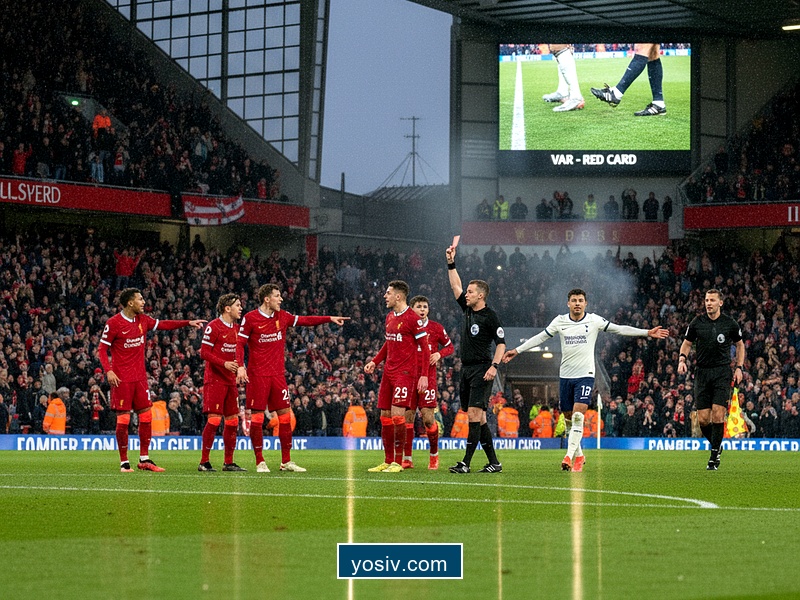
We need to stop talking about technology and start talking about biomechanics. As a scout who has spent two decades analyzing the micro-movements of elite athletes—tracking hip swivels, plant-foot stability, and eccentric muscle loading—the officiating disaster between Tottenham and Liverpool wasn't just a communication breakdown. It was a fundamental failure to understand the physics of the human body in motion.
When we freeze-frame a tackle or draw lines on a screen, we strip the game of its essential kinetic context. The controversy surrounding the Curtis Jones red card and the Luis Díaz disallowed goal reveals a terrifying truth: the people adjudicating the Premier League do not understand the bio-dynamics of the sport they govern. They are judging static anatomy in a fluid ecosystem.
The Kinetic Chain of the Curtis Jones Tackle
Let’s dissect the dismissal of Curtis Jones. If you look at the still image, as referee Simon Hooper was instructed to do by the VAR monitor, it looks grotesque. The studs are high; the contact is above the ankle. A clear red card in a vacuum. But football is not played in a vacuum, and scouting reports don't rely on photos.
When you analyze the video in real-time, Jones engages the ball with the outside of his boot. This is a crucial distinction. In coaching terms, he is attempting to "pinch" the ball against the turf to shield possession. However, the ball is spherical. When force is applied to the top quadrant of a sphere, the object rotates, and the foot naturally rolls over the curvature.
"The mechanic of the foot rolling over the ball is a physics inevitability, not a malicious choice. By freezing the frame at the point of contact with Yves Bissouma's shin, VAR ignores the initial vector of the challenge."
From a scouting perspective, we look for "intent in the plant leg." Was Jones’s standing leg locked, transferring all his body weight into the impact? No. His center of mass was shifting backward, away from the collision. His ankle was in a state of plantar flexion (toes pointed down) attempting to hook the ball, not dorsiflexion (toes up, heel driven), which is the hallmark of a leg-breaking stomp.
The officials failed to distinguish between a "forceful impact" and a "deflected mechanism." By stripping the play of its velocity and momentum, they criminalized a biological accident. This obsession with the point of contact, rather than the movement pattern leading to it, is creating a league where players are punished for the laws of physics.
The Diaz Offside: A Failure of Proprioception
The Luis Díaz incident is more than a failure of protocol; it is an insult to the art of the striker. When scouting forwards, we look for "trigger movements"—the split-second unweighting of the feet just before a defender steps up. Díaz timed his run against the Spurs high line with surgical precision.
The PGMOL admitted a "significant human error," but let’s look at the geometry. Micky van de Ven’s body shape was compromised; his hips were open, attempting to recover depth. Cristian Romero was flat-footed. Díaz, conversely, was leaning into his acceleration phase. The naked eye of a linesman usually catches this because of the stark contrast in momentum vectors. The striker is exploding; the defender is stalling.
| Element | Spurs Defensive Setup | Liverpool Trigger | Officiating Failure |
|---|---|---|---|
| Body Shape | Square hips, reactionary stance | Loaded quads, forward lean | ignored dynamic positioning |
| Visual Cue | Step-up trap | Blindside run initiation | Failed to verify visual evidence |
| Outcome | Broken defensive line | Valid goal execution | Broken reward mechanism |
The failure here was audial and procedural, yes, but it stemmed from a lack of "game feel." The VAR operators, Darren England and Dan Cook, were so detached from the rhythm of the match that they confirmed a goal simply by saying "check complete," failing to realize the on-field decision was disallowed. This isn't just incompetence; it's a cognitive disconnect. They aren't watching a football match; they are processing data points like accountants, missing the flow of the narrative entirely.
The Tactical Fallout: Managing the Negative Transition
The unseen consequence of these decisions is the destruction of tactical integrity. Liverpool was forced into a 5-3-0 low block, a formation usually reserved for relegation candidates clinging to a point, not one of Europe's pressing elites. Jurgen Klopp’s "heavy metal football" relies on synchronized pressing triggers. When you remove two players (Jones and later Diogo Jota), you don't just lose bodies; you lose the capacity to cover passing lanes.
We must analyze the biomechanics of fatigue in this context. Joël Matip’s own goal in the dying seconds was a direct result of neural fatigue. When the brain is overworked by the immense concentration required to defend with nine men for 20 minutes, motor control degrades. Matip’s reaction time to the Pedro Porro cross was milliseconds slower than his standard baseline. His body shape was reactive rather than proactive. He was trying to adjust his feet while exhausted, leading to a clumsy kinetic firing pattern that sliced the ball into his own net.
Historically, this mirrors the defensive rigidity required by Arrigo Sacchi’s AC Milan, who mastered the art of "shadow play"—moving as a cohesive unit without the ball. Liverpool executed this nearly perfectly, but the physiological load placed on the players by the officiating errors made the final structural collapse inevitable. You cannot cheat energy systems forever.
The Protocol of Panic
The release of the audio form the VAR room exposes a terrifying lack of professionalism. We hear panic. We hear swearing. We hear operators who sound like they are defusing a bomb rather than reviewing a game. In elite coaching, we preach "calm eyes." A quarterback scanning the field, a center-back watching the play develop—they must remain detached to process information accurately.
The officials displayed "tunnel vision," a sympathetic nervous system response to stress where peripheral awareness vanishes. They focused so hard on the specific process of drawing lines or checking frames that they lost the macro-context: What did the referee actually call?
This is the same psychological phenomenon we see in rookie goalkeepers who freeze when a striker breaks the line. The PGMOL has officials who are technically trained but temperamentally unfit for the speed of the modern game. They are officiating by flowchart, not by feel.
The Scouting Verdict
Football is a game of angles, momentum, and controlled aggression. By legislating the game through slow-motion replays, we are creating a version of the sport that is biomechanically impossible to play. Players cannot stop their momentum in mid-air. They cannot dissolve their skeletal structure to avoid contact after winning the ball.
If I scouted a player who hesitated in the tackle the way officials want them to, I would mark them as a liability. "Lacks conviction," the report would say. "Pulling out of 50/50s creates injury risk."
The Liverpool vs. Tottenham incident wasn't a scandal because of a few bad calls. It was a scandal because it exposed that the custodians of the game view football as a series of unrelated static images, rather than a continuous, violent, beautiful flow of kinetic energy. Until they understand the biomechanics of the athletes they judge, the integrity of the Premier League remains a broken leg waiting to happen.