
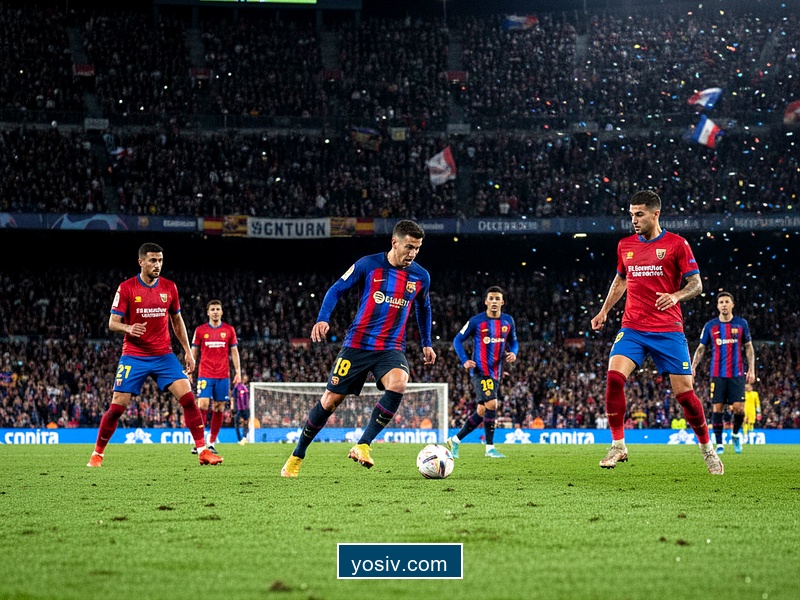
While the casual observer is frantically Googling how to stream Barcelona vs. Osasuna to catch a glimpse of the title race, the seasoned eye is searching for something far more elusive than a WiFi signal: the resurrection of an identity. I have spent the last two decades covering the shifting sands of La Liga, from the Rijkaard revolution to the post-Messi depression, and what we are witnessing now is not a return to form—it is a violent, beautiful deviation from the scripture written at La Masia twenty years ago.
To understand the stakes of a fixture like this, you have to look past the league table. You must look at the ghosts haunting the Montjuïc turf. When Barcelona plays a gritty, defensive side like Osasuna, the comparison isn't against Real Madrid; it is against the shadow of the 2008-2012 dynasty. And for the first time in a decade, this Barcelona side isn't trying to copy the Guardiola blueprint. They are burning it.
The Death of Tiki-Taka, The Birth of Blitzkrieg
For fifteen years, "The Barcelona Way" was synonymous with control. It was the hypnotic, suffocating horizontal circulation that Pep Guardiola perfected. Against a team like Osasuna, who historically deploy a rigid 4-4-2 low block reminiscent of the Javier Aguirre era, the Xavi-Iniesta axis would pass the ball 900 times, probing for a microscopic fissure.
That era is dead. Under the current regime, Barcelona has traded the scalpel for the sledgehammer. This 2024-25 iteration, influenced heavily by the Germanic school of pressing brought by Hansi Flick, cares little for possession statistics. They want verticality.
"The difference between the 2011 team and today is the acceptance of chaos. Pep’s Barcelona feared losing the ball. This Barcelona treats a turnover as a triggering mechanism to hunt."
Against Osasuna, this tactical shift changes the viewing experience entirely. We aren't watching a python squeeze its prey; we are watching a pack of wolves. The transition speed from Pedri and Gavi—when fit and firing—mirrors the intensity of Jurgen Klopp’s Liverpool more than it does the 2011 Blaugrana. It is high-risk, high-reward football that leaves gaps the size of the Ebro river behind the defensive line, something historical Osasuna strikers like Savo Milošević or Walter Pandiani would have feasted on.
Lamine Yamal and the Messi Burden
It is impossible to discuss this fixture without addressing the elephant in the stadium. Lamine Yamal is not the "next Messi." That label is a curse that destroyed Bojan Krkić, weighed down Giovani dos Santos, and broke Ansu Fati. However, the optics are undeniable. When you watch Yamal cut inside from the right flank against a stubborn Osasuna defense, the muscle memory of the Camp Nou collective consciousness twitches.
But let’s look at the mechanics. In 2005, a teenage Lionel Messi operated as a pure dribbler, a chaos agent protected by the structure of Deco and Ronaldinho. He didn't have to lead. Yamal, conversely, is being asked to be the creative engine at 17. The statistical output of Yamal this season already eclipses Messi’s 2005-06 numbers in terms of creative responsibility (xG assisted), but he lacks the physical protection Messi enjoyed.
Osasuna defenders are not sentimental. Historically, players like Patxi Puñal made a career out of "reducing the influence" of Barça’s wingers through physical attrition. Watching how Yamal handles the inevitable rotational fouling will tell us if he has the physical durability to match his technical arrogance. Messi learned to ride tackles by keeping his center of gravity aggressively low; Yamal, taller and more languid, plays with a fragility that terrifies me every time he hits the turf.
The Lewandowski Paradox vs. The Eto'o Standard
If we are measuring against legends, Robert Lewandowski is the anti-Eto'o. Samuel Eto'o was the first defender of the Guardiola era. His press was feral. He chased lost causes against Osasuna goalkeepers just to incite the crowd. Lewandowski, in his veteran stage, offers a different proposition: economy of movement.
This creates a tactical disconnect that rarely existed in 2009. When Barcelona presses high against Osasuna, the first line of pressure is often porous because Lewandowski cannot replicate Eto'o’s manic energy. This forces the midfield line to jump earlier, exposing the center-backs.
However, inside the box, the Pole is a superior technician to Eto'o. Eto'o required volume; he needed three chances to score one. Lewandowski operates on efficiency. Against a deep-lying Osasuna defense that might only concede two clear-cut chances in 90 minutes, Lewandowski’s clinical nature is arguably more valuable than Eto'o’s industry. It is a trade-off: defensive structure for offensive certainty.
The Osasuna Factor: Why This Isn't a Walkover
We must respect the opposition’s history. Osasuna has never been a team that rolls over for the aristocracy. I remember the 2012 loss at the Reyno de Navarra (3-2) that effectively ended Guardiola’s hopes of a fourth consecutive league title. That night, Osasuna played with a directness and aggression that bypassed Barça’s midfield entirely.
| Season | Result | Significance |
|---|---|---|
| 2008-09 | 2-3 Loss | Pep's treble winners lost at home to a relegation-threatened Osasuna (played mostly reserves, but the grit was real). |
| 2011-12 | 3-2 Loss | The game that practically handed the league to Mourinho's Madrid. |
| 2019-20 | 1-2 Loss | Osasuna won at Camp Nou with 10 men, marking the nadir of the Setién era. |
The current Osasuna side possesses the aerial threat to hurt Barcelona. In the era of Puyol and Piqué, aerial bombardment was managed through positioning and bravery. The current defensive pairing, while talented on the ball, lacks the raw aerial dominance of the 2010 vintage. If Osasuna forces corners, the ghosts of set-piece failures past will begin to swirl.
The Verdict: Evolution or Erosion?
Streaming this match isn't just about watching a game; it's an audit of Barcelona's soul. Are we watching a team that has successfully modernized, moving away from the dogmatic adherence to "Johan Cruyff’s bible" to embrace the physical realities of modern football? Or are we watching a team that has lost its unique identity to become just another high-pressing European super-club?
In 2009, Barcelona beat you because they were smarter than you. In 2025, they try to beat you because they are faster than you. Against a stubborn, rugged Osasuna, speed often runs into a brick wall. Intelligence finds the loose brick.
Watch Pedri. If he controls the tempo, we are seeing flashes of Xavi. If the game becomes a basketball match of end-to-end transitions, we are seeing the final surrender of the Guardiola philosophy. Barcelona will likely win, but the *manner* of the victory matters more than the three points. We aren't just counting goals; we are looking for the art that used to make this fixture a symphony rather than a shootout.