
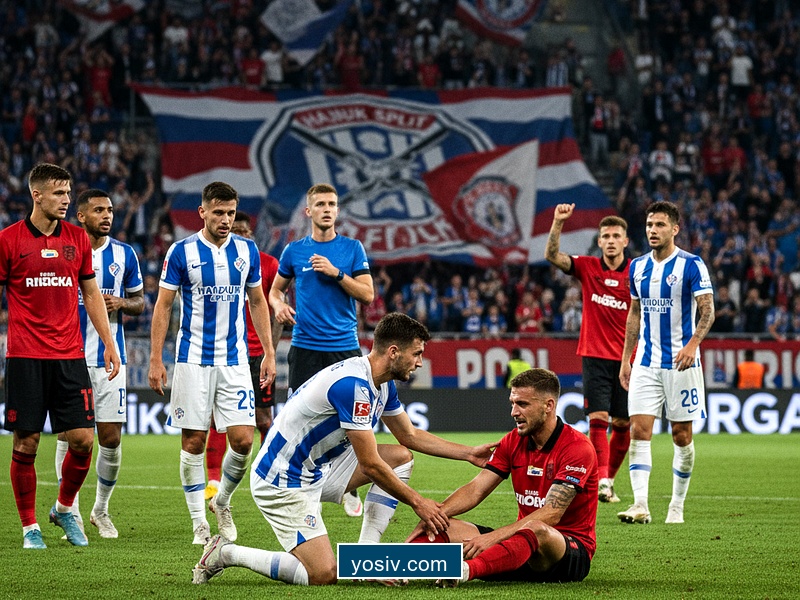
In the modern era of football, where every micro-movement is analyzed by optical tracking cameras and every decision is weighed against an Expected Goals (xG) model, we often forget that the sport remains a visceral, physical confrontation between human beings. The recent incident involving Tottenham Hotspur loanee Luka Vušković rushing to the aid of an opponent is not merely a "feel-good" story for the aggregation sites. It is a flash of archaic nobility.
It was a moment that stripped the game of its commercial veneer. No VAR check, no tactical foul, no glancing at the referee. Just a teenage defender recognizing distinct human peril and acting before the medical staff could even leave the bench. In doing so, Vušković did not just save a moment; he channeled a lineage of defensive leaders that has been slowly eroding over the last two decades.
The Physiology of a Savior
To understand the gravity of Vušković’s reaction, we must look past the sentiment and analyze the cognitive processing involved. In high-stakes athletics, players operate within what military strategists call the OODA Loop—Observe, Orient, Decide, Act. For a defender, this loop is usually tuned to ball trajectory and spatial denial.
For Vušković to break that loop instantly—overriding the competitive instinct to play to the whistle—requires a level of peripheral awareness usually reserved for veterans with fifteen years on the pitch. We are witnessing a physiological anomaly: a teenager who processes the safety of an opponent as a higher priority than the structure of his defensive line. This is not coached behavior. You cannot drill empathy into a center-back during rondo sessions.
"Great defenders anticipate the ball. Legendary defenders anticipate the danger, regardless of the jersey it wears."
Echoes of 2014: The Kankava Standard
The immediate historical parallel to this event isn't found in the highlight reels of Messi or Ronaldo, but in a terrifying afternoon in Dnipropetrovsk in March 2014. It was there that Jaba Kankava, the Dnipro midfielder, pried open the jaws of Dynamo Kyiv’s Oleg Gusev after a collision left the latter swallowing his tongue.
Kankava saved a life that day. He didn't wait for permission. He operated on raw, human instinct. Vušković’s intervention belongs to this same genus of action. It recalls a time when the "hard men" of football were also its guardians. We look back at the 2000s—the era of Carles Puyol and Paolo Maldini—and we see a different code of conduct.
Puyol, the shaggy-haired heart of Barcelona, was ferocious. He would put his face in the path of a boot if it meant saving a goal. Yet, his legacy is equally defined by the moments he stopped his own teammates, like Dani Alves, from dancing after a goal when the opponent was humiliated, or when he halted play to check on a fallen adversary. This "warrior-monk" dichotomy is what defined the elite defenders of the mid-2000s. They were violent in their craft but gentle in their humanity. Vušković, at a frighteningly young age, seems to have inherited this lost gene.
The Death of Cynicism in the VAR Era
Why does this resonate so deeply now? Because the modern game is plagued by cynicism. The last ten years have seen the rise of "game management" as a euphemism for deception. We watch players feign head injuries to stop counter-attacks. We see tactical rolling on the turf to burn seconds off the clock. The laws of the game regarding head injuries, designed to protect players, are routinely weaponized by coaches to disrupt momentum.
In this landscape of calculated deceit, Vušković’s honesty is jarring. It cuts through the theatre. It suggests that despite the industrialization of youth academies—where players are churned out as tactical automatons—there is still room for the individual conscience.
Tactical Implications: The Thinking Defender
From a purely sporting perspective, this rapid cognitive switching bodes remarkably well for his parent club, Tottenham Hotspur. Ange Postecoglou’s high-line system demands defenders who can make split-second decisions in isolation. A defender who can assess a medical emergency in milliseconds is a defender who can read a counter-attack before the pass is even thrown.
The Croatian lineage of defenders supports this theory. Look at the trajectory from Robert Kovač to Darijo Srna, and now to Joško Gvardiol. The Croatian school of defending has always blended a rugged, almost brutal physicality with a high football IQ. They do not panic. Vušković is proving to be the next evolution of this archetype: physically imposing (standing at 1.93m), technically gifted enough for the modern buildup, but possessing the mental fortitude of a captain from the Serie A golden era.
Beyond the Stat Sheet
We are currently obsessed with data. We measure progressive carries, aerial duel success rates, and possession-adjusted interceptions. But there is no metric for "Crisis Response." There is no heat map for character.
When Vušković eventually arrives in the Premier League, the pundits will obsess over his pace and his passing range. They will compare him to Van de Ven or Romero. But the true analysts, those who remember the days when a handshake meant something, will look at this incident in the Bundesliga context and see something more valuable than a clean sheet.
They will see a player who understands that football is a matter of life and death, but not in the way Bill Shankly meant. He understands that the person wearing the other color is an opponent, not an enemy. In the sterilized, hyper-commercialized world of 2025 football, Luka Vušković has reminded us that the best defenders protect the goal, but the legends protect the game itself.