
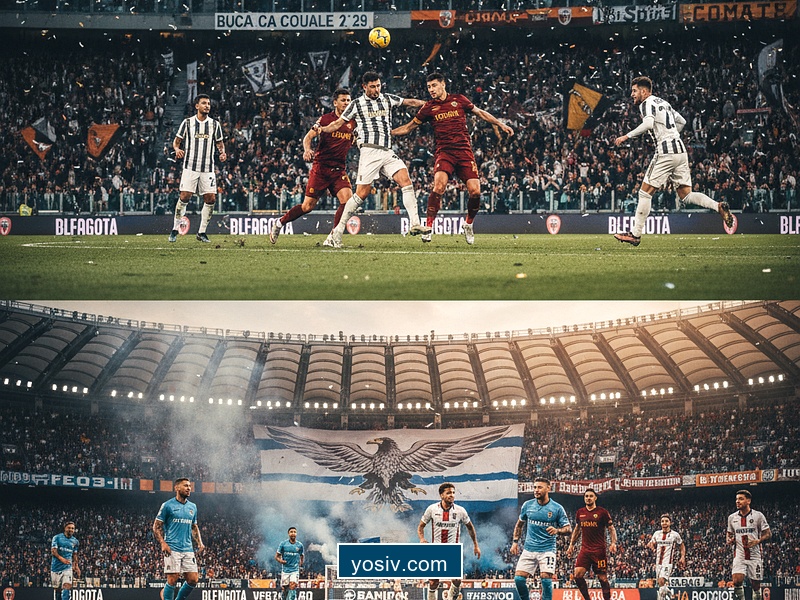
The scoreboard at the Allianz Stadium flickered with a result that felt less like a conclusion and more like a resignation. Juventus and Roma, two aristocrats of Italian football, played out a tactical stalemate that would have been unthinkable two decades ago. Meanwhile, in the capital, Lazio dispatched Cremonese with a functionality that borders on bureaucratic.
Watching the current iteration of the Bianconeri labor against a Roma side searching for its soul, one cannot help but feel the crushing weight of history. We are witnessing the "Netflix-ification" of Serie A: the production value is higher, the camera angles are sharper, but the script lacks the visceral, blood-on-the-teeth drama of the golden era.
To understand why this weekend's double-header felt hollow despite the tactical proficiency on display, we must stop looking at xG maps and start looking at the ghosts haunting the hallways of Turin and Rome.
The Death of the Cynical 1-0
Thiago Motta’s Juventus is an intellectual exercise. It is fluid, positional, and obsessed with control. But control is not dominance. In the mid-2000s, under Fabio Capello, Juventus didn't care about ball progression stats. They cared about strangulation.
In 2005, the Juventus midfield axis of Patrick Vieira and Emerson was physically terrifying. They didn't press high; they simply occupied the center of the pitch like bouncers at a nightclub you weren't cool enough to enter. Watching today's midfield try to replicate that authority is like watching a cover band attempt Led Zeppelin.
"The difference between the Juve of 2005 and 2025 is the difference between a sniper and a machine gunner. Capello's team needed one chance to end you. Today's team needs fifteen shots to feel like they are in the game."
Dusan Vlahovic is a talented striker, burdened by a chaotic system. But compare his frantic movement to the reptilian stillness of David Trezeguet. Trezeguet, the "Cobra," often touched the ball fewer than 20 times in 90 minutes. He didn't drop deep to link play; he didn't drift wide to create space. He waited in the box, a silent assassin, knowing that Pavel Nedved or Mauro Camoranesi would eventually provide the bullet. Vlahovic works harder, certainly, but Trezeguet worked smarter. The Frenchman understood that a striker’s currency is goals, not heatmap coverage.
Roma: The Totti Vacuum and the Loss of "Romanismo"
On the other side of the pitch, Roma's performance was a testament to modern fragility. The Giallorossi possess technical quality—Paulo Dybala is a joy when fit—but they lack the arrogant defiance of the 2001-2006 era.
Twenty years ago, a Roma trip to Turin was an act of war. Led by Francesco Totti and the volatile genius of Antonio Cassano, Roma played with a chip on their shoulder the size of the Colosseum. I remember the 4-0 demolition in February 2004. That wasn't just a win; it was a humiliation of the northern establishment. Cassano mocking the corner flag; Totti signaling "4" with his fingers. It was petty, it was beautiful, and it was entirely absent today.
The modern Roma suffers from a corporate identity crisis. They want to play a high-pressing, European style, yet they are haunted by the ghost of Luciano Spalletti’s 4-6-0—the strikerless formation that revolutionized football in 2006. That team moved like a swarm of bees. Today's Roma moves like a committee. They are polite guests in matches where they used to be home invaders.
Lazio vs. Cremonese: The Aristocracy Has Fallen
While the heavyweights sparred in Turin, Lazio’s fixture against Cremonese highlighted a different kind of decay: the economic decline of the "Seven Sisters."
Lazio won, yes. But let’s contextaulize the personnel. Under Sven-Göran Eriksson in 2000, Lazio was arguably the best team in the world. They had Juan Sebastián Verón directing traffic, Alessandro Nesta inventing modern defending, and Hernán Crespo costing world-record fees. They were bankrolled by Cirio’s millions, operating with a financial doping that eventually burst, but my god, did it burn bright.
Today, under the austere stewardship of Claudio Lotito, Lazio is a miracle of budget management. Mattia Zaccagni is a fine player, a grinder who earns his paycheck. But asking him to carry the mantle of Pavel Nedved is unfair. Nedved was a force of nature, a Ballon d'Or winner who ran until his lungs burned and shot with both feet from 30 yards. Zaccagni manages the game; Nedved broke it.
A Statistical Reality Check: The Efficiency Gap
The degradation of quality isn't just nostalgia; it's visible in the tactical profiles of the league's elite. Here is the shift in philosophy between the titans of 2005 and 2025.
| Metric | Juventus (Capello '05) | Juventus (Current Era) |
|---|---|---|
| Possession Avg | 46% | 58% |
| Shots to Goal Ratio | 4.2 | 7.8 |
| Defensive Line | Low Block / Compact | High Press / Vulnerable |
| Primary Playmaker | Deep-Lying (Emerson) | Inverted Winger / #10 |
The data suggests we have traded efficiency for aesthetics. Modern coaches are obsessed with "dominating the ball," whereas Marcello Lippi and Capello were obsessed with dominating the space. The result against Roma was a consequence of two teams trying to play the "right way" rather than the winning way.
The Homogenization of Calcio
The deeper issue revealed by these fixtures is the tactical homogenization of Serie A. Twenty years ago, a match against Cremonese was a nightmare of man-marking and mud. Provincial teams played Catenaccio, forcing the big teams to earn every inch. Today, even Cremonese tries to build from the back. They press high. They play "proactive" football.
This sounds like progress, but it actually makes life easier for the giants. Lazio didn't have to break down a fortress today; they just had to wait for Cremonese to make a mistake in their build-up phase. The tactical diversity of the league—the clash of styles between Zeman’s all-out attack and Nereo Rocco’s deep defense—has been replaced by a uniform high-press ideology imported from the Bundesliga.
The Verdict
We cannot turn back the clock. The financial might of the Premier League has stripped Serie A of the ability to hoard the world's best talent like Cragnotti and Moratti once did. We will likely never see a striker pairing like Vieri and Ronaldo at Inter again, nor a bench that features Del Piero.
However, what we can demand is personality. The draw between Juventus and Roma was technically proficient but emotionally bankrupt. It lacked the spite, the venom, and the sheer will to win that defined the rivalry when Totti and Del Piero exchanged pennants.
Until a manager in Italy dares to abandon the obsession with possession stats and rediscovers the dark art of the cynical victory, we are destined to watch simulate battles. Today was football, certainly. But it wasn't Calcio.