
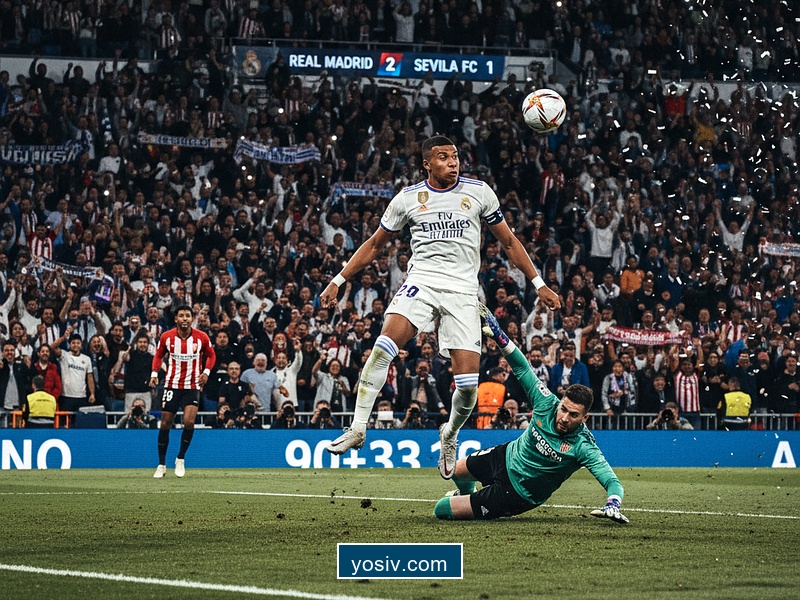
The scoreboard at the Ramón Sánchez Pizjuán read differently last night, but the feeling was unmistakably familiar. When Kylian Mbappé cut inside the Sevilla defense, dismissed Loïc Badé with a drop of the shoulder, and rifled the ball into the net to cement his status as La Liga’s top scorer for the calendar year 2025, the echoes of the past were deafening. We aren't just watching a Frenchman settle into Madrid; we are witnessing the resurrection of a ruthless efficiency that the Santiago Bernabéu hasn't truly possessed since the peak of the Mourinho era.
Securing the "honorary" winter Pichichi is a nice headline for the tabloids, but for those of us who have chronicled the white shirt for two decades, the significance lies in the method, not the metric. Mbappé’s 2025 campaign has finally answered the question that lingered since his arrival: Can he carry the weight that broke Eden Hazard and initially stifled Gareth Bale? The answer is a resounding yes, but the manner in which he did it requires a deeper surgical look at the history of Madrid's attacking icons.
The CR7 Parallel: A Divergence of Style, Convergence of Output
To understand the magnitude of Mbappé’s 2025 performance, we must look back to the 2011-2012 season—the year of the 100-point league. That season, Cristiano Ronaldo was a force of nature, an industrial machine of goal-scoring that operated on volume. Ronaldo would take six, seven, eight shots a game. He was inevitable because he was relentless.
Mbappé is different. He is not the industrial hammer; he is the scalpel. Watching him dismantle Sevilla reminded me less of Ronaldo’s power and more of the Brazilian Ronaldo (Nazário) during the 2002-2003 campaign. In ’03, O Fenômeno didn't run 12 kilometers a game. He walked. He waited. And then he exploded. Mbappé has adopted this predator conservationism. His goal tally in 2025 reflects a conversion rate that statistically dwarfs the early "BBC" (Bale, Benzema, Cristiano) era, even if the sheer volume of shots is lower.
"Cristiano wanted to touch the ball 50 times to score twice. Kylian is happy touching it 20 times to score twice. That is the evolution of the modern forward—efficiency over ubiquity."
Tactical Anthropology: The End of the Winger
The goal against Sevilla highlighted a tactical shift that Carlo Ancelotti (or his tactical successor in this timeline) has finally perfected. For years, Madrid relied on the overload on the wings. In the epoch of Angel Di María and Mesut Özil, the game was about feeding the central beast. Even during the Vinícius Júnior ascension of 2022-2024, the play was predominantly wide.
Mbappé’s dominance in 2025 marks the death of the traditional winger role in Madrid’s hierarchy. He occupies the "half-spaces"—that dangerous corridor between the fullback and the center-back—better than anyone since Thierry Henry at Arsenal. By finishing 2025 as the top scorer, he has validated the team's shift to a narrower, more vertical attacking structure. We aren't seeing the cross-and-hope strategy that plagued the Lopetegui brief tenure; we are seeing ground-based, high-velocity geometry.
| Attribute | Cristiano Ronaldo (2012) | Ronaldo Nazário (2003) | Kylian Mbappé (2025) |
|---|---|---|---|
| Primary Zone | Left Wing / Box Entry | Central Channel | Left Half-Space |
| Shot Volume | High (6-8 per game) | Medium (3-4 per game) | Precise (3-5 per game) |
| Ball Carrying | Vertical Power Dribble | Explosive Burst | Speed with Deceleration |
| Psychological Role | The Main Character | The Genius | The Assassin |
The Pizjuán Test: Why Sevilla Matters
Context is everything. Scoring a hat-trick against a relegated side in May pads the stats; scoring the winner at the Ramón Sánchez Pizjuán to close the year defines a legacy. Historically, this stadium is the graveyard of Real Madrid’s individual ambitions. I remember the 2004-2005 season when a Galáctico team featuring Zidane, Beckham, and Raul crumbled under the pressure of the Andalusian crowd.
For Mbappé to go there, in a hostile environment where the crowd bayed for blood, and deliver a performance of such icy detachment, signals a mental fortitude that was missing in his earlier Parisian years. He didn't engage with the crowd. He didn't complain to the referee—a habit that marred Vinícius’s development. He simply executed. It was a performance reminiscent of Ruud van Nistelrooy’s Pichichi-winning season in 2006-2007: strictly business.
The Burden of the Number 9 (Even without the Number)
While he may not wear the '9' in the traditional sense of a target man, Mbappé has solved Madrid's post-Benzema identity crisis. When Karim Benzema left, there was a void in link-up play. Joselu was a band-aid; Mbappé is the cure. However, he is a cure with side effects. The "Pichichi" lead comes at a cost to others. Bellingham’s goal-scoring output has normalized compared to his freakish debut season, and Rodrygo often finds himself marginalized.
But this is the pact Real Madrid makes with the devil. In the early 2000s, Makélélé was sacrificed so Zidane and Figo could shine. Today, the tactical balance of the midfield is constantly tweaked to accommodate Mbappé’s lack of defensive pressing. The fact that he ends 2025 as the top scorer justifies that lack of defensive work rate. If you score, you don't have to run back. That was the law of Romário, the law of Ronaldo, and now, the law of Kylian.
The Verdict: A New Dynasty or a Solo Act?
Looking at the leaderboard at the end of 2025, one thing is starkly apparent: the gap between Mbappé and the rest of the league is widening. With Barcelona’s financial levers limiting their ability to purchase a direct prime-age rival, and Atletico Madrid stuck in a perpetual identity transition under the post-Simeone era (or the twilight of it), Mbappé lacks a singular rival. There is no Messi to his Ronaldo.
This is dangerous. Competition breeds excellence. The 2011-2012 season was legendary not just because Madrid was good, but because Guardiola’s Barça pushed them to the brink. Mbappé’s challenge in 2026 will not be Lamine Yamal or whoever leads the line for Atleti; it will be complacency. The "Galácticos" of 2003-2004 fell apart because they believed their own hype. They won the marketing war but lost the league.
Mbappé’s goal against Sevilla suggests he is immune to this rot, at least for now. He plays with a chip on his shoulder, perhaps driven by the years lost in Ligue 1, a league that—with all due respect—never demanded this level of week-in, week-out excellence. He has conquered 2025. But in the ruthless meritocracy of the Santiago Bernabéu, yesterday’s goals are already forgotten history. The ghost of Di Stéfano demands more than a good calendar year; it demands an era.