
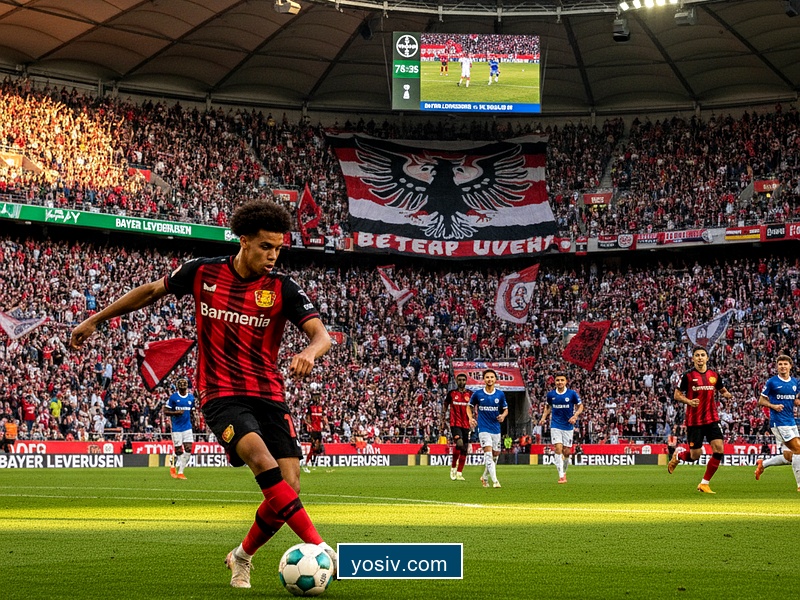
The scouting report on Montrell Culbreath, recently highlighted by the Bundesliga’s official channels, reads like a modern footballing algorithm’s dream: pace, technical versatility, and the coveted dual-national passport (USA and Germany). But to view the 16-year-old merely as another "prospect" is to ignore the seismic shift occurred at Bayer 04 Leverkusen over the last two decades. As a columnist who stood in the freezing terraces of the BayArena in the mid-2000s, I can tell you that Culbreath isn't just a talent; he is the structural correction of a historical failure.
To understand the weight on this young winger's shoulders, we must rewind exactly 20 years. The year is 2005. Bayer Leverkusen, still nursing the hangover of their "Neverkusen" treble horror of 2002, attempted to integrate another high-profile American attacker: Landon Donovan. It was a disaster. The comparison between Donovan’s failed loan and Culbreath’s organic rise offers a perfect lens to view how European player development—and the specific demands of the Bundesliga—have evolved from an attritional physical battle to a cognitive chess match.
The Ghost of Americans Past: 2005 vs. 2025
In January 2005, Donovan arrived in Leverkusen with bleached hair and MLS hype, thrust into a squad managed by the pragmatic Klaus Augenthaler. The tactical landscape was rigid. Augenthaler played a flat 4-4-2 or a conservative 4-1-4-1, relying heavily on the individual brilliance of Dimitar Berbatov and the mercurial Andriy Voronin. There was no structure to nurture a creative, drifting forward like Donovan. He was asked to play as a traditional winger or a second striker against rugged, man-marking defenders.
Donovan failed not because he lacked talent, but because the ecosystem rejected him. He made seven appearances, zero starts, and fled back to California.
Contrast this with Montrell Culbreath’s environment under the overarching philosophy of Xabi Alonso (even if Culbreath is currently tearing it up with the U17s and U19s). The modern Leverkusen does not isolate talent; it insulates it within a system. Culbreath, who was instrumental in Leverkusen’s U17 national title run, operates in a sophisticated 3-4-2-1 setup that demands intelligence over raw athleticism. Unlike the 2005 era, where wingers were expected to hug the touchline and cross, Culbreath operates in the "half-spaces"—the vertical corridors between the center back and full back.
"The difference between the Leverkusen of 2005 and today is the difference between a factory and a laboratory. Augenthaler wanted cogs for a machine; the current academy wants scientists who can improvise."
Tactical Breakdown: The "Schneider" Archetype
If we look for a direct lineage to Culbreath’s playstyle, we shouldn't look at Donovan, but rather at the legendary Bernd Schneider. Known as the "White Brazilian," Schneider was the heartbeat of the Leverkusen midfield in the 2000s. He wasn't the fastest player, but his technical floor was astronomically high. He could dribble in phone booths and execute passes that split defenses.
Culbreath shows flashes of this specific DNA. While modern wingers like Moussa Diaby (who recently departed) relied on blistering pace to run behind defenses, Culbreath is comfortable receiving the ball in front of the block. His ability to drive centrally from the flank mirrors Schneider’s propensity to drift inside, creating overloads. This is the crucial evolution: 20 years ago, a winger staying central was "out of position." Today, it is a tactical requirement.
Comparative Analysis: The Development Gap
| Category | The 2005 Era (Donovan/Augenthaler) | The 2025 Era (Culbreath/Alonso) |
|---|---|---|
| Primary Attribute | Physicality & Stamina | Cognitive Speed & Press Resistance |
| Winger Role | Chalk on boots, cross early | Inverted playmaker, "Pocket" player |
| Youth Integration | Sink or swim (High failure rate) | Curated pathway (Loan armies, U19 integration) |
| System | Rigid 4-4-2 | Fluid 3-4-2-1 / 4-3-3 |
The Geopolitical Football: USMNT vs. DFB
The sourcing on Culbreath highlights his dual eligibility, a narrative that has become exhausting yet vital. However, the context here is different from the Julian Green hysteria of 2014. The USMNT is no longer desperate for any talent; they are desperate for elite talent. With Christian Pulisic, Gio Reyna, and Folarin Balogun, the U.S. has a core. They don't need a savior; they need depth.
Germany, conversely, is in a crisis of creativity. The DFB (German FA) has produced an endless line of central midfielders (Kimmich, Goretzka, Groß) but has failed to produce dynamic 1v1 wingers since Leroy Sané. This makes Culbreath a high-priority asset for Germany in a way that previous dual-nationals were not. The DFB usually loses these battles (see: Sergino Dest, Yunus Musah) because they rely on the prestige of the eagle on the chest. The U.S. Federation, historically, pitches a faster route to senior minutes.
Culbreath's partnership with Francis Onyeka in the Leverkusen youth ranks is key. They represent a cohort, not isolated stars. 20 years ago, Americans in the Bundesliga (Steve Cherundolo, Conor Casey) were outliers. Today, they are part of the academy furniture. This social comfort is a massive, quantifiable variable in development that didn't exist when Donovan was eating dinner alone in Cologne.
The "Baby Werkself" and the Path Forward
There is a danger in over-analyzing a teenager, but Leverkusen’s track record forces us to pay attention. This is the club that polished Kai Havertz, Florian Wirtz, and Julian Brandt. The "Baby Werkself" (a play on the club's factory team nickname) has a distinct pipeline.
The critical divergence point for Culbreath will be his physical maturation. The Bundesliga of 2025 is faster than the Bundesliga of 2005. The pressing triggers are instantaneous. In the mid-2000s, a player like Robson Ponte could take three touches to turn. Today, under Xabi Alonso’s counter-pressing regime, you have perhaps 0.5 seconds before possession is stripped.
If Culbreath is to succeed where Donovan failed, it won't be because he is more talented. It will be because the infrastructure around him understands what he is. He isn't a marketing tool or a curiosity from across the Atlantic. He is a modern "Schienenspieler"—a rail player capable of playing multiple vertical roles—bred in a laboratory designed to produce exactly that profile.
The Verdict
Montrell Culbreath represents the final maturation of the transatlantic football relationship. We are no longer watching raw athletes trying to learn European tactics on the fly. We are watching technically refined products who happen to have American passports. For Leverkusen, he is the next Wirtz. For the USMNT, he is the depth required to compete in 2026. For the historian, he is proof that the Bundesliga has finally learned how to utilize the American attacker.