
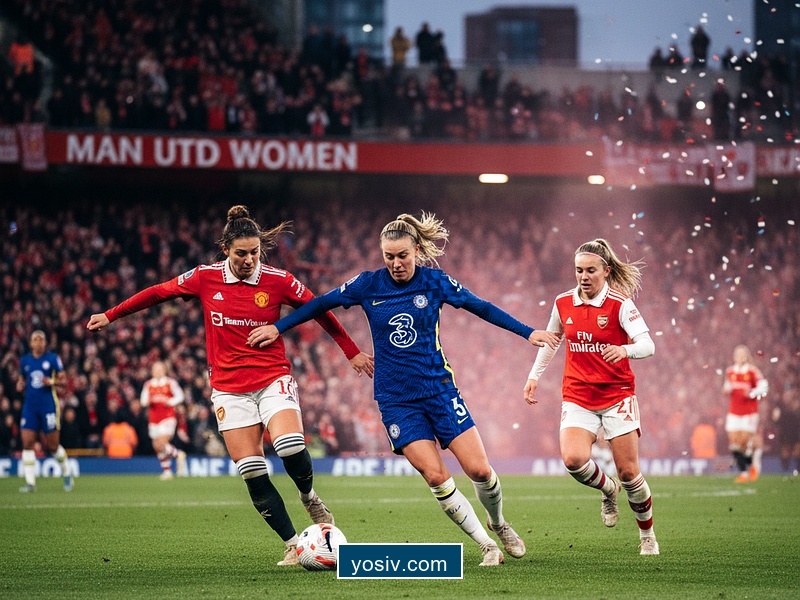
The Women’s Champions League knockout stage is not merely a tournament bracket; it is the most brutal forensic audit in football. As we approach the business end of the 2024-25 campaign, the fortunes of Chelsea, Arsenal, and Manchester United offer a stark, disjointed picture of the Women's Super League (WSL). We are witnessing a league that markets itself as the best in the world, yet frequently arrives at European customs with its passport expired.
To understand the current standing of these three clubs, we must stop looking at the current WSL table and start looking backward. The ghost of 2007 still haunts English football. That was the year Vic Akers’ Arsenal won the quadruple, lifting the UEFA Women's Cup (the precursor to the UWCL) against Umeå IK. nearly two decades later, that remains the solitary English triumph. The performance of our current contenders must be measured not against each other, but against the gold standard set by Akers’ "Invincibles" and the European dynasties that followed.
Chelsea: The Frankfurt of the Modern Era?
Chelsea sits in the most favorable position, yet they remain an enigma wrapped in blue. Under the new regime, following the departure of Emma Hayes to the USWNT, they have retained their domestic swagger. However, watching them navigate the group stages, one cannot help but draw parallels to the 1. FFC Frankfurt sides of the mid-2000s.
Like that legendary German outfit led by Birgit Prinz, this Chelsea side is built on physical dominance and ruthless efficiency rather than tactical romance. Where Frankfurt had Prinz bulldozing defenses, Chelsea has relied on the raw, kinetic energy of Mayra Ramírez and the clinical nature of Sam Kerr (when fit). It is a strategy of attrition.
However, there is a distinct difference in the midfield engine room. The great Frankfurt teams, or even the Lyon dynasty of the 2010s with Louisa Necib, possessed a technical fluidity that Chelsea sometimes lacks. The Blues often bypass the midfield battle, relying on transitions. Against the likes of Real Madrid or Celtic in the groups, this works. But against Aitana Bonmatí’s Barcelona? It feels like bringing a sledgehammer to a fencing match.
The current Chelsea squad has the deepest bench in Europe, reminiscent of the galactico approach of Lyon under Jean-Michel Aulas. Yet, they lack the psychological edge that Sonia Bompastor—now in the dugout—possessed as a player. Bompastor knew how to kill a game with possession; Chelsea still tries to kill games with adrenaline. Unless they can temper their verticality with the patience of the 2007 Arsenal side, another semi-final heartbreak seems written in the stars.
Arsenal: A Ferrari with a fragile gearbox
If Chelsea is a blunt instrument, Arsenal is a piece of fine china—exquisite to look at, but terrifying to handle. Their journey to this point has been a oscillation between brilliance and baffling incompetence. Comparing this squad to the 2007 European champions reveals exactly what has been lost in the evolution of the modern game.
The 2007 Arsenal team was anchored by Faye White and anchored in midfield by the terrifying duo of Jayne Ludlow and Ciara Grant. They were not just footballers; they were street fighters. They won that final against Umeå—a team that boasted a young Marta—over two legs by suffocating the Brazillian virtuoso. They accepted suffering as part of the job description.
The current Arsenal vintage, conversely, seems allergic to discomfort. They possess superior technical ability; Leah Williamson is a far more progressive ball-player than Faye White ever was. But in Europe, ball progression means nothing if you cannot survive a siege. We saw this fragility in their group stage fluctuations. When the rhythm is disrupted by a high-pressing team like Bayern Munich or Lyon, Arsenal’s midfield tends to dissolve.
Tactically, the Gunners are suffering from an identity crisis. They are trying to emulate the "Total Football" of Barcelona without the relentless off-the-ball pressing triggers that make it work. It is a luxury approach in a competition that rewards pragmatism. Unless they can rediscover the grit of the Ludlow era—the ability to win ugly—their knockout journey will be short. They are playing poetry while the rest of Europe plays prose.
Manchester United: The harsh lesson of heritage
And then we have Manchester United. To discuss them in the context of the looming knockout stages is largely an academic exercise in failure. Their early exit in the qualifying rounds to Paris Saint-Germain was not bad luck; it was a correction by the market.
United’s struggle highlights a truth the WSL refuses to acknowledge: you cannot buy European pedigree. United is currently where Manchester City was in 2016—a domestic force with absolutely no idea how to manage the dark arts of European football.
Look back at the trajectory of Umeå IK in the early 2000s or Wolfsburg in the early 2010s. These teams built their European status over half a decade of continuity. United, under Marc Skinner, attempted to skip steps. They resemble the Fulham Ladies experiment of the early 2000s—the first fully professional team in Europe that burned bright and vanished because the infrastructure didn't match the ambition.
United’s tactical setup against European opposition has been naive. In the WSL, individual brilliance from players like Ella Toone can unlock low blocks. In Europe, against a seasoned operator like PSG's Grace Geyoro, individual brilliance is swallowed by systemic discipline. United lacked the tactical flexibility to switch from Plan A. They played checkers while Europe played chess.
The Tactical Chasm: W-M vs. The Modern 4-3-3
The broader concern for all three English clubs is the tactical evolution occurring on the continent. Ten to fifteen years ago, the dominant formation was a rigid 4-4-2 or 4-2-3-1, relying on wingers to hit the byline. This suited the English style of pace and power—think of Karen Carney or Rachel Yankey flying down the wings.
Today, the European elite (Barcelona, Lyon, Bayern) utilize inverted full-backs and box midfields that create numerical overloads centrally. We are seeing a resurgence of W-M shapes in possession, similar to what Pep Guardiola reintroduced to the men's game.
Chelsea is the only English side that has partially adapted to this, largely due to their squad versatility. Arsenal attempts it but leaves vast spaces in transition. United simply hasn't faced high-level opposition often enough to learn it. The English game is still heavily reliant on transition moments, whereas the European champions control the space between the lines.
The Verdict
As the knockout stages loom, the scorecard is grim but clear. Manchester United are already a casualty of their own inexperience. Arsenal are a nostalgic heavyweight relying on muscle memory rather than current form, desperate to channel the spirit of 2007 but lacking the steel. Chelsea remains the solitary genuine contender, a ruthless machine that nevertheless lacks the soul of a true European champion.
The WSL may generate the most revenue and the most hype, but until an English captain lifts that trophy again, we are merely watching wealthy pretenders gazing across the channel at the true royalty of the game.