
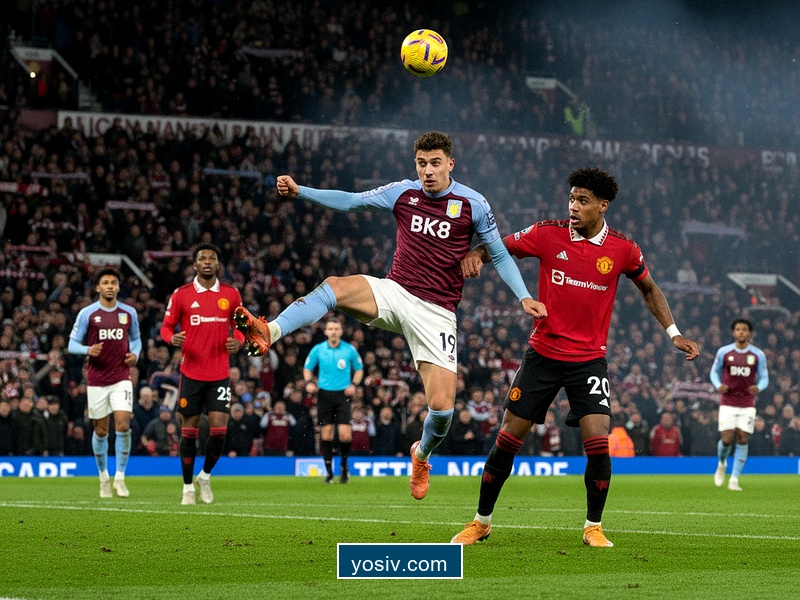
There is a specific smell to a football team that has forgotten how to suffer together. It is not found in the Expected Goals (xG) tables or the possession statistics. It is visible in the nanoseconds following a turnover. When the ball is lost, do the shoulders drop? Does the central midfielder sprint five yards to close the angle, or does he gesture at the winger? Watch Manchester United’s transition defense for ten minutes, and you see the rot. They are a collection of expensive individuals playing in isolation; Aston Villa, conversely, is a hive mind operating a high-voltage trap.
The betting markets have tightened, reflecting a reality that anyone with a scout’s accreditation has seen coming for months. Villa Park has become a fortress not because of the noise, but because of the geometry. Unai Emery has constructed a tactical torture chamber designed specifically to dismantle chaotic structures. Erik ten Hag’s United is the definition of chaos.
The Art of the Offside Trap vs. The Lazy Run
To understand why this matchup is a tactical mismatch, one must look at the line of engagement. Emery’s Villa plays with one of the most aggressive high defensive lines in Europe, often compressing the play into a 25-meter vertical strip. This is high-risk, high-reward, but it requires absolute synchronization between the back four.
From a scouting perspective, watch Ezri Konsa and Pau Torres. They don't just hold the line; they manipulate it. They step up in unison the moment the opponent’s ball-carrier drops his head to strike a pass. This isn't luck; it's a drilled trigger.
Now, contrast this with Manchester United’s forward line. Marcus Rashford and Alejandro Garnacho possess electric pace, theoretically the kryptonite to a high line. However, their movement patterns are often reactive rather than proactive. A scout looks for "curved runs"—movements that start onside and bend behind the defender. United’s forwards tend to make straight-line dashes. Against Villa’s disciplined step-up, straight runs lead to the assistant referee’s flag. If United cannot time their release to the millisecond—and their disjointed midfield suggests they can’t—they will spend 90 minutes running into an offside wall, leading to visible frustration and a breakdown in body language.
The Midfield Box and the "Rest Defense" Disaster
The match will be won or lost in the half-spaces. Emery typically utilizes a 4-4-2 out of possession that morphs into a 4-2-2-2 or a 3-2-5 in possession. The key is the "box midfield." Youri Tielemans and Amadou Onana sit, while Morgan Rogers and John McGinn invert. This creates a four-man central overload against United’s pivot.
"United’s midfield shape often resembles a doughnut—solid on the edges, empty in the middle. Villa’s shape is a spear."
Watch the body orientation of Kobbie Mainoo or Casemiro (whoever starts). They are constantly forced to check their shoulders because Villa’s number 10s inhabit their blind spots. When Villa bypasses the first line of pressure, United’s midfield is frequently caught flat-footed, facing their own goal. In coaching terms, United lacks a functional "Rest Defense" (Restverteidigung). When they attack, their defensive structure disintegrates.
Conversely, look at Villa’s work *off* the ball. Tielemans has evolved. His scanning frequency—the number of times he checks his surroundings before receiving—is elite. He dictates the "pausa," slowing the game down to draw United’s pressers out of position before releasing a vertical pass to Watkins. United does not possess a player currently operating with that level of cerebral calmness.
Watkins vs. De Ligt: A Study in Biomechanics
The individual duel that will define the scoreline is Ollie Watkins against Matthijs de Ligt or Lisandro Martinez. Watkins is a nightmare for modern center-backs because he rarely engages in a physical wrestle where the defender is comfortable. He plays on the "peel."
Watch Watkins when the ball is wide. He doesn't run to the near post immediately. He drifts to the blind side of the far center-back, hovering just out of peripheral vision. He forces the defender to turn his neck. Biomechanically, if a defender has to turn his head 180 degrees to track the striker and the ball, his reaction time slows by a fraction of a second. Watkins lives in that fraction.
United’s defenders have shown a propensity for ball-watching. De Ligt, despite his pedigree, can be heavy-footed on the turn. If Watkins drags him into the channels, it opens the "cutback zone" for the trailing runs of Rogers or Ramsey. This is a pattern Villa executes with robotic precision, while United defends cutbacks with panic and scrambling.
The Psychological Tell: Reaction to Adversity
Professional scouts don't just watch feet; they watch hands. The specific "tell" for Manchester United’s collapse is the arm wave. Bruno Fernandes is the primary culprit, but the contagion has spread. When a press is broken, look at the reaction of the United front line. Do they sprint back to form a compact block (recovery runs), or do they throw their hands up and jog?
Under Emery, Villa players treat a turnover like a personal insult. Their transition from attack to defense is violent. They swarm. This intensity is quantifiable in "PPDA" (Passes Allowed Per Defensive Action), but it’s more visceral than data. It is a culture of accountability. Ten Hag has spoken for years about "standards," yet on the pitch, the standard is negotiable. At Villa Park, under the lights, that negotiability is fatal.
The Unseen Importance of Morgan Rogers
While the headlines focus on Watkins, the tactical linchpin is increasingly Morgan Rogers. His physical profile is unique—a ball-carrier with the frame of a linebacker and the feet of a winger. He operates in the "pockets" between the lines.
United’s defensive scheme struggles immensely with ball-carrying midfielders. They rely on man-marking phases that get disjointed when an opponent dribbles through the zone. Rogers’ ability to receive on the half-turn and drive specifically at the heart of the defense forces United’s center-backs to step out. Once they step out, the space behind for Watkins is created. It is a simple two-step checkmate that United has failed to solve all season.
Verdict: Structure Conquers Chaos
The betting odds may offer value on a draw given the individual talent in Manchester United’s squad. A moment of brilliance from Fernandes or a wonder-strike from Rashford is always possible. But relying on moments is the strategy of the desperate.
Unai Emery plays chess while Ten Hag is seemingly hoping the pieces fall in his favor. Villa’s structural integrity, their superiority in transition, and their mastery of the "dark arts" of game management (tactical fouls, slowing restarts) give them a distinct edge. The scout’s eye sees a United team that is physically present but tactically absent. Expect Villa to exploit the wide channels, overload the central zones, and ultimately, outwork a United side that looks like it is waiting for the season to end.