
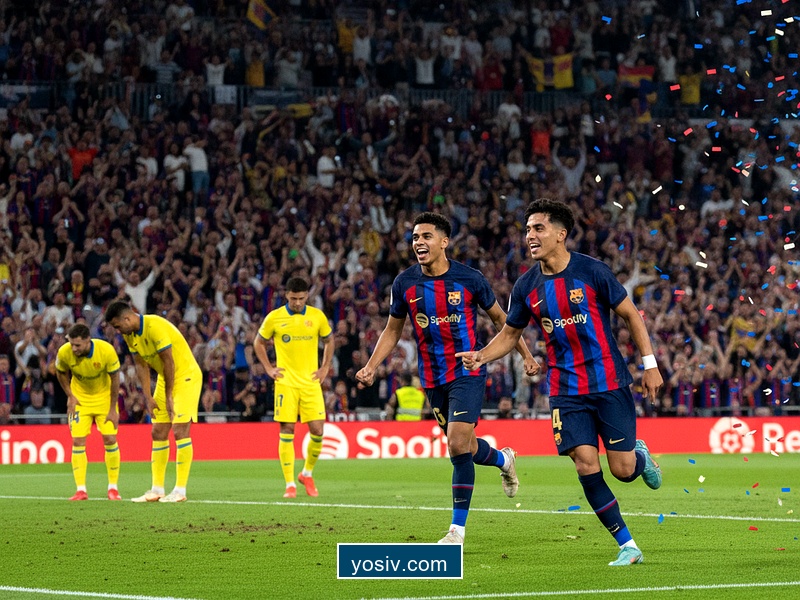
There is a specific frequency of silence that falls over the Estadio de la Cerámica when Barcelona is truly, devastatingly effective. It is not the silence of boredom, but of awe mixed with resignation. We heard it this weekend as Barcelona dismantled Villarreal, a match that looked less like a standard league fixture and more like a séance summoning the ghosts of the Pep Guardiola era. With Raphinha and Lamine Yamal on the scoresheet, the scoreboard read like a victory, but the kinetics on the pitch read like a revolution.
For the better part of a decade, watching Barcelona has felt like viewing a faded photocopy of a masterpiece. The possession was there, but the venom was gone. However, this performance against the Yellow Submarine offered irrefutable proof that the "Flick Experiment" is not just working—it is re-engineering the club’s DNA by splicing it with the ruthlessness of the 2009 treble winners.
Lamine Yamal: The Burden of the Chosen One
Let us address the elephant in the room, or rather, the teenager on the wing. To watch Lamine Yamal against Villarreal was to suffer a distinct sense of déjà vu. We are conditioned to avoid the comparison. We are told it is unfair to the child. But when a player receives the ball on the right flank, drops his shoulder, and cuts inside with that specific, liquid geometry, the shadow of Lionel Messi is impossible to ignore.
However, the comparison to the 2011 peak-Messi is lazy. Yamal currently mirrors the 2005-2007 version of Leo—the raw, anarchic force that Frank Rijkaard unleashed upon La Liga. Against Villarreal, Yamal wasn't just a playmaker; he was a disruptor. His assist—a trivela of absurd audacity—was not just a pass; it was a statement of intent.
"We spent years looking for the next Messi, ignoring the fact that you don't replace a deity. You wait for the universe to correct itself. In Yamal, the Camp Nou faithful aren't seeing a replacement; they are seeing a reincarnation of the audacity we thought died when Leo left for Paris."
Historically, the "Messi role" has been a graveyard for talented players. Bojan Krkic, Giovani dos Santos, and even Ansu Fati buckled under the weight of the crown. Yamal plays with a terrifying lightness. He plays as if he is unaware of the history books, much like the 19-year-old Messi who scored a hat-trick against Real Madrid in 2007. The technical execution against Villarreal—specifically the ability to pause time in the box before picking a pass—is a trait that usually takes a decade to acquire. Yamal has it before he can legally drive a car.
Raphinha: The Spirit of Samuel Eto'o
If Yamal is the silk, Raphinha has become the steel. The Brazilian’s brace in this fixture changes the narrative surrounding his tenure in Catalonia. For two seasons, Raphinha was viewed as a financial lever with boots—a player to be sold to balance the books. He was criticized for lacking the samba flair of Neymar or the wizardry of Ronaldinho.
This criticism missed the point entirely. Raphinha is not the heir to Neymar; he is the modern iteration of Samuel Eto’o or Pedro Rodriguez. In the 2008-09 season, Eto’o didn't just score 30 goals; he was the first line of defense, pressing center-backs until they panicked. This is exactly what Raphinha provided against Villarreal. His goals were clinical, yes, but his off-the-ball movement was predatory.
Under Hansi Flick, Raphinha has been liberated from the touchline. He is making the same diagonal runs that Pedro used to make for Xavi, cutting between the fullback and the center-back to exploit the "half-spaces." This tactical shift has turned him from a predictable winger into a chaotic variable that defenses cannot track. He is the engine room of the attack, providing the kinetic energy that allows Yamal the luxury of stillness.
The Tactical Pivot: Flick vs. Guardiola
The 5-1 scoreline (or the emphatic nature of the win) suggests total dominance, but the method of victory highlights a sharp deviation from the "Cruyffista" purity. Guardiola’s Barcelona killed you with a thousand cuts, suffocating opponents with 75% possession until they collapsed from exhaustion. It was horizontal hypnosis.
Hansi Flick has injected a Germanic verticality that makes this team more dangerous in transition than any Barça side since Luis Enrique’s MSN era (Messi, Suarez, Neymar) of 2015. Against Villarreal, there were moments where Barcelona bypassed the midfield entirely. This is heresy to the purists, but it is necessary for survival in modern football.
Consider the high line. Flick’s defensive line plays with a suicidal arrogance, often camped on the halfway line. It requires the center-backs to be sprinters and the goalkeeper to be a sweeper. In 2011, Carles Puyol and Gerard Piqué relied on positioning. Today, Pau Cubarsí and Iñigo Martínez rely on recovery pace and the offside trap. It is high-risk, high-reward football that turns every match into a heart attack—and it is utterly compelling.
Comparative Analysis: The Eras Collide
| Attribute | The Guardiola Era (2008-2012) | The Flick Era (Current) |
|---|---|---|
| Primary Playmaker | Xavi/Iniesta (Central Control) | Lamine Yamal (Wide Creativity) |
| Defensive Philosophy | Possession as Defense | The High-Line Offside Trap |
| Winger Function | Create width for Messi (Pedro/Villa) | Inverted scoring threats (Raphinha/Yamal) |
| Tempo | Andante (Slow build-up) | Allegro (Vertical counter-pressing) |
The Villarreal Benchmark
Why does a win against Villarreal matter so much? Because El Madrigal (now La Cerámica) has historically been the graveyard of Barcelona managers. It was here in 2004 that a Frank Rijkaard team crumbled, signaling they weren't ready. It was here that Tata Martino’s tenure began to show cracks.
Villarreal is a team that demands respect. They are technically proficient and physically robust. To go there and not just win, but to embarrass them, suggests a mental fortitude that has been absent since the 2015 Champions League run. When the score was tight, or when Villarreal threatened to equalize, previous Barcelona iterations—specifically the Xavi Hernandez version of last year—would have retreated into a shell, passing backward to protect the lead.
This team did the opposite. They accelerated. When they smelled blood, they attacked. This "killer instinct" is the missing ingredient that led to the European humiliations in Rome, Liverpool, and Lisbon. Raphinha’s second goal was not about technique; it was about the refusal to settle for a single-goal cushion.
The Resurrection of La Masia
Ultimately, this victory reinforces the only truth that matters in Catalonia: the answers are always at home. The financial crisis that crippled the club forced them to look inward, and they found gold in the rubble. Yamal, Cubarsí, Casadó, and Balde are not just filling gaps; they are outperforming the mercenaries the club spent a billion euros on over the last decade.
In 2008, Pep Guardiola discarded Deco and Ronaldinho to build around a core of academy graduates. Flick, whether by choice or financial necessity, is doing the same. The result is a team that fights for the badge rather than the paycheck. You could see it in the celebrations against Villarreal. This wasn't business; it was personal.
Barcelona has found its new teeth. They are sharp, they are young, and for the first time in years, they are ready to bite.