
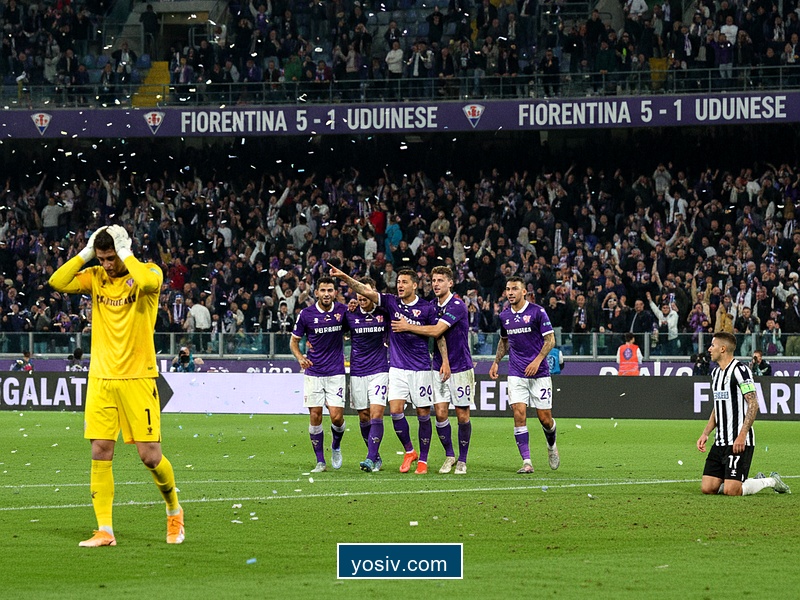
In the unforgiving theatre of Serie A, momentum is a fragile currency. At the Stadio Artemio Franchi, we didn't just witness a 5-1 drubbing; we watched a biomechanical breakdown of a football team. While the headlines will lazily point to Maduka Okoye’s early catastrophic error as the catalyst, a professional eye sees a rot that runs far deeper than a pair of slippery gloves. This was a structural failure of the highest order, a clinic in how body language and poor spatial awareness can turn a competitive fixture into a training ground rondo for the opposition.
The Kinetic Chain of Goalkeeping Failure
Let’s dissect the "gift" from Okoye. In isolation, it looks like a technical error. In scouting terms, it is a failure of scanning frequency and pre-loading decisions. Modern goalkeeping requires the Number 1 to function as an auxiliary centre-back in the build-up phase. When Okoye received the ball, his body shape was closed, limiting his passing vectors to a predictable 45-degree angle. This is blood in the water for a pressing unit.
High-level scouts don't look at the hands; they look at the feet and the eyes. Before the ball even arrived, Okoye failed to check his blind side. His decision loop was reactive rather than proactive. By the time he realized the press was engaged, his sympathetic nervous system triggered a panic response—muscle tension increased, fluidity vanished, and the technical execution failed. It is the classic "freeze" response in the fight-or-flight mechanism. But the true tragedy wasn't the goal; it was the contagion effect. A goalkeeper’s anxiety is distinctively viral; it infects the defensive line instantly.
Fiorentina’s Manipulation of the Half-Spaces
While Udinese imploded, Fiorentina’s tactical setup under the floodlights was a masterclass in positional rotation. The scoreline suggests vertical dominance, but the damage was done laterally. The Viola midfield operated with what we call "gravity"—the ability to draw opponents out of position without touching the ball.
Watch the tape of the second and third goals. The Fiorentina midfielders consistently received the ball with "open hips," allowing them to break the first line of pressure with a single touch. Conversely, Udinese’s defensive shape lacked vertical compactness. The distance between their defensive line and midfield unit stretched to 25-30 meters at times. In coaching theory, this is the "kill zone." Fiorentina’s attackers settled into these pockets, turning freely and driving at a retreating backline that had lost faith in its goalkeeper.
"Defensive organization is built on trust. When the goalkeeper wavers, the defensive line drops five yards deeper to compensate. That five-yard retreat opens the space for the opposition's number 10. It is a domino effect of cowardice."
The Psychology of the Negative Transition
The most damning assessment of Udinese comes from their behavior during negative transitions—the moments immediately after losing possession. A disciplined side reacts to a turnover within 1.5 seconds, engaging a counter-press or falling into a structured low block. Udinese did neither.
I observed a recurring somatic marker in the Udinese pivot players: the "shoulders slump." Upon losing the ball, there was a momentary pause—a gesture of frustration rather than a kinetic reaction to recover the ball. This 0.5-second hesitation is fatal against a team moving the ball with Fiorentina's tempo. It indicates a team that is mentally fragile, playing the scoreboard rather than the moment. When the third goal went in, the Udinese back three stopped communicating. The pointing stopped. The verbal cues vanished. Silence in a defensive line is the sound of resignation.
Tactical Theory: The Overload vs. The Man-Marking Fallacy
Historically, Italian football prided itself on the Catenaccio roots—rigid man-marking and zonal discipline. Udinese attempted a hybrid system that failed miserably against Fiorentina’s fluid movements. The Viola utilized "third-man runs" effectively—a pattern where Player A passes to Player B, who sets it for a running Player C. This beats man-marking because the defender tracking Player C cannot see the ball and the man simultaneously.
Udinese’s defenders were constantly caught ball-watching. In the lead-up to the penalty and subsequent goals, their center-backs were guilty of "ball fixation." They tracked the flight of the leather rather than scanning for the runners engaging in blind-side movements. This is fundamental academy-level neglect. If you cannot detach your eyes from the ball to scan your immediate environment, you simply cannot survive in the top tier of European football.
The Unseen Metrics: Acceleration and Deceleration
While standard stats track distance covered, the elite metric is High-Intensity Metabolic Load Distance (HMLD). Fiorentina’s players were winning the battle of deceleration. Football is a game of stopping and starting. The Viola attackers could decelerate, change direction, and accelerate into a new vector sharply. Udinese’s defenders looked heavy-legged, turning like ocean liners.
This physical disparity often points to a conditioning mismatch or, more likely, cognitive fatigue. When the brain is overwhelmed by tactical chaos (caused by the early error), the legs feel heavier. The neural pathways between decision and action become clogged. Udinese looked slow not because they lack speed, but because they were processing information too slowly. By the time their brain told their legs to intercept a pass, the ball was already in the net.
Historical Context: The Shadow of the Seven Sisters
To understand the gravity of this result, one must look at the historical trajectory. Fiorentina is pushing to reclaim a spot among the elite, reminiscent of the "Seven Sisters" era of the 1990s when Serie A ruled the world. Performances like this are statements of intent. They suggest a squad depth and a tactical versatility that belongs in Europe.
For Udinese, a club that has historically been a factory for scouting hidden gems (think Alexis Sanchez or Rodrigo De Paul), this performance signals a crisis of identity. They have transitioned from a team that unearths diamonds to a team that collects stones. The recruitment strategy of fielding physical, athletic players devoid of tactical nuance is being exposed by managers who employ intricate positional play.
The Verdict
A 5-1 scoreline is rarely an accident. It is an autopsy of a team's week in training. Maduka Okoye will take the public flogging for his error, but the technical staff must look at the subsequent 80 minutes. The lack of on-pitch leadership, the disintegration of the defensive chain, and the inability to alter the tactical setup when the initial game plan failed are the real stories here.
Fiorentina didn't just win; they dismantled the psychological profile of their opponent. They recognized the fear instated by the early goal and pressed on the bruise until the limb severed. For Udinese, the video review session will be a horror show. Not because of the goals conceded, but because of the walking, the slumped shoulders, and the silence. You can fix a goalkeeper's footwork; you cannot easily fix a team's broken spirit.