
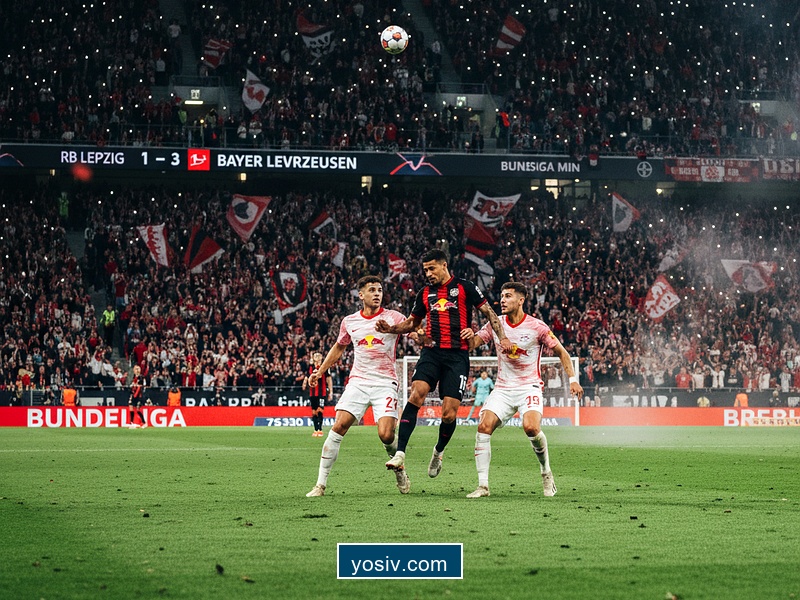
The scoreboard at the Red Bull Arena read 1-3, but the numerical value felt almost polite compared to the tactical violence actually inflicted on the pitch. In this 2025/2026 Bundesliga campaign, we aren't just watching a football match; we are witnessing the calcification of a new German dynasty. RB Leipzig did not just lose three points to Bayer Leverkusen; they lost an ideological argument.
For two decades, the Bundesliga has been the spiritual home of Gegenpressing—that heavy-metal, transition-reliant chaos preached by Ralf Rangnick and perfected by Jurgen Klopp. RB Leipzig is the corporate manifestation of that philosophy. But Xabi Alonso has walked into the cathedral of speed and dismantled it with something far more terrifying: absolute, suffocating control. This result confirms that the tectonic plates of German football have shifted permanently away from the Red Bull model of "chaos creation" toward Alonso’s "chaos mitigation."
The Evolution of Alonso-Ball: Beyond the Invincibles
To understand why this 3-1 victory is sustainable, we must ignore the narrative of Leverkusen’s historic 2023/24 unbeaten run. That is ancient history in football terms. The brilliance of Xabi Alonso’s project lies in his refusal to be nostalgic about his own success. The 3-4-2-1 formation that conquered Germany two years ago has mutated.
Against Leipzig, we didn't see the standard wing-back overload. We saw a sophisticated 3-box-3 in possession that rendered Leipzig’s pressing triggers useless. By inverting the wing-backs into central midfield alongside Granit Xhaka, Alonso created a four-man box midfield that outnumbered Leipzig’s double pivot. This is pure arithmetic weaponized by technique. Leipzig’s press relies on isolating ball carriers near the touchline. Alonso simply removed the touchline from the equation, forcing the ball through the central corridors where his technical superiority is absolute.
"The difference between a good manager and a revolutionary one is the ability to kill the opponent's greatest strength before a ball is kicked. Alonso turned Leipzig's energy into a liability."
The Obsolescence of the Red Bull Model
We need to have a frank conversation about the RB Leipzig project. For years, their recruitment strategy—buy elite U21 talent, press high, sell high—was the envy of Europe. However, Saturday’s match exposed the tactical ceiling of that model. When you rely entirely on youthful exuberance and transition moments, you are at the mercy of variance. You need the opponent to make a mistake.
Leverkusen, under Alonso, does not make mistakes. They treat the ball with a reverence that is almost Spanish in origin but German in efficiency. By denying Leipzig the chaotic transitions they crave, Leverkusen forced the hosts to play a game of positional chess they are ill-equipped to win. The Red Bull "Project" feels stagnant because it hasn't evolved beyond the principles laid down in 2016. They are still trying to run through walls; Leverkusen has learned to open the door.
Tactical Breakdown: The Trap in Zone 14
| Strategic Element | RB Leipzig (The Past) | Bayer Leverkusen (The Future) |
|---|---|---|
| Possession Phase | Vertical, high-risk passing intended to break lines instantly. | Horizontal dragging to bait the press, followed by surgical verticality. |
| Defensive Shape | Aggressive high block, man-oriented pressing. | Compact mid-block that denies space between lines (Zone 14). |
| Player Profile | Athletes first, technicians second. Focus on sprint speed. | Cognitive speed first. Players who resist pressure (Wirtz, Garcia). |
The second goal highlighted this disparity perfectly. A typical Leipzig counter-press was baited by Edmond Tapsoba holding the ball a second longer than comfortable. As Leipzig committed bodies forward, a single diagonal ball bypassed six Red shirts. This wasn't a counter-attack; it was a pre-meditated surgical strike. Alonso has coached his defenders to act as playmakers, a concept derived from the Pep Guardiola school but adapted for the physicality of the Bundesliga.
Florian Wirtz: The Raumdeuter Reborn
While the system is the star, Florian Wirtz remains its gravitational center. His performance in this 3-1 rout illustrated why he is the rightful heir to the German football throne, surpassing the legacy of Thomas Müller. Müller coined the term Raumdeuter (space interpreter), but Wirtz is a Raumbeherrscher (space dominator).
Throughout the match, Wirtz did not stick to a position. He operated in the pockets of space vacated by Leipzig’s over-eager pressing. When Leipzig’s center-backs stepped up, he dropped deep. When they held the line, he ran in behind. This level of tactical fluidity requires a manager who trusts his players’ intellect implicitly. It suggests that Alonso’s training sessions are cognitive workouts as much as physical ones. This creates a sustainability that money cannot buy. You can buy fast legs; you cannot easily buy the collective intelligence Leverkusen displayed in Saxony.
The Bayern Munich Context
Why does this result matter beyond the three points? Because it signals to Bayern Munich that the anomaly of 2024 was not a fluke. Usually, when a challenger upsets the Bayern hegemony (think Wolfsburg 2009 or Dortmund 2012), the empire strikes back by poaching the rival's best talent or waiting for the underdog to regress to the mean.
Leverkusen has done the opposite. They retained their core, added veteran stability in key areas, and evolved the tactics. This 3-1 win away at a top-four rival is the kind of result Bayern used to monopolize. It is a statement of "championship routineness." Alonso has instilled a psychological armor in this squad. They went down a goal early? Irrelevant. The system provides the solution.
Sustainability of the 'Neverkusen' Exorcism
Critics often wait for the "second season syndrome" or, in this case, the third-year decline. Yet, the underlying numbers suggest Leverkusen is actually improving. Their expected goals conceded (xGA) figures have dropped even further compared to their title-winning season. This indicates that Alonso is prioritizing structural integrity over the erratic brilliance of individual moments.
The "Project" in Leverkusen is built on the modern reality that football is a game of space, not just transitions. By controlling the space, you control the game. Leipzig, and by extension the chasing pack in the Bundesliga, are still playing a game of probability. They hope that if they roll the dice enough times (press enough, run enough), they will win. Alonso has stopped rolling dice. He has loaded them.
As the final whistle blew, the contrast was stark. Marco Rose looked like a man trying to solve a Rubik’s cube in the dark, furiously twisting and turning. Xabi Alonso stood motionless, a man who had solved the puzzle days ago in a video room. This wasn't just a win; it was an eviction notice to the old guard of German tactical theory. The era of mindless pressing is dead. Long live Control.