
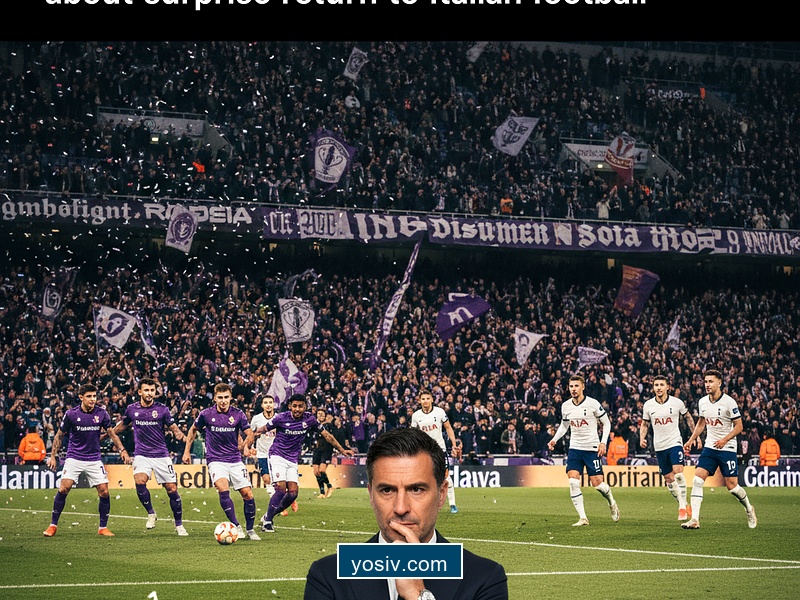
The rumor mill in Tuscany is rarely quiet, but the latest whispers emerging from the Stadio Artemio Franchi are loud enough to wake the ghosts of Calcio past. Fiorentina approaching Fabio Paratici—the architect of Tottenham’s chaotic rebuild and the man at the epicenter of the Juventus "Plusvalenza" scandal—is not merely a hiring decision. It is an existential pivot.
For Rocco Commisso, the billionaire owner who has spent his tenure railing against the shadowy underbelly of Italian football, courting Paratici is an admission of defeat. It is an acknowledgment that in Serie A, virtue does not fill trophy cabinets. To understand the gravity of this move, we cannot look simply at Paratici’s recent exile; we must juxtapose this moment against the golden, reckless era of the "Seven Sisters" and the specific operational history of Fiorentina’s sporting direction over the last two decades.
The Corvino Archetype vs. The Paratici Trader
To grasp the philosophical shift this represents, one must look back at the gold standard of Fiorentina’s management: the Pantaleo Corvino eras (2005–2012, and his later return). Corvino was, and remains, a "minatore"—a miner. He was a scout’s director. He dug into the Balkans and South America to unearth Stevan Jovetić, Adem Ljajić, and Felipe Melo. He built the legendary Cesare Prandelli sides that qualified for the Champions League by finding undervalued assets and polishing them.
Fabio Paratici is the antithesis of the miner. He is a day trader. He operates on volume, leverage, and relationships with super-agents.
During his tenure at Juventus alongside Giuseppe Marotta, and later solo, Paratici’s strategy was defined by hoarding talent and "opportunity" signings. He didn't scout Cristiano Ronaldo; he facilitated the financial engineering to get him. He didn't unearth Matthijs de Ligt; he outbid the competition.
"Corvino built teams with a magnifying glass and a pickaxe. Paratici builds them with a Rolodex and a checkbook. One leaves a legacy of youth development; the other leaves a legacy of amortization costs."
If Fiorentina hires Paratici, they are abandoning the "Viola Park" philosophy of organic growth. They are signaling a desire to return to the reckless ambition of the Cecchi Gori era, albeit—hopefully—without the bankruptcy.
Echoes of the Late 90s: The Cecchi Gori Syndrome
The last time Fiorentina operated with the aggression Paratici typically demands was under Vittorio Cecchi Gori in the late 1990s. That era, characterized by the brilliance of Gabriel Batistuta and Manuel Rui Costa, was fueled by unsustainable spending that eventually imploded.
Commisso has been financially prudent, criticizing the debt-laden models of Inter and Juventus. Yet, the team is stuck in a glass ceiling—perpetual Conference League finalists, never Champions League participants. The 2024-2025 landscape of Serie A requires a leap. Atalanta has solidified their status; Bologna has surged. Fiorentina is treading water.
Bringing in Paratici is a move straight out of the late 90s playbook: high risk, high reward. It suggests Commisso is tired of being the richest owner with the most average results. He wants the Paratici who identified Cristian Romero and Destiny Udogie for Tottenham—players who physically dominate the modern game—but he risks inheriting the Paratici who overextended Juventus into financial disarray.
Tactical Implications: The "Premier League" Injection
Paratici’s brief but impactful spell at Tottenham reveals exactly what he would bring to Florence. Despite the noise surrounding his exit, his recruitment at Spurs was elite. He moved the club away from rigid technicians and toward physical monsters.
Look at the spine he constructed in North London:
- Destiny Udogie: A physical phenomenon at fullback.
- Pape Matar Sarr: Endless engine in midfield.
- Dejan Kulusevski: A powerhouse winger who doubles as a creator.
- Rodrigo Bentancur: A press-resistant deep-lying playmaker.
Fiorentina’s current squad is technically proficient but physically fragile. They lack the verticality and aggression required to break into the top four. The modern Serie A is no longer just about tactical chess; it is about intensity. Gasperini’s Atalanta and Conte’s Napoli have proven that.
If Paratici arrives, expect a tactical revolution in the transfer market. The days of signing aging technicians (like Arthur Melo or erratic talents like Jonathan Ikoné) will end. Paratici will look to the French Ligue 1 and the physical edges of the Premier League academies. He targets athletes first, footballers second—a necessary evolution for a Viola side that often looks beautiful but toothless.
The Hypocrisy of the "System"
The most biting aspect of this potential union is the moral contortion required by Rocco Commisso. For years, Commisso has positioned himself as the anti-Juventus. He publicly feuded with the Agnelli family. He called out the exorbitant agent fees of the Mendes and Raiola empires. He demanded transparency.
Fabio Paratici is the system Commisso hates. He is the man who was handed a 30-month ban (later reduced/modified in scope) for financial irregularities designed to circumvent the very rules Commisso upholds. Paratici thrives in the gray areas of capital gains and agent favors.
Why make the call? Because the honest approach hasn't worked. In Italian football, there is a cynical truth: you can have the moral high ground, or you can have the Scudetto. Rarely do you get both.
Comparing the Executives: A Statistical Reality
To visualize the shift, compare the player trading profiles of the Corvino era (The Miner) versus the Paratici era (The Trader) during their peaks.
| Metric | Pantaleo Corvino (Fiorentina Peak) | Fabio Paratici (Juve/Spurs Peak) |
|---|---|---|
| Primary Market | Eastern Europe, South America | Serie A Rivals, Premier League, Super-Agents |
| Avg. Player Age at Signing | 21.5 Years | 25.8 Years |
| Squad Turnover Rate | Moderate (3-4 starters per year) | High (Constant churn for profit/book balancing) |
| Marquee Signing Type | Stevan Jovetić (€8m - Unknown) | Cristiano Ronaldo (€100m - Global Icon) |
| Legacy Risk | Technical Failure | Financial/Regulatory Investigation |
The Final Verdict: A Deal with the Devil?
This approach signifies desperation. Fiorentina has the infrastructure—Viola Park is one of the best training centers in the world. They have the fanbase. They have the history. But they lack the "malizia"—the cunning—to navigate the shark tank of the transfer market.
Paratici brings that cunning in spades. He can pick up the phone and get a deal done with Chelsea or Real Madrid in a way the current Fiorentina hierarchy simply cannot. He provides instant legitimacy on the European stage.
However, the cost is the soul of the project. If Paratici arrives, the "Family" atmosphere Commisso cultivates will be replaced by the cold, transactional nature of modern super-club management. Players will become assets on a balance sheet to be flipped for plusvalenza. The squad will improve, the football will likely become more robust, and the Champions League anthem may finally return to Florence.
But when the dust settles, Commisso may find that in hiring the man who helped break Juventus, he has imported the very disease he spent half a decade trying to cure. It is a gamble on glory, played with chips borrowed from the devil.