
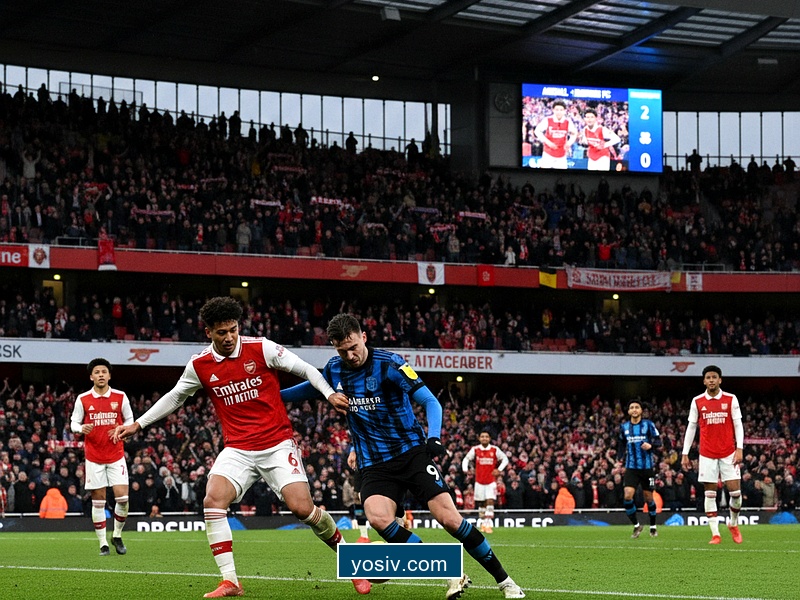
The rumor mill is rarely kind, but the recent reports from Metro suggesting Crystal Palace are already scouting replacements for Eddie Nketiah—barely months after his £30 million arrival from Arsenal—scents less like idle gossip and more like aggressive course correction. As a columnist who has spent two decades analyzing the biomechanics of Premier League forwards, this isn't shocking. It is the inevitable result of a scouting department falling in love with a name rather than a profile.
Recruitment in the modern game is often reduced to spreadsheets and "expected goals" (xG) data, but the breakdown between Nketiah and Oliver Glasner’s rigorous system at Selhurst Park is a failure of the "unseen" game. We need to strip away the price tag and look at the tape. The issues plaguing Nketiah aren't about talent; they are about geometric incompatibility with his new environment.
The Myth of the "Poacher" in a High-Press System
The lay observer sees Nketiah as a "fox in the box"—a finisher who comes alive inside the six-yard area. While historically accurate, this archetype is dying in the top half of the Premier League unless accompanied by elite pressing triggers. When analyzing Nketiah’s body language during defensive transitions at Palace, a worrying pattern emerges: the "passive reset."
Under Mikel Arteta, Arsenal’s pressing structure was so compact that Nketiah rarely had to cover large vertical distances. He was a cog in a suffocating machine. At Palace, under Glasner, the press is more chaotic and requires high-intensity sprints to close down passing lanes in the channels. Watch Nketiah’s movement when possession is lost. He has a tendency to drop his shoulders and jog backward in a straight line. In professional scouting terms, we call this "failing to affect the cover shadow."
By running in straight lines rather than arcing his run to cut off the passing angle to the center-back or pivot, he allows the opposition easy exits. This isn't laziness; it's a cognitive habit formed at an academy level where his team always had the ball. Palace requires a street-fighter who understands leverage and angles without the ball. Nketiah is pressing like a player waiting for his team to win the ball back for him, rather than winning it back himself.
Biomechanics: The Issue of Back-to-Goal Leverage
The most glaring tactical mismatch is Nketiah’s inability to act as a vertical reference point. Glasner’s system, which often relies on wing-backs and quick transitions, necessitates a striker who can "pin" a center-back. This is a specific biomechanical skill. It requires the striker to lower their center of gravity, widen their stance, and engage the posterior chain to hold off a defender while waiting for support runners like Eberechi Eze.
Nketiah lacks the skeletal frame and the specific "contact balance" for this role. When the ball is fired into him at pace—a staple of Palace’s counter-attacking variance—he frequently attempts to receive it on the half-turn or with a deft flick. While aesthetically pleasing when it works, the failure rate is too high in the chaotic midfield third.
"A striker in a mid-table side cannot treat the ball like a luxury item. It is a tool for survival. When Nketiah tries to spin a 6'4" center-back rather than secure the ball, he isn't just losing possession; he is exposing his entire team to a counter-attack because the midfield has already started moving forward in anticipation of hold-up play."
Jean-Philippe Mateta, for all his technical limitations, understands the dark arts of leverage. He uses his forearms to create separation before the ball arrives. Nketiah waits for the ball to arrive before engaging the defender, by which point the window for retaining possession has closed. This is the difference between a "shirt" and a "system player."
The "False Activity" of Dropping Deep
A disturbing trend in Nketiah's heat maps since moving to South London is his increasing desire to drop into the number 10 space to touch the ball. This is a classic symptom of a striker who lacks confidence in his supply line. In scouting circles, we refer to this as "false activity."
By vacating the central channel to come short, Nketiah compresses the space that Eze and Daichi Kamada want to operate in. He is effectively clogging his own team's creative arteries. At Arsenal, Gabriel Jesus did this effectively because the wingers (Saka and Martinelli) would immediately invert into the space Jesus vacated. At Palace, the mechanisms are different. When Nketiah drops deep, he leaves the opposition center-backs unmarked and comfortable, allowing them to step up and compress the pitch.
A top-tier scout watching Nketiah off the ball will notice a lack of "double movements." A double movement is the feint to go short before spinning long (or vice versa). Nketiah tends to make single, honest runs. In the Premier League, honest runs are easily tracked. He runs to where the ball is, rather than running to move the defender away from where the ball needs to go.
The Recruitment Disconnect: Data vs. Context
Why did this transfer happen? It reeks of "Data Scouting" without "Contextual Scouting." On a spreadsheet, Nketiah’s non-penalty xG (npXG) per 90 minutes at Arsenal looked elite. But data is dependent on game state. Nketiah accumulated those stats playing for a team that dominated 65% of possession, pinned opponents in their own box, and provided cut-backs from the byline.
Palace bought the output without understanding the ecosystem required to produce it. They needed a chaotic, physical disruptor—a modern-day Kevin Davies or a nuanced Ivan Toney type. Instead, they bought a finisher who needs white-glove service in a restaurant where the waiters are currently fighting in the kitchen.
The Verdict
The reports that Palace are looking for a replacement are not an indictment of Nketiah’s career, but they are a damning verdict on the club’s summer strategy. You cannot teach a 25-year-old poacher to suddenly develop the skeletal leverage of a target man or the relentless, curved pressing runs of a pressing monster.
If Palace keeps him, Glasner must radically alter his approach to suit the player, perhaps moving to a two-striker system where Nketiah plays off a target man. However, Premier League managers rarely change their philosophy for a £30m player; they change the player. The "unseen" work—the scanning, the pinning, the rest defense positioning—suggests Nketiah is still playing Arsenal’s game in a Crystal Palace shirt. Until he realizes he is no longer at the Emirates, he will remain a luxury player in a blue-collar system.