
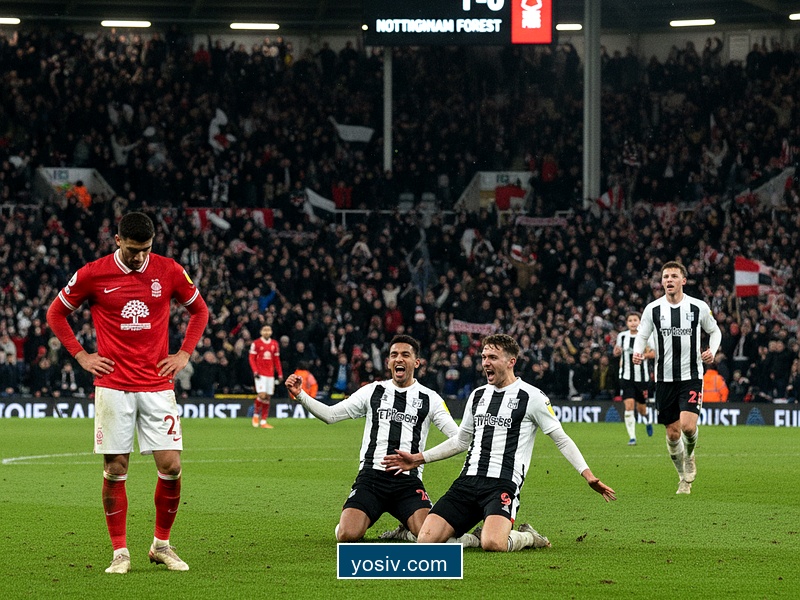
There is a specific type of victory that supporters endure, pundits dismiss, but professional scouts quietly admire. Fulham’s 1-0 triumph over Nottingham Forest was precisely that: a masterclass in the unglamorous, dark arts of Premier League game management. While the headlines will scream about a "fortunate" victory and a "toothless" Forest side, looking at the match through a wide-angle lens reveals a different narrative. This wasn't luck. This was a structural victory, spearheaded by a striker who has reinvented his mechanics to survive at the elite level.
To understand why Marco Silva's side took all three points, you have to ignore the ball for a moment. You have to look at the spaces between the lines and the body orientation of Raul Jimenez. The narrative that Fulham were lucky is lazy; they were patient, and in the modern game, patience is a tactical weapon, not a passive state.
Jimenez: The Evolution of a Target Man
Raul Jimenez’s penalty was the statistical difference, but his movement patterns prior to the spot-kick were the tactical difference. Pre-injury Jimenez was a force of nature, relying on explosive verticality. The 2024/2025 iteration of Jimenez is a cerebral assassin. Watching him against the Forest block, I noted his "scanning frequency"—the number of times a player checks their shoulder before receiving possession.
Jimenez is currently scanning at an elite rate. Before the ball even leaves a teammate's foot, he has already mapped the position of Murillo and Milenković. He isn’t trying to beat them for pace anymore; he is manipulating their starting positions. Throughout the first half, Jimenez repeatedly dropped into the "Zone 14" pocket (the space between the opposition midfield and defense). This is classic False 9 behavior, but with a twist. He doesn't drop to create, he drops to drag.
By pulling a Forest center-back two yards out of the defensive line, he created diagonal passing lanes for Fulham’s wide players. This is the "unseen work." It doesn't show up on xG (Expected Goals) charts, but it destabilizes the integrity of a low block. When Silva says Jimenez "needed" this goal for the record books, he is speaking to the psychology, but tactically, Fulham needed Jimenez to be a nuisance. His ability to receive the ball on the "half-turn"—shielding with his back arm while pivoting his hips toward goal—is currently among the best in the league. It creates fouls, it breaks rhythm, and ultimately, it creates the chaos that leads to penalties.
The Myth of the "Toothless" Attack
Sky Sports labeled Forest "toothless," implying a lack of effort or desire. A scout sees something more concerning: a structural disconnect. Forest’s issue wasn't a lack of biting; it was that their jaw was dislocated. The vertical distance between their double pivot and their front line was consistently too large, often exceeding 25 meters. In coaching terms, their team shape was "broken."
"When you play against a Marco Silva mid-block, if you don't occupy the half-spaces, you are essentially passing the ball in a U-shape until you lose patience."
Forest fell into the trap of "sterile domination." They possessed the ball in safe zones, but their body language in transition was reactive rather than proactive. Watch the hips of the Forest midfielders when they lost possession. Instead of an immediate "counter-press" trigger—sprinting to regain the ball within 5 seconds—there was a collective hesitation. They dropped back. This split-second hesitation allowed Fulham to reset their defensive shape. You cannot break down a structured Premier League defense if you allow them to breathe every time the ball turns over.
Furthermore, Forest lacked "blindside runs." Too often, their attackers made runs across the face of the Fulham defenders, where they could be easily tracked. The most dangerous runs are made from the defender's blind spot, cutting across the back shoulder. Fulham’s center-backs barely had to turn their heads. That is an indictment of Forest's offensive coaching patterns this week.
Marco Silva’s "Rest Defense"
We need to give credit to Marco Silva’s evolution. Years ago, his teams were synonymous with glass jaws—great going forward, fragile at the back. At Craven Cottage, he has instilled a rigorous "Rest Defense." This term refers to the positioning of players while their team is attacking, specifically preparing for the moment possession is lost.
Throughout the match, even when Fulham were pressing high, their defensive line held a strict structure, condensing the pitch. They utilized a high line not to catch Forest offside, but to shrink the playable area. By compressing the vertical space to about 30 meters, they suffocated Forest’s midfield creators. It wasn't spectacular; it was suffocating. This is the hallmark of a mature team. They didn't win because they were flashy; they won because they refused to become stretched.
The Psychology of the Spot Kick
Let's dissect the penalty itself. There is a biomechanical aspect to Jimenez’s technique that makes him statistically one of the best from 12 yards. Most strikers decide a corner and blast it. Jimenez waits for the "keeper collapse."
His run-up is slow, stuttered. He keeps his eyes on the goalkeeper’s knees, not the ball. The moment the keeper’s knees buckle or shift weight to one side, Jimenez rolls it to the other. It requires nerves of steel and extreme hip flexibility to adjust the foot angle at the last millisecond. It is a game of chicken, and Jimenez rarely blinks. The narrative that Fulham were "fortunate" to get the penalty ignores the composure required to convert it in a game where chances were gold dust.
The Verdict: Substance Over Style
In the modern Premier League, where data analytics often trump the eye test, this match was a reminder of the human element. Forest had the possession metrics, but Fulham had the spatial intelligence. Jimenez didn't outsprint anyone; he outthought them. Silva didn't out-attack Nuno; he out-structured him.
Scouts don't leave games like this talking about "luck." They scribble notes about Fulham’s compaction, Jimenez’s hold-up mechanics, and Forest’s inability to penetrate the half-spaces. Fulham are no longer a team just happy to survive; they are a team that knows how to win ugly. And in a league defined by chaos, the ability to control the tempo without the ball is the most sophisticated skill of all.