
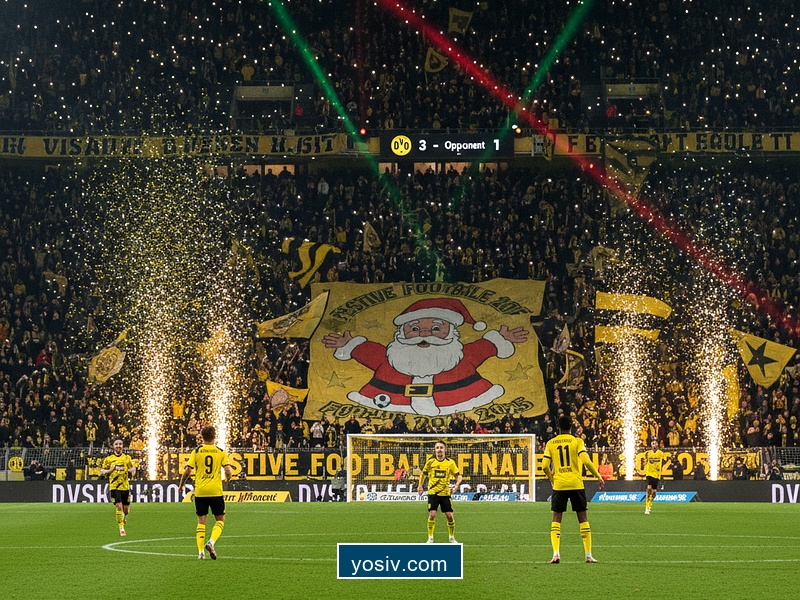
The yellow lights of the Westfalenstadion always burn a little brighter in late December. There is a specific cadence to Borussia Dortmund’s final home game of the calendar year—a mixture of glühwein, relief, and the inevitable chorus of "Jingle Bells" echoing off the Südtribüne. According to reports, the festive vibes were in full force following BVB's final Bundesliga matchday of 2025. The points are in the bag, the players are smiling, and the winter break arrives with the club in a position of strength.
But let us not be seduced by the optics of a snowy celebration. We have been here before. We have seen Dortmund sides dazzle in the Hinrunde only to dissolve into a puddle of nervous energy once the daffodils bloom. To accept these "festive vibes" at face value is a dereliction of analytical duty. The real story isn't the victory itself, nor the atmosphere; it is the tactical architecture Nuri Şahin has quietly poured concrete over for the last 18 months. Is this joy derived from fleeting individual brilliance, or is it the byproduct of a systemic evolution that can finally withstand the pressures of a title chase?
The Death of "Heavy Metal" Nostalgia
For over a decade, Dortmund chased the ghost of Jürgen Klopp. Every manager hired since 2015 was implicitly asked to recreate the heavy metal pressing intensity that defined the 2011 and 2012 title years. It was an impossible standard that led to a schizophrenic identity crisis—oscillating between Thomas Tuchel’s positional rigidity and Edin Terzić’s emotion-fuelled chaos ball. What we witnessed in this final match of 2025, however, suggests that Şahin has finally exorcised those ghosts.
The philosophy currently on display is far removed from the frantic transition game of old. It is closer to a hybrid model, borrowing the control mechanisms of Pep Guardiola’s Manchester City while retaining verticality. Şahin, influenced heavily by his tactical education under mentors like Arne Slot and his own cerebral playing days, has implemented a strict Juego de Posición. The "vibes" are good because the players are no longer relying on adrenaline to win matches; they are relying on geometry.
"The difference between a moment and an era is structure. Dortmund has spent ten years living for the moment. This winter feels different because the chaotic variance has been replaced by predictable, suffocating control."
Tactical Maturity: The Inverted Blueprint
To understand why this winter feels different, look at the heat maps of the full-backs throughout the latter half of 2025. In the Terzić era, the strategy was often width and overload. Under the current regime, we are seeing a committed use of the inverted wing-back to create a box midfield. This allows Dortmund to dominate the central corridors against low-block teams—the very teams that historically cost BVB the Bundesliga title.
This tactical shift addresses the club's fatal flaw: the vulnerability to the counter-attack. By packing the center of the pitch with four technical players, the team’s Restverteidigung (rest defense) is robust. The 2025 iteration of Dortmund does not need to run 120km per game to win; they simply strangle the opponent's transition before it begins. This conservation of energy is crucial. The festive cheer is likely fueled by a squad that isn't physically shattered, a stark contrast to the injury-ravaged winters of the past five years.
The Business of Sustainability
Sustainability in modern football is rarely about tactics alone; it is about the integration of the transfer strategy with the manager's vision. For years, Dortmund operated as a luxury finishing school. They bought elite individual talents—Jude Bellingham, Erling Haaland, Jadon Sancho—who could win games single-handedly but often operated outside a cohesive structure. When those stars left, the system collapsed.
The "Project" under the current technical director and management team has pivoted. The squad composition at the end of 2025 reflects a move toward "system players" rather than just "showcase assets." We are seeing high-technical-floor players who fit specific zones. If the festive vibes are genuine, it is because the team is no longer terrified of one star player picking up a knock. The reliance on the 'Great Man Theory' of football has vanished.
The Psychological Barrier
We must address the psychological scars. No deep dive into Borussia Dortmund is complete without acknowledging the trauma of May 2023—the home draw against Mainz that handed Bayern Munich the title. That afternoon broke something in the club's soul. It created a culture of anxiety where every lead felt precarious.
The "festive vibes" reported this week are significant not because of the points, but because of the manner of the performance. A team playing with anxiety does not generate festive vibes; they generate relief. If the atmosphere at Signal Iduna Park was truly celebratory, it indicates that Şahin has managed to rewire the collective nervous system of the squad. He has replaced fear with arrogance. In the Bundesliga, you cannot win without a degree of arrogance.
League Context: The Bayern Vacuum
Context is everything. A successful Hinrunde for Dortmund must always be measured against the Bavarian barometer. The Bundesliga landscape in late 2025 is more fractured than in the hegemonous years of the 2010s. With Bayer Leverkusen proving that the glass ceiling can be shattered and RB Leipzig consistently hovering, Dortmund's definitions of success have shifted.
The danger here is complacency. If the festive mood is derived merely from being "in the mix," it is worthless. The philosophy must be title-winning, not just Champions League-qualifying. The data suggests that Dortmund's expected goals against (xGA) has dropped significantly this season compared to the frantic 2023/24 campaign. Defense wins titles, and for the first time in years, BVB looks like a team that actually enjoys defending.
Verdict: A Corner Turned, or Another Cul-de-Sac?
It is easy to get swept up in the romanticism of the Yellow Wall waving flags in the December chill. Football is, after all, an emotional business. But the cold, hard reality is that Dortmund has been the masters of the "false dawn" for a decade. They are the kings of being the runner-up, the princes of "almost."
However, the evidence suggests this time is structurally different. The reliance on tactical discipline over emotional momentum is the key differentiator. Şahin is building a machine, not a rollercoaster. The festive vibes are not the result of a lucky streak, but the output of a coherent, high-functioning system.
If this philosophy holds through the dreary months of January and February, if they can maintain this positional rigidity on cold nights in Augsburg and Heidenheim, then the project is real. Until then, enjoy the glühwein, but keep one eye on the tactical setup. That is where the truth lies, hidden beneath the Christmas cheer.