
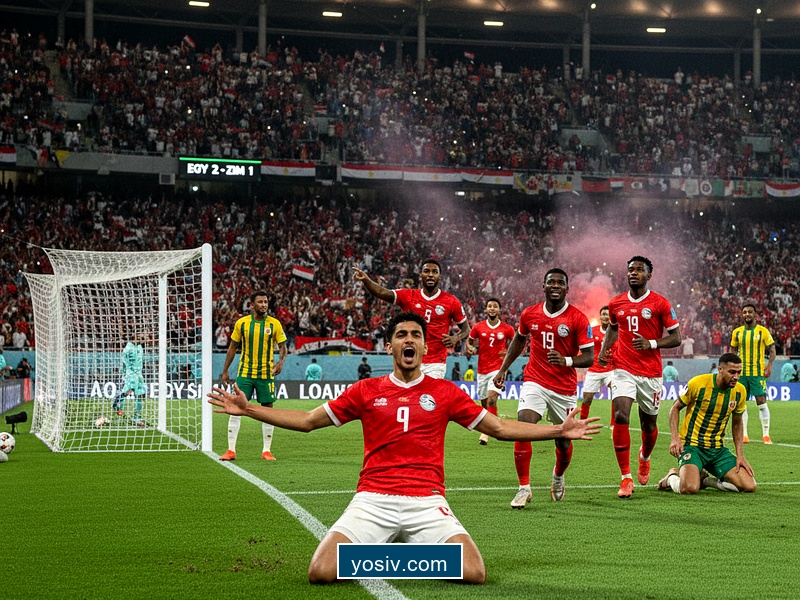
The scoreboard at the final whistle read 2-1. On the surface, Egypt’s opening victory over Zimbabwe in Morocco on this crisp December evening fits the narrative of a continental giant doing what is necessary. Mohamed Salah scored the late winner; Omar Marmoush, now carrying the weight of his Manchester City pedigree, ignited the comeback. The headlines will praise the resilience. They will speak of character.
But let us not be seduced by the romance of the last-minute rescue. To view this match as a triumph is to ignore the alarming structural cracks in the foundation of this Egyptian project. What we witnessed was not a tactical masterclass by Hossam Hassan, but an act of desperation saved by individual brilliance. If the philosophy behind this team is simply "give it to the superstars and pray for chaos," the Pharaohs are walking a tightrope over a canyon.
The Myth of "Grinta" Over Tactics
Hossam Hassan was hired to bring fire. As a player, he was the embodiment of Egyptian passion—a striker who played with a snarl. As a manager, he has attempted to transpose that personality onto a tactical system. The result, evident against a brave but limited Zimbabwe side, is a frantic brand of football that lacks the geometric sophistication required to dominate modern tournaments.
For 70 minutes, Zimbabwe didn't just frustrate Egypt; they out-maneuvered them in the transition. The Warriors’ low block was disciplined, yes, but Egypt’s inability to dismantle it revealed a startling lack of positional play. Under the previous pragmatism of Hector Cúper or the rigid structure of Carlos Queiroz, Egypt was boring but impenetrable. Under Hassan, they are exciting but porous.
"We cannot confuse energy with efficiency. Running more does not mean playing better. Egypt’s midfield spent the first half chasing shadows because the pressing triggers were non-existent."
The "Project"—if we can call it that—seems to be a rejection of the modern European methodology dominating African football (see: Regragui’s Morocco) in favor of a nostalgic return to the "street football" spirit of the early 2000s. The problem? The game has moved on. The 2006-2010 Golden Generation under Hassan Shehata won three consecutive AFCONs not just on passion, but because they possessed a telepathic understanding of space that this current squad sorely lacks.
Marmoush: The Double-Edged Sword
The equalizer came from Omar Marmoush, and his performance encapsulates the paradox of this team. Since his high-profile move to Manchester City, Marmoush has refined his game under Pep Guardiola, learning the art of the "pause" and the precise cut-back. Yet, wearing the Egyptian red, he is forced to revert to hero-ball.
Against Zimbabwe, Marmoush was dropping as deep as his own left-back position to retrieve the ball. This is a damning indictment of the midfield’s inability to progress play through the lines. When your most dangerous wide forward is initiating play from the defensive third, your structure is broken. While his solo drive and finish were sublime, relying on a winger to dribble past four defenders is not a sustainable offensive strategy against the likes of Senegal or Nigeria.
The Statistical disconnect
Comparing the tactical footprint of Egypt's dominance era to the current setup reveals the regression in control:
| Metric | Egypt (2010 Era - Shehata) | Egypt (2025 - vs Zimbabwe) |
|---|---|---|
| Possession Structure | Patient, Triangle-based | Vertical, Direct, Chaotic |
| Turnovers in Midfield | Low (About 8 per game) | High (22 recorded today) |
| Reliability | System created chances | Individuals create chances |
The Salah Dilemma: Savior or Crutch?
Then there is Mohamed Salah. The Liverpool icon is undoubtedly chasing legacy. He wants the continental trophy that has eluded him, the one piece of silverware that would elevate him above the criticisms of his international career. His late winner was pure instinct—a ghosting run into the box that Zimbabwe failed to track.
However, the reliance on Salah is becoming a tactical straitjacket. The "Project" seemingly dictates that every attack must eventually filter through the right half-space. Zimbabwe knew this. They overloaded that flank, nullifying Salah for large swathes of the game. It was only when the game fractured in the dying minutes—when tactics dissolved into fatigue—that Salah found space.
This is the fundamental flaw in Hassan’s approach. He is betting on the game breaking down. He wants the frantic back-and-forth because he believes his individuals are superior in a shootout. But tournament football, especially in the knockout stages, is rarely about chaos. It is about control. By failing to establish a coherent rest-defense (the structure adopted while attacking to prevent counters), Egypt offered Zimbabwe three clear-cut chances on the break. Better finishers would have buried the game before Salah ever had his moment.
Sustainability of the emotional Wave
Can Egypt win the AFCON playing this way? Perhaps. The tournament is being held in North Africa, and the emotional wave of the crowd in Morocco (heavily populated with traveling Egyptian ultras) acts as a twelfth man. Emotion is a powerful drug in football.
But history warns us against mistaking adrenaline for ability. Ivory Coast in 2023 (played in 2024) won on pure miracle energy, surviving by the skin of their teeth. Is that the blueprint Egypt wants to follow? It is a high-risk strategy that usually ends in heartbreak. The great teams—the 2002 Cameroon side, the 2019 Algerians—controlled their destiny. They didn't need comebacks against Zimbabwe.
The managerial philosophy here appears to be a reactive one. There is no evidence of a proactive plan to break down low blocks other than "give it to Mo or Omar." In the modern game, where video analysis exposes one-dimensional teams within weeks, this lack of complexity is negligence.
The Verdict
The three points are on the board. The fans in Cairo are celebrating. But the technical staff should be worried. The comeback win over Zimbabwe has papered over the cracks of a disjointed system that relies too heavily on the individual brilliance of its Premier League stars.
If the objective of this "Project" is to build a team for the future, tonight was a failure. If the objective is to win this specific tournament by any means necessary, they are alive, but living dangerously. Hassan must realize that grit is a garnish, not the main course. Unless he installs a midfield structure that can control the tempo and protect his backline, the euphoria of this late winner will be a distant memory when they face a team that refuses to panic.