
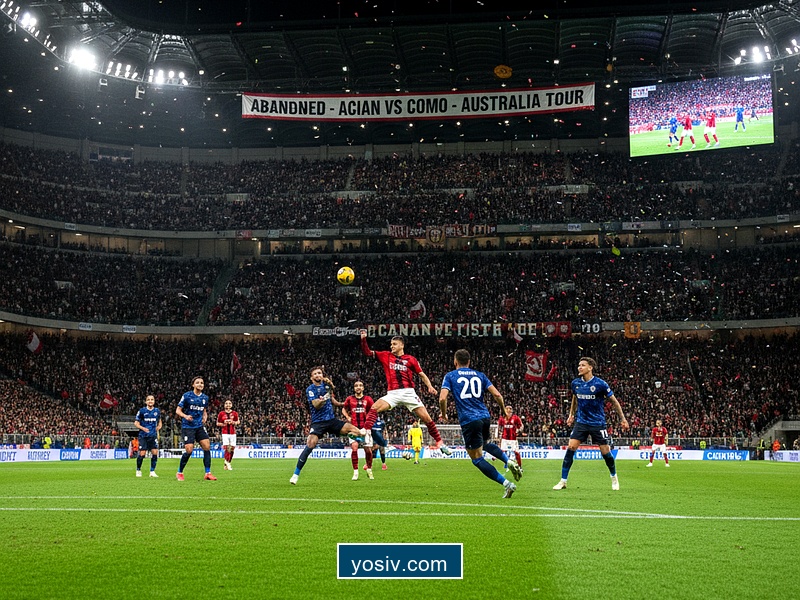
The announcement that the proposed exhibition match between AC Milan and Como 1907 in Perth, Australia, has been abandoned will be met with groans in the marketing departments of Via Aldo Rossi and disappointment from the expatriate faithful down under. But inside the tactical war room at Milanello, and within Cesc Fàbregas’s lakeside laboratory, glasses should be raised. This cancellation is not a commercial failure; it is a sporting reprieve.
Modern football creates a dissonance between the "Club as a Brand" and the "Club as a Team." The former demands ubiquity, forcing exhausted squads to hawk jerseys in torrential rainstorms in Perth or humid bowls in New Jersey. The latter demands specificity, rest, and repetition. For Paulo Fonseca’s AC Milan, a project teetering between brilliance and fragility, avoiding a 17,000-kilometer round trip for a glorified kickabout is the most significant tactical victory of the season.
The RedBird Algorithm vs. The Grass Roots
To understand why this cancellation matters, one must dissect the friction at the heart of the Rossoneri ownership. RedBird Capital, led by Gerry Cardinale, views AC Milan as a media asset. Their strategy is explicitly American: expanding the IP, leveraging the intersection of sports and fashion, and turning players into content creators. The proposed Australia trip was a classic play from this playbook—exporting the product to untapped markets.
However, the "product" is currently broken on the pitch. Paulo Fonseca was hired not as a custodian, but as an architect. His mandate was to dismantle the vertical, individualistic chaos of the late Stefano Pioli era and install a dominant, possession-based system. This is not a plug-and-play update. It requires the kind of neural rewiring that only happens on the training pitch, not in business class cabins.
Fonseca’s philosophy relies on sophisticated positional interchanges. He demands his double pivot (often Fofana and Reijnders) to manipulate space rather than just cover grass. He requires his fullbacks to invert or overlap based on the trigger movements of Rafael Leão and Christian Pulisic. When Milan plays well, they look like a European elite. When they play poorly, the distances between the lines stretch to the horizon, leaving the center-backs exposed to humiliating transitions.
The cancellation of a commercial tour is the modern equivalent of a new signing. It buys the one commodity money cannot purchase: time.
History provides a cautionary tale. Look at the summer of 2023, where Milan spent weeks traversing the United States. The commercial revenue was substantial, but the team started the season with visible disjointedness in defensive transitions. High-pressing systems, like the one Fonseca desires, wither under the weight of jet lag. By scrapping the Australia plan, Milan inadvertently prioritized the Scudetto chase over the balance sheet.
Como: The Vanity Project That Became Real
On the other side of this abandoned fixture lies Como 1907. It is lazy to categorize Como merely as the plaything of the Hartono brothers. While the celebrity shareholders (Thierry Henry, Dennis Wise) suggest a retirement home for the famous, the appointment of Cesc Fàbregas as manager signals a profound tactical ambition.
Fàbregas is not managing to survive; he is managing to innovate. A disciple of the Wenger and Guardiola schools, Fàbregas is attempting to implement a style of play that is alien to the relegation scrap. We are talking about baiting the press, playing out from the back with high-risk passes, and utilizing technically gifted midfielders like Nico Paz to control tempo.
For a newly promoted side, this is suicide or genius, with very little middle ground. A trip to Australia would have treated Como as a novelty act—the "cool" Italian team with the nice kits. But Fàbregas needs his squad to be treated as Serie A grinders. Dragging a squad fighting for survival to the Southern Hemisphere would have been an act of hubris. They need tactical drilling on defensive shape, not a promotional tour celebrating their aesthetic.
The Sustainability of the "Showtime" Model
The abandonment of this match forces us to confront the sustainability of the managerial projects in Serie A. We are seeing a shift in Italy. The era of the defensive pragmatist—the Allegri archetype—is fading, replaced by coaches who view football as a systemic, proactive endeavor. Thiago Motta at Juve, Fonseca at Milan, and Fàbregas at Como represent this shift.
This style of football is cognitively demanding. It is not about "grinta" (grit); it is about geometry. When player fatigue sets in, mental sharpness dulls. When sharpness dulls, the geometric shape collapses. This is why the Premier League teams often struggle tactically in December; the volume of matches erodes the system.
If Milan wants to sustain a challenge against Inter’s mechanized efficiency or Napoli’s Conte-driven intensity, they cannot treat their players like Harlem Globetrotters. The sustainability of the "Milan Project" under RedBird hinges on results. If Fonseca fails to deliver a trophy or a deep Champions League run, the brand value decreases far more than the loss of ticket sales in Perth.
Tactical Theory: The Cost of the Flight
Let’s look specifically at Milan’s defensive issues this season. They suffer from a lack of compactness. Under Fonseca, the defensive line holds high, relying on an offside trap that requires telepathic synchronization between Tomori, Pavlovic, or Gabbia. One millisecond of delay—the kind caused by accumulative fatigue—turns a successful trap into a one-on-one with Mike Maignan.
Furthermore, Milan’s reliance on Rafael Leão is a double-edged sword. Leão is a cheat code in isolation but a liability in the press. Fonseca has been trying to construct a system that covers for Leão’s defensive apathy without stifling his offensive genius. This requires the other nine outfield players to work harder, shift faster, and communicate constantly. This is high-energy, high-cognitive load football. It does not travel well.
Had the Australia match proceeded, we likely would have seen a dip in performance in the subsequent domestic fixtures. Muscle injuries, which have plagued Milan for three years, spike after transcontinental travel. The medical staff at Milanello likely viewed the Perth contract with dread. Its cancellation is a victory for sports science over sports marketing.
The Verdict
The abandonment of Milan vs. Como in Australia is a non-story for the news cycle, but a headline event for the football purist. It represents a rare moment where the relentless churn of the football industrial complex halted, blinking in the face of logistical reality.
For Paulo Fonseca, currently walking a tightrope between skepticism and promise, this is a lifeline. He needs his players in Milanello, eating properly, sleeping in their own beds, and watching video analysis of defensive shape—not waving at fans in a different hemisphere. The project requires cement, not glitter. And cement takes time to dry.