
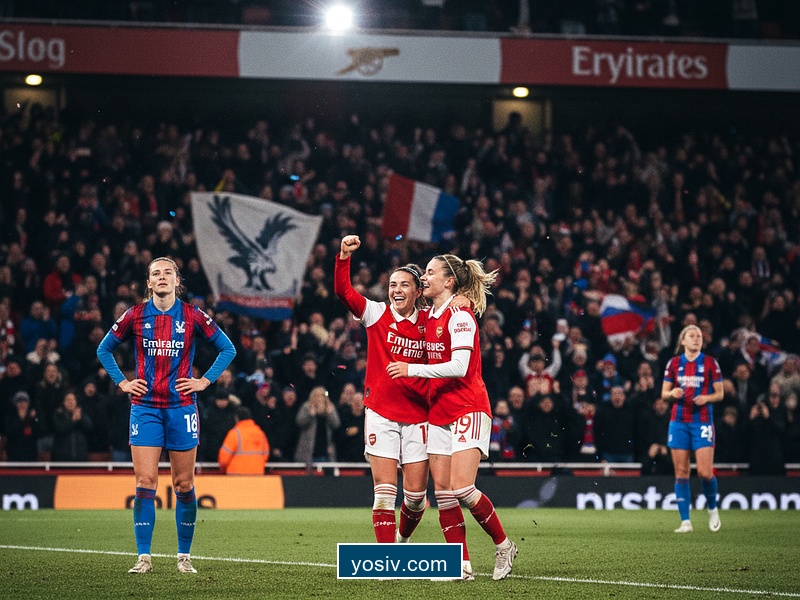
The scoreboard at the VBS Community Stadium read Crystal Palace 0, Arsenal 2, but the cold, hard integers of a League Cup quarter-final rarely tell the full story. For the casual observer, this was a routine dispatching of a Championship side by a Women’s Super League juggernaut. It was professional. It was expected. But for those of us who have tracked the trajectory of this club since the days when they played on park pitches in front of one man and his dog, the significance of Sunday’s victory wasn't the goals. It was the return of the number 6 shirt.
Leah Williamson’s first start following her devastating ACL injury is not merely a squad boost; it is the restoration of an ideological pillar. To understand why, we must look backward before we look forward. We must contextualize this modern Arsenal side against the monolithic shadow of the legends that built the house: the Vic Akers generation.
The Ghost of the Quadruple
Twenty years ago, Arsenal Ladies (as they were then known) were not just a football team; they were an inevitability. Under Vic Akers, they operated with a ruthlessness that the current WSL, with its parity and broadcast deals, can scarcely comprehend. The 2006-2007 season remains the gold standard of British women's football—a Quadruple-winning campaign that included the crowning glory of the UEFA Women's Cup (now the Champions League).
That team didn't just win; they strangled opponents. They went on a 108-game unbeaten run in the league between 2003 and 2009. The DNA of that side was forged in the fires of leaders like Jayne Ludlow, Kelly Smith, and the indomitable Faye White. When we watch Arsenal today, struggling for consistency in a league dominated by Chelsea’s wallet and Manchester City’s infrastructure, we are constantly measuring them against that impossible ghost.
The return of Williamson bridges that gap. While the game has evolved from the physical attrition of the 2000s to the tactical chess of the 2020s, the requirement for a totemic figure at the heart of the defense remains unchanged. Williamson is the spiritual successor to Faye White, yet she represents the total evolution of the center-back position.
White vs. Williamson: The Evolution of the Armband
Comparing Faye White to Leah Williamson offers a perfect case study in how the sport has transformed. White, the captain of that legendary 2007 side, was a defender in the classical English mold. She was a stopper. Her game was defined by aerial dominance, last-ditch tackles, and a willingness to put her head where most wouldn't put their boots. She played with a bandage around her head as often as she played without one. Her job was to destroy.
Williamson is the antithesis of the destroyer; she is an architect. Against Crystal Palace, her influence wasn't measured in bruised shins but in progressive passing yards. In the modern game, the center-back is the first playmaker. Williamson possesses the vision of a midfielder—a trait she shares with former teammate and legend Jen Beattie, but with superior mobility.
"In the Akers era, the defense was a castle wall. Today, under Eidevall, the defense is the launchpad. Williamson doesn't just protect the goal; she dictates the tempo of the entire match from the 18-yard line."
This tactical shift is crucial. Against a deep block like Crystal Palace, a traditional stopper is redundant. You need a player who can step into midfield, overload the central channels, and thread the ball through the 'eye of the needle.' That is what Arsenal have missed desperately in her absence. Lotte Wubben-Moy has been heroic, developing into a fantastic defender in her own right, but Williamson brings a calmness that permeates the entire eleven.
Tactical Era Comparison
| Attribute | The Akers Era (c. 2007) | The Eidevall Era (Current) |
|---|---|---|
| Defensive Shape | Rigid 4-4-2 Flat | Fluid 4-3-3 / 4-2-3-1 |
| CB Role | Stopper / Sweeper (Clear lines) | Ball-Playing / Quarterback (Build-up) |
| Possession | Direct, Counter-attacking pace | High possession, intricate triangles |
| Captain Profile | Faye White (The Warrior) | Leah Williamson (The Technician) |
The Palace Job: More Than Just Qualification
Let's dissect the match itself. A 2-0 win away at Palace in the League Cup might seem perfunctory, but the reaction of Lotte Wubben-Moy tells you everything about the current psychological state of the squad. Her post-match comments focused on "building momentum." This is code for "stabilizing the ship."
In the mid-2000s, Arsenal would have likely beaten a second-tier side 7-0 without breaking a sweat. The gap has closed, yes, but Arsenal's recent inconsistent form has made these banana skins more slippery. The clean sheet here is the vital statistic. With Williamson back partnering Wubben-Moy or Codina, the communication lines are re-established.
The goals—often the headline grabbers—were secondary to the control exerted. In the first half, there were moments of rust, understandable given the rotation. But the second half showed the "Arsenal Way" re-emerging: rapid ball circulation, switching play from flank to flank to stretch the tired Palace legs. This was reminiscent of the 2006 team wearing down opponents like Umeå IK, not through brute force, but through relentless technical superiority.
The Necessity of Silverware
We must address the uncomfortable reality of the trophy cabinet. For a club with Arsenal’s history, the drought of league titles since 2019 is becoming a crisis of identity. The Continental Tyres League Cup (Conti Cup) has often been sneered at by purists as the lesser of the domestic honors. However, in the current climate, Jonas Eidevall cannot afford to be choosy.
Vic Akers hoarded FA Cups like they were receipts. He won 14 of them. The current Arsenal side needs to rediscover that habit of winning, regardless of the competition. The victory over Palace keeps a pathway to silver open. It provides a platform for Williamson to regain match fitness before the crucible of the WSL title race heats up and the Champions League demands intensify.
A Warning from History
There is a cautionary tale from the archives. After the Invincibles and the Quadruple winners, Arsenal went through a painful transition as other clubs professionalized. They relied too long on the fading grandeur of their golden generation. They cannot make the same mistake now by assuming Williamson’s return instantly fixes the systemic issues in breaking down low blocks that have plagued them this season.
Leah Williamson is world-class. She is, frankly, the best ball-playing defender on the planet when fit. But she is not a time machine. She cannot transport the team back to 2007 when they were the only professional outfit in town. She can, however, provide the spark of arrogance—the good kind—that defined the club for two decades.
The 2-0 win at Palace was a small step, but seeing the captain's armband back on the arm of a homegrown talent who understands the weight of the marble halls? That is a giant leap. The steel of the Akers era hasn't been replaced; it has been refined, polished, and on Sunday, it finally returned to the pitch.