
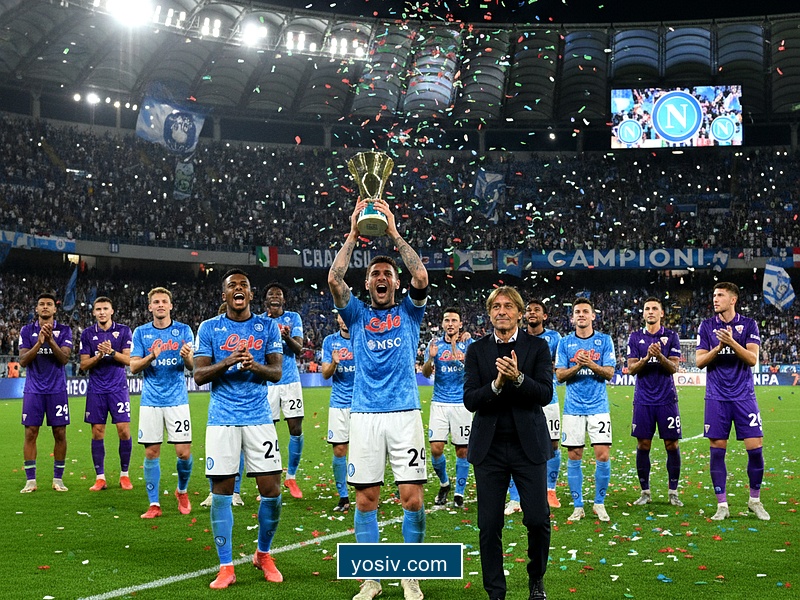
Antonio Conte stood on the podium in Riyadh, the Saudi air thick with confetti and the echoes of "O Sole Mio," clutching the Supercoppa Italiana. It was a moment of vindication for a manager brought in to restore order to a club that had violently oscillated between Scudetto ecstasy and mid-table depression in the span of twenty-four months. Yet, in the post-match presser, the Pugliese tactician doused the celebratory limoncello with a bucket of ice water.
"We are not ready to dominate," Conte muttered, his eyes scanning the back of the room rather than the trophy sitting before him. "Winning a knockout game is not the same as commanding a league."
He is right. And he is terrified. Not of the opposition, but of the history that haunts the Stadio Diego Armando Maradona. To understand Conte’s reticence, we must look beyond the scoresheet and compare this embryonic squad to the last Napoli team that truly frightened Europe—the Walter Mazzarri era of the early 2010s—and the Juventus machine Conte himself built a decade ago.
The Mirage of the "Three Tenors"
To the uninitiated, Napoli’s current victory feels like a return to the peak. But those of us who sat in the press box at the San Paolo in 2011 know the difference between kinetic energy and structural dominance. The benchmark for this Napoli side isn't the Luciano Spalletti Scudetto winners of 2023—that was a tactical unicorn, a perfect storm of Osimhen and Kvaratskhelia peaking in a vacuum.
The true comparison is the 2010-2013 Napoli under Mazzarri. That team possessed the "Three Tenors": Edinson Cavani, Ezequiel Lavezzi, and Marek Hamsik. They were heavy metal football personified. They didn't control games; they detonated them. I recall the 2012 Coppa Italia Final, where they strangled Conte’s invincible Juventus 2-0. It was pure adrenaline, fueled by counter-attacks that moved faster than the camera could track.
However, that team never dominated. They were insurgents. They thrived on chaos. Conte’s current rejection of the "dominance" label stems from his obsession with control. He looks at his current squad—Romelu Lukaku holding up play, Scott McTominay driving from deep, Alessandro Buongiorno marshalling the back three—and sees a team that knows how to suffer, but not yet how to suffocate.
"Dominance is not scoring three goals on the break. Dominance is taking the ball in the first minute, keeping it until the ninetieth, and never letting the opponent believe, even for a second, that they belong on the same pitch." — Antonio Conte (Archived, 2013)
Tactical Evolution: The 3-4-3 of Then vs. The 3-5-2 of Now
The distinction lies in the geometry of the pitch. Mazzarri’s 3-4-2-1 was vertical. In 2011, Gokhan Inler and Walter Gargano were destroyers, tasked solely with winning the ball to launch Lavezzi. It was exhilarating but fragile. If the opponent sat deep, Napoli crumbled.
Conte is attempting to engineer something far more cynical and sustainable. His current 3-5-2 (or hybrid 3-4-3) relies on "automations"—pre-rehearsed passing sequences that remove the need for improvisation. He doesn't want the mercurial brilliance of a Lavezzi; he wants the robotic efficiency of his 2012 Juventus midfield (Vidal-Pirlo-Marchisio). He doesn't have that yet. Stanislav Lobotka is a metronome, but he lacks the vertical passing range of Andrea Pirlo. Andre-Frank Zambo Anguissa has the lungs of Arturo Vidal but lacks the finishing instinct.
Conte denies they are ready to dominate because he knows they are winning on grit ("Grinta") rather than systemic superiority. The Super Cup win was a victory of moments, not a ninety-minute lecture.
The Statistical Gap: Chaos vs. Control
Let’s look at the metrics that keep Conte awake at night. We can compare the 2011/12 "Golden Era" Napoli with the current Conte iteration to see why he refuses to accept the favorite tag.
| Metric | Mazzarri's Napoli (2011-12) | Conte's Napoli (Current) | Conte's Ideal (Juve 2012) |
|---|---|---|---|
| Possession % | 46% (Counter-Attack) | 51% (Transition) | 58% (Control) |
| Goals Conceded (Avg) | 1.1 per game | 0.8 per game | 0.5 per game |
| Source of Goals | Solo Brilliance (Cavani) | Set Pieces / Wing Play | Midfield Runners |
| Points Dropped (Bottom 10) | High (Inconsistent) | Moderate | Zero (Ruthless) |
The data highlights the problem. Mazzarri’s team dropped points against the minnows—Chievo, Bologna, Siena—because they couldn't break down a low block. Conte sees the same flaw in his current squad. They can beat Inter or Milan in a one-off Super Cup clash because the big teams attack, leaving space. But to dominate Serie A, you must beat Empoli 1-0 on a rainy Tuesday night without breaking a sweat. Napoli is not there yet.
The Ghost of Expectations
There is a psychological dimension here that is uniquely Neapolitan. In Turin or Milan, a trophy is an expectation; in Naples, it is a canonization. When Napoli won the UEFA Cup in 1989 or the Scudetto in 1990, the city partied for months. The subsequent hangover lasted decades.
Conte is waging a war against this environment. By publicly stating "we are not ready," he is trying to inoculate his players against the "Scudetto of August" syndrome—the media hype that declares Napoli champions before the winter frost sets in. He remembers 2018 under Maurizio Sarri, a team that played beautiful football, earned 91 points, and won nothing. Why? Because they lacked the cynicism to grind out results when the aesthetics failed.
He looks at Khvicha Kvaratskhelia and sees immense talent, but questions if the Georgian has the mental callousness of a Pavel Nedved. He looks at Lukaku and wonders if he can maintain the intensity of a Carlos Tevez for 38 rounds. The Super Cup is dangerous for Conte because it validates the talent without testing the endurance.
The League Context: Why the Super Cup Lies
We must also contextualize the opposition. Italian football in 2025 is in a state of flux. Inter remains the squad with the deepest roster, built by Beppe Marotta to withstand injuries. AC Milan is a project of American algorithms, high ceiling but low floor. Juventus is rebuilding its identity.
In this landscape, Napoli’s Super Cup win is akin to a boxer winning the first round on a heavy haymaker. It’s impressive, but it doesn't prove cardio. Conte knows that his bench depth is arguably 40% weaker than Inter’s. If Lobotka or Di Lorenzo suffer an injury, the "automations" break down. In 2012, when Maggio or Zuniga were out, Mazzarri’s Napoli lost their width and collapsed. Conte is seeing the same thin ice beneath his feet.
The Verdict
Antonio Conte is a manager who treats compliments like poison. His declaration that Napoli is "not ready to dominate" is half truth, half motivational strategy. He is trying to strip the joy out of the victory to focus on the labor of the league.
This Napoli side possesses the fire of the Cavani years, but they have not yet acquired the ice of the Lippi or Capello years. Until they can go to the Stadio Benito Stirpe in Frosinone and win with the boring, inevitable efficiency of a glacier, Conte will not admit they are kings. He doesn't want to be the manager of a team that wins a cup and fades; he wants to build a dynasty. And dynasties are not built on confetti; they are built on the denial of satisfaction.
Napoli has the hardware, but Conte is right: they do not yet have the hegemony.