
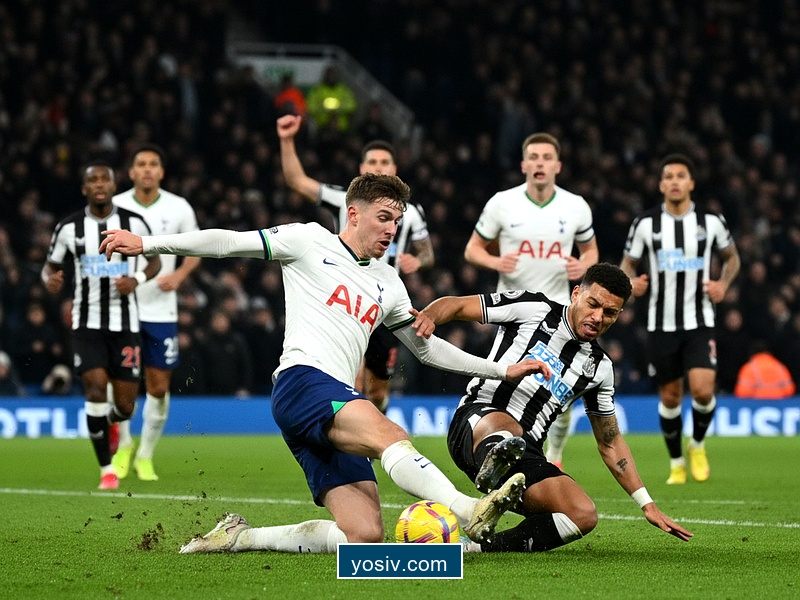
The sound of a tibia snapping is distinct. It is a dull, dry crack that cuts through the ambient noise of a packed Anfield, instantly silencing 60,000 people. When Arne Slot stood before the press cameras, his face drawn and pale, to accuse Micky van de Ven of being "reckless," he wasn't just speaking as a grieving manager. He was identifying a systemic issue in modern defensive mechanics. The confirmation from Liverpool’s medical team that Alexander Isak has suffered a severe leg fracture and broken ankle isn’t just a tragedy for the Swede; it is a damning indictment of the Premier League’s obsession with recovery pace over positional intelligence.
As a scout, you look for specific markers in a challenge. You look for intent, sure, but mostly you look at biomechanics. What we saw between Liverpool’s new talisman and Tottenham’s speed merchant was a collision of physics that only had one outcome.
The Mechanics of the "Desperation Slide"
To understand why this injury happened, we have to strip away the emotion and look at the data profiles of the two athletes involved. Micky van de Ven is currently one of the fastest center-backs in world football. His top speed clocks regularly above 37 km/h. This asset, however, is a double-edged sword.
In scouting terms, we call this the "Recovery Crutch." Defenders with elite speed often develop poor initial positioning habits because they know their pace can bail them out. When Van de Ven launched into that challenge, he was traveling at near-maximum velocity. The kinetic energy generated by a 193cm defender moving at that speed is immense.
The "reckless" nature Slot alludes to isn't about malice; it's about control. At that velocity, once a player commits to the slide—specifically the "scissor" motion where the trailing leg sweeps through—they surrender all agency. They become a projectile. Van de Ven didn't tackle the ball; he tackled the space the ball occupied, and Isak’s plant foot was the collateral damage. It is a technique that is increasingly coached out of academies in Spain and Italy, yet remains fetishized in the Premier League as "commitment."
Isak’s Movement Profile: The Victim of his own Grace
Alexander Isak is a unique physiological specimen. Standing 6'4" but possessing the agility of a winger, his center of gravity is deceptively high. Watch his tape from the last six months. His movement patterns in the final third are predicated on what we call "stop-start deceleration." He lures defenders in, pauses, and then explodes.
This style invites contact. But unlike a low-center-of-gravity player like Mohamed Salah or Bernardo Silva, who can ride challenges by bouncing off contact, Isak’s height means his legs act as long levers. When his foot is planted to execute a pivot or a shot, the torque on his ankle is already high.
The moment of impact occurred during a transition phase. Isak had dropped into the half-space—a classic Slot trigger—to receive and turn. His weight was fully committed to his left leg (the anchor). When Van de Ven arrived, there was zero "give" in Isak’s joint. The force had nowhere to go but through the bone. It is the cruelest aspect of the sport: the very biomechanics that make Isak an elegant striker also make him structurally vulnerable to high-velocity impact.
Tactical Fallout: The Death of the "False Target"
The injury report confirms Isak is out "indefinitely." For Arne Slot, this is not a plug-and-play situation. Liverpool’s tactical setup this season has evolved specifically around Isak’s hybrid skillset. He isn’t just a goalscorer; he is the team's primary pressing trigger and link-up pivot.
Slot demands his number 9 to perform two contradictory functions:
- Vertical Stretching: Pushing the opponent's defensive line back to create midfield space.
- The False Drop: Coming short to overload the midfield pivot.
Isak was executing these movements with 94% efficiency in pass reception retention. If Liverpool turns to Darwin Nuñez, the tactical geometry changes fundamentally. Nuñez is an agent of chaos, a "channel runner." He does not possess the pause-and-wait temperament required for Slot’s control-based build-up. Nuñez attacks space; Isak creates it.
Without Isak, Liverpool’s "rest defense"—their structure while in possession—becomes vulnerable. Isak’s ability to hold the ball allowed the midfield line to compress. If the replacement striker loses the ball cheaply (a Nuñez trait), Liverpool will be exposed to counters, exactly the scenario that led to Van de Ven’s tackle in the first place.
The Refereeing Directive and Player Safety
We must address the elephant in the room: the officiating standard regarding "follow-through." The Premier League has raised the bar for physical contact this season to encourage game flow. While aesthetically pleasing, it creates a grey area for defenders.
Referees are currently instructed to look at the point of contact on the ball. If the defender touches the ball first, the subsequent carnage is often deemed incidental. This is a flawed application of the laws of physics. Van de Ven got a toe on the ball. Technically, a "clean" tackle in the eyes of 1990s punditry. But the trailing leg—the one that fractured Isak’s tibia—carried the force of a car crash.
Professional scouts and coaches argue that "endangering the safety of an opponent" should supersede "winning the ball." If your velocity is so high that you cannot arrest your momentum before breaking a bone, the tackle is, by definition, reckless. Slot is correct in his assessment. The tackle was uncontrolled, regardless of ball contact.
The Road to Recovery: Psychological Scarring
The physical surgery is just step one. Modern orthopedics are miraculous; Isak’s bone will heal. The metal rod inserted into his tibia will make the leg stronger than before. The real challenge is the "phantom flinch."
I have tracked dozens of players returning from compound fractures—Andre Gomes, Virgil van Dijk, Harvey Elliott. The data shows a distinct change in their "engagement distance" for the first 12 months post-return. They release the ball 0.5 seconds earlier. They hesitate to plant the foot in 50/50 duels.
For a player like Isak, whose game relies on baiting defenders into committing before skipping past them, this psychological hurdle is massive. If he loses that split-second arrogance—the belief that he is quicker than the tackle—he becomes an ordinary striker.
Conclusion? No, a Warning.
This incident will be debated on talk shows as a singular unfortunate event. It isn't. It is a symptom of a league where athleticism has outpaced regulation. Players are faster and stronger than ever before, but the human skeleton has not evolved to withstand the impacts generated by the likes of Micky van de Ven at full flight.
Liverpool has lost their structural lynchpin. Tottenham has likely lost their defender to a lengthy suspension if the FA reviews the "excessive force" guidelines correctly. But the game has lost one of its most graceful movers to the brute force of raw speed. Until the definition of a "good tackle" evolves to account for momentum and follow-through, the surgery wards will continue to fill up with the league's best technicians.