
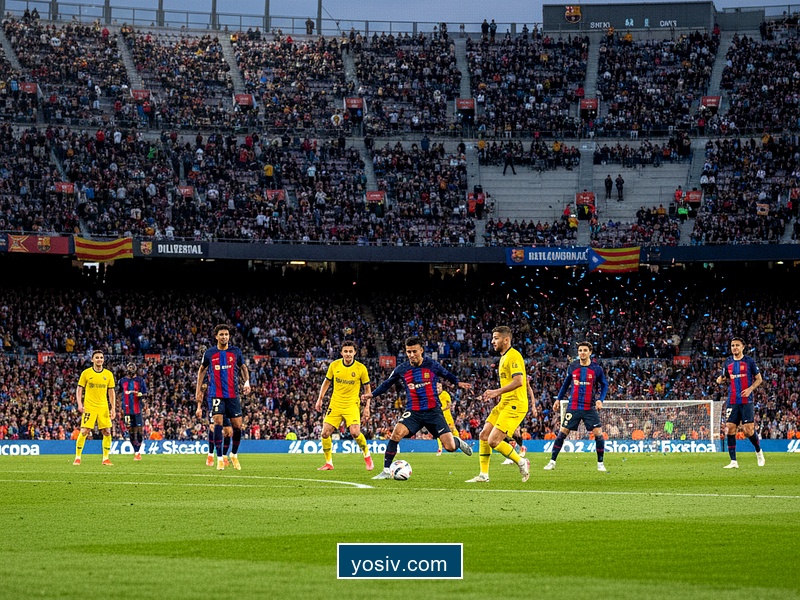
The teamsheet for a fixture against Villarreal usually invites a discussion about rotation, fatigue, and the grind of La Liga. When the news drops about a "major absence"—in this case, the unavailability of Ferran Torres due to suspension—the immediate punditry focuses on who slots into the left wing or the false nine role. Is it Ansu Fati? Does Raphinha shift central? Does Pau Víctor get a look?
These questions, while valid for fantasy football managers, miss the forest for the trees. The lineup Hansi Flick puts out at the Estadio de la Cerámica is not merely a tactical selection; it is a manifesto on the sustainability of his high-risk, high-reward project. We are witnessing a collision between German efficiency and Catalan chaos, and looking at the predicted lineup offers a window into the soul of a club that is trying to sprint a marathon.
The Death of the "DNA" Discussion
For nearly two decades, every Barcelona manager has been shackled by the ghost of Johan Cruyff. The requirement wasn't just to win; it was to win while monopolizing the ball. Xavi Hernández, for all his love for the club, drowned in this philosophical purity test. Hansi Flick has done something radical: he has ignored it.
The "Major Absence" headline is significant not because Ferran Torres is irreplaceable—he is visibly not—but because his absence forces Flick to double down on a physical, vertical style of play with a squad that is thinner than paper. Unlike the obsession with horizontal control, Flick’s Barcelona is obsessed with verticality. The metric that matters now isn't pass completion percentage; it is the number of sprints made into the final third.
When we look at the predicted lineup, likely featuring teenagers like Lamine Yamal and perhaps a heavily burdened Pedri, we aren't seeing a "La Masia dream." We are seeing financial necessity masquerading as youth development. Flick’s project is built on the precarious assumption that 17-year-old bodies can withstand the physical demands of a Gegenpress system usually reserved for prime athletic specimens like the 2020 Bayern Munich squad.
The Offside Trap as a Lifestyle
To understand the risk Flick is taking against a team like Villarreal, you must look at the defensive line. This season, Barcelona has caught opponents offside more than any other team in Europe's top five leagues by a significant margin. This isn't luck. It is a calculated gamble.
"Flick does not ask his defenders to defend space; he asks them to compress it until it vanishes. It requires a level of mental synchronization that usually takes years to build. He is trying to install it in months."
Against Marcelino’s Villarreal, a team that thrives on rapid transitions and exploiting space behind full-backs, this high line is the ultimate litmus test. Marcelino is one of the few managers in Spain who refuses to be baited into sterile possession. He wants to hit you fast. If Inigo Martinez or Pau Cubarsí step up a fraction of a second too late, the "Project" looks naïve. If they time it right, it looks revolutionary.
This tactical stubbornness defines the current regime. Flick demands the defensive line play at the halfway line not because he wants to dominate possession, but because he wants to shorten the pitch to make pressing easier for a midfield that lacks a true, world-class physical destroyer in the mold of a prime Sergio Busquets or a Javi Martinez.
The Raphinha Paradox and the New Meritocracy
The predicted lineup highlights the fascinating evolution of Raphinha. Under the previous regime, the Brazilian was constantly scrutinized for his lack of "samba" flair compared to Neymar or Ronaldinho. Under Flick, Raphinha has become the captain without the armband. Why? Because Flick’s philosophy values output over aesthetics.
Raphinha’s pressing numbers are elite. His willingness to make unselfish runs creates the space that Lamine Yamal exploits. In the absence of key attackers, Raphinha is the glue holding the attack together. This signals a cultural shift at the club. The hierarchy is no longer determined by pedigree or price tag, but by cardiovascular capacity.
This meritocracy is refreshing, but it is also dangerous. By relying so heavily on the players who are willing to run themselves into the ground, Flick risks reaching a physical cliff edge by February. We saw this movie before with Pedri in his breakout season. The "Major Absence" today might be a suspension, but the fear is that the major absences in March will be muscular injuries across the board.
Can Chaos Be Structured?
The Villarreal match represents a specific tactical hurdle: The "Mid-Block Trap." Villarreal is comfortable sitting deep and springing traps. Barcelona’s predicted lineup, likely featuring Eric Garcia or Marc Casadó in the pivot, lacks the press-resistance of a Frenkie de Jong or the spatial awareness of Gavi.
This forces the game into a state of structured chaos. Flick wants the game to be frantic. He believes his team can win a shootout. It is a departure from the control-freak nature of Guardiola or Xavi. Flick is essentially saying, "We will create five big chances. You might create three. We will win on volume."
However, this variance is terrifying for a club that needs stability. La Liga is won by grinding out boring wins away from home, not by engaging in basketball matches on grass. If Barcelona concedes two goals to Villarreal but scores three, the fans will cheer, but the analysts should worry. A title challenge built on outscoring your defensive frailties is sustainable in the Bundesliga, perhaps, but rarely in La Liga, where low blocks are an art form.
The Verdict: A Necessary Gamble
Ultimately, the lineup against Villarreal is a reflection of the hand Flick has been dealt. He is navigating a salary cap crisis, a stadium renovation, and a boardroom that is perpetually on fire. In this context, his philosophy is the only logical path.
He cannot buy a squad of Galacticos, so he must manufacture a squad of soldiers. He cannot rely on individual brilliance to unlock defenses every week, so he relies on systemic pressing to force errors. The absence of Ferran Torres is a blip; the reliance on Lamine Yamal is a strategy.
If Barcelona wins at Villarreal, it won't be because they outplayed them in the traditional "Barça style." It will be because they outworked them. That is the new reality. The crest is the same, the colors are the same, but the engine has been swapped. We are no longer watching an orchestra; we are watching a heavy metal band trying to play an acoustic set, and somehow, the noise is working. For now.