
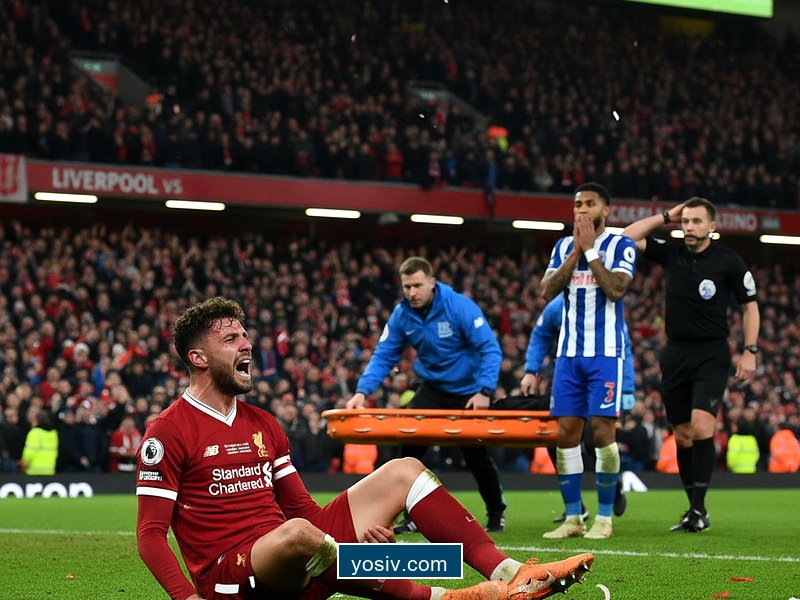
The snap echoed louder than the Kop’s groans. When Alexander Isak went down, clutching his tibia, it wasn’t just a bone that fractured; it was the entire architectural integrity of Liverpool’s attack. While the headlines scream "broken leg" and pundits calculate recovery timelines in months, the true devastation requires a scout’s eye to decipher. We aren't just losing a goalscorer; we are losing a biomechanical anomaly that redefined how a number nine operates in the Premier League.
I have spent two decades sitting in drafty stands watching strikers. There are target men who function as walls, and poachers who function as ghosts. Isak was neither. He was a drift-compatible weapon, a player whose body mechanics allowed him to act as a 6’4” winger centrally deployed. To understand why his absence is catastrophic, we must look past the goals and analyze the kinetic chain that has now been severed.
The Biomechanics of a Unicorn
In scouting terminology, we often discuss "separation mechanics." How quickly can a player create a yard of space from a standing start? Usually, players over 190cm suffer from a high center of gravity, making their turning radius resemble an oil tanker. Isak was the exception to the biological rule. He possessed an unnatural elasticity in his hips.
Watch the tape of his movement prior to the injury. Isak rarely received the ball static. He utilized a "pre-movement" trigger—a slight hop or a deceptive lean—before the ball arrived. This shifted the defender’s weight onto their heels. When Isak received possession, his first touch wasn't just about control; it was a directional tool to exploit that shifted weight.
"The tragedy of a tibial fracture for a player of Isak’s profile is not the loss of speed, but the potential loss of proprioception—the body's ability to sense movement, action, and location. For a dribbler who relies on snake-like agility, the mental trust in that leg is as vital as the calcium knitting it back together."
This injury fundamentally threatens that elasticity. Rehabilitation can fix the bone, but retraining the neuro-pathways to trust a planted leg during a high-velocity change of direction is the true battle. We saw this with Virgil van Dijk’s ACL; the body heals, but the subconscious hesitation remains for a season. For a defender, hesitation is manageable. For a striker whose game is built on micro-second feints, it is fatal.
The Tactical Void: The Half-Space Drifter
Liverpool’s current system relies heavily on the striker vacating the central channel to overload the half-spaces. This is where the unseen work happens. Isak was a master of the "blind-side arc." He wouldn't run straight at a centre-back; he would arc his run behind the defender’s field of vision, forcing them to turn their neck 180 degrees. That split second of turning time is where Mohamed Salah feasts.
Without Isak, the geometry collapses. Let's look at the alternatives through a cold, analytical lens:
| Attribute | Alexander Isak | Darwin Núñez | Diogo Jota |
|---|---|---|---|
| Primary Movement | Lateral Drifting / Channel Running | Vertical Chaos / Direct Sprints | Box Predation / Poaching |
| Defensive Gravity | Draws CBs out of position (Technical) | Forces defensive depth (Physical) | Exploits existing gaps (Spatial) |
| Link-up Play | Drop-and-turn pivot | One-touch layovers | Close-quarters combination |
The table exposes the issue. Núñez pushes defenses back, but he lacks Isak’s ability to receive the ball to feet, turn, and drive through a low block. Jota is elite in the box but vanishes in the build-up phase against physical low blocks. Isak was the bridge. He could drop deep like Firmino but run in behind like Torres. That duality is now gone.
The Ripple Effect on Rest Defense
A concept rarely discussed in mainstream media is "rest defense"—the structure a team maintains while attacking to prevent counter-attacks. Isak was crucial here, not through tackling, but through "shadow cover."
When Liverpool pressed high, Isak’s body shape was elite. He didn't just run at the goalkeeper; he curved his run to cut off the passing lane to the pivot (the #6). By isolating one side of the pitch, he made the pitch smaller for the rest of the Liverpool press. This is high-level cognitive work. It requires constant scanning—Isak’s scanning frequency was among the highest in the league.
If his replacement chases the ball linearly rather than cutting passing lanes, Liverpool’s midfield will be exposed. We saw glimpses of this vulnerability last season when the pressing triggers were disjointed. The midfield ends up covering 40 yards of lateral space because the striker failed to funnel the play correctly. The injury doesn't just hurt the goal tally; it destabilizes the defensive transition.
Historical Precedents and the 'Long' Recovery
We must temper expectations regarding his return. History is littered with tall, technical dribblers who lost their edge after lower-leg trauma. Look at the trajectory of players like Abou Diaby or, more pertinently, the change in style of Zlatan Ibrahimović post-injury later in his career. Zlatan adapted by becoming a static target man. Isak is too lean, too reliant on fluidity, to play that role effectively.
The Premier League creates a brutal environment for recovery. The physical load on the tibia during a high-press sprint is immense. Liverpool’s medical team is world-class, but they cannot cheat physics. If Isak returns and plays with a rigid ankle or a hesitant gait, he becomes an average striker. And an average striker at Anfield is simply a passenger.
The Emotional Component: Aura and Fear
Finally, we must address the intangible: the "fear factor." Defenders were terrified of Isak because he embarrassed them. He didn't just beat them; he twisted them into knots. That psychological edge forces defenders to commit two men to him, leaving space elsewhere.
When he returns, the first tackle will be the defining moment of his career. Every centre-back in the league will test that leg within the first ten minutes. It is the unwritten law of the professional game. If he flinches, the aura evaporates. Liverpool have depth, yes. They have talent, undoubtedly. But they have lost their unicorn, and in a league decided by singular moments of magic, the mundane rarely lifts the trophy.