
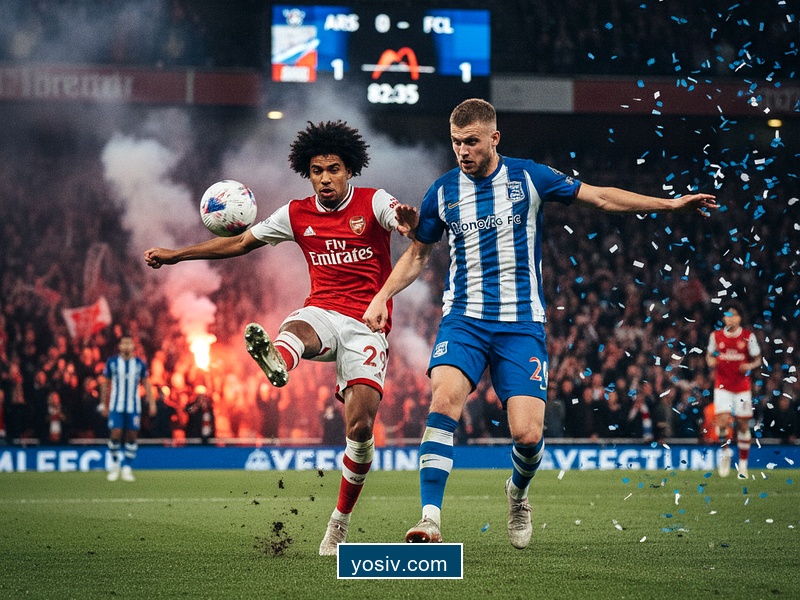
There is a brutal, silent language spoken on the training grounds of the Premier League. It isn’t found in the post-match press conferences or the sanitized data packets sent to owners. It is spoken in the subtle shifting of eyes when a striker demands the ball and a midfielder chooses, instead, to recycle possession backward. It is the language of lost trust. And at Selhurst Park, that silence is deafening surrounding Eddie Nketiah.
The reports surfacing that Crystal Palace are already scouring the January market to replace their marquee summer signing—the man supposed to carry the torch for the post-Zaha era—are not merely gossip. They are the inevitable tactical conclusion of a scouting error that ignored biomechanics in favor of reputation. Having spent two decades watching forwards try to transition from "Big Six" luxury players to mid-table grinders, I see the warning signs flashing in neon. Nketiah is not a bad footballer, but he is a catastrophic stylistic mismatch for Oliver Glasner’s demands.
The Fallacy of the "Fox in the Box"
The modern Premier League has effectively killed the pure "poacher," yet Nketiah’s game is entirely predicated on this archaic archetype. When we analyze his movement patterns through a scout's lens, we see a player waiting for the perfect ecosystem rather than creating one.
Watch Nketiah in the transition phase. His primary movement trigger is almost always linear—a straight dart between the center-backs looking for a through ball. In 2004, this was sufficient. In 2025, against low blocks or compact mid-blocks, it is easily nullified. He lacks the eccentric strength required to engage in physical grappling with modern defenders. When the ball is played into his feet with his back to goal, his center of gravity is often too high, causing him to be easily displaced by aggressive center-halves like Virgil van Dijk or even Lewis Dunk.
Unlike Jean-Philippe Mateta, who utilizes a wide stance and uses his arms to create a "scanning radius" that keeps defenders at bay, Nketiah plays narrow. He compresses his own space. When he receives the ball, his first instinct is proximal control—stopping the ball dead—rather than a progressive touch into space. This kills the momentum of Palace’s counter-attack, allowing the opposition defensive shape to reset. He is a striker who needs service on a silver platter in a team that requires its forward to be the waiter, the chef, and the busboy.
Analysis of the "Unseen" Work
The most damning indictment comes when analyzing his work off the ball. We talk often about pressing, but there is a difference between "busy" running and "smart" running. Nketiah runs hard—his distance metrics are rarely in question—but his cover shadow usage is rudimentary.
Elite pressing forwards, think Kai Havertz or even Dominic Solanke, curve their runs to cut off passing lanes to the pivot player while closing down the goalkeeper. Nketiah tends to press in straight lines. This allows opposition defenders to simply bypass him with a simple lateral pass. He expends energy without disrupting the opponent's build-up rhythm. It is the visual definition of "inefficient output."
Furthermore, his scanning frequency in the final third is alarmingly low for a player of his pedigree. Before receiving a pass, a top-tier forward scans the area 0.6 to 0.8 times per second to build a mental map of the pitch. Nketiah often fixates solely on the ball. This "ball-watching" leads to what we call blind-side turnovers; he receives possession unaware that a secondary presser is collapsing on him from his peripheral vision.
The Hale End Tax and Historical Context
There is a historical phenomenon we must address: the overvaluation of Arsenal academy products. For years, clubs have paid a premium for the technical floor provided by Hale End, assuming that competence in Arsène Wenger’s or Mikel Arteta’s rondos translates to survival in the trenches of the league. We saw it with Joe Willock (who eventually adapted), Reiss Nelson, and Ainsley Maitland-Niles. The technical empathy required to play for Arsenal is vastly different from the chaotic, second-ball duality of Crystal Palace.
Palace fell into the trap of buying the badge, not the player. They assumed that Nketiah’s limited minutes at the Emirates were due to the brilliance of Gabriel Jesus or Kai Havertz. The reality, exposed now under the harsh lights of Selhurst Park, is that Arteta moved on because Nketiah could not function as a "false nine" or a "target man." He is a pure finisher who doesn't finish enough to justify his lack of general play.
"In a system like Glasner’s, which relies heavily on wing-backs and verticality, the number nine serves as the fulcrum. If the fulcrum is brittle, the entire lever snaps."
Why Replacement is the Only Option
The rumors of Palace seeking a replacement are not reactionary; they are corrective. The underlying metrics suggest that sticking with Nketiah is a sunk cost fallacy. His Non-Penalty xG (Expected Goals) per 90 minutes has flatlined, but more concerning is his xA (Expected Assists).
When Mateta plays, he occupies two defenders, creating pockets of space (gravity) for Eberechi Eze and Michael Olise (before his departure) or Ismaila Sarr. Nketiah has zero gravity. Defenders are comfortable leaving him 1v1, which allows them to double-team Palace’s creative wide players. By simply being on the pitch, Nketiah makes his teammates worse because he simplifies the defensive equation for the opposition.
If Palace enters the market, they aren't looking for a "better" finisher. They are looking for a completely different biomechanical profile. They need a player capable of post-up play—someone who can receive the ball at chest height, absorb contact, and lay it off to an onrushing midfielder. They need a chaotic element. Nketiah is too tidy, too polite, and too predictable for the scrap Palace finds themselves in.
The Verdict
Eddie Nketiah is a victim of the modern game’s specialization. Ten years ago, he would have been Jermain Defoe—a lethal asset used to snipe goals. Today, where every player must be a multi-functional athlete capable of pressing, linking, and disrupting, he is a luxury item in a thrift store economy.
Palace made a £30 million mistake. Recognizing it in January and moving to rectify it isn't panic; it's professional diligence. The Premier League is unforgiving of square pegs in round holes, and right now, Nketiah is floating in the periphery of matches, a ghost in a Palace shirt, haunting a team that desperately needs a monster.