
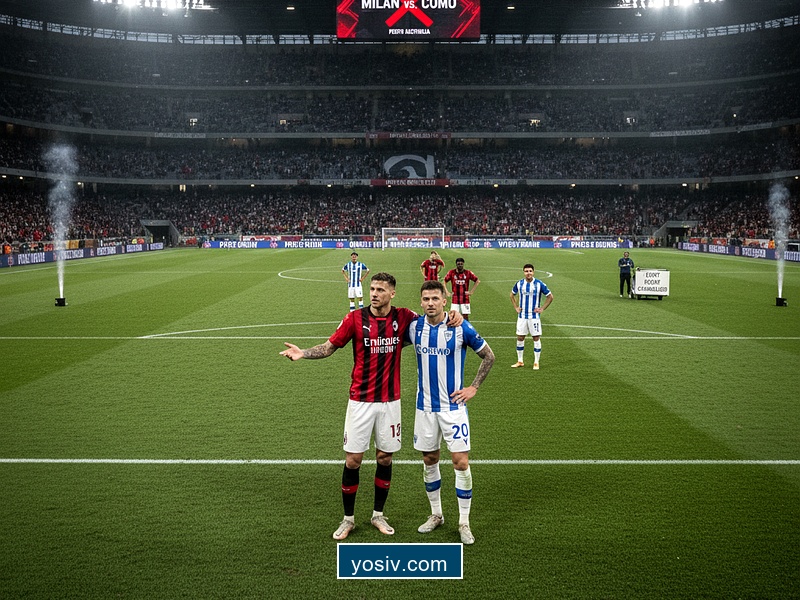
The sudden collapse of the proposed exhibition match between AC Milan and Como 1907 in Perth, Australia, will be mourned by accountants and marketing executives. For the purists, and arguably for the managers involved, it is an act of divine intervention. The cancellation of this logistical hallucination—a mid-season jaunt to the other side of the planet—forces us to look past the "brand expansion" rhetoric and scrutinize the actual footballing projects currently unfolding in Lombardy.
We are witnessing two distinct, high-risk philosophical experiments in Serie A. On one side, the data-driven, Americanized reconfiguration of AC Milan under Paulo Fonseca. On the other, the romantic, celebrity-backed idealism of Cesc Fàbregas at Como. Both projects are fragile. Both require time on the training pitch, not 20-hour flights to Western Australia. The failure of this commercial venture provides a rare moment of clarity to assess whether either manager’s philosophy is actually sustainable beyond the hype.
The Como Paradox: Champagne Football on a Beer Budget
Como 1907 is the most fascinating anomalies in European football. Owned by the Hartono brothers (the richest owners in Italian football via the Djarum Group) yet operating in a boutique stadium by the lake, they are not a typical promoted side. The cancellation of the Perth trip prevents them from parading their "brand" globally, forcing a reckoning with their tactical reality.
Cesc Fàbregas is not merely a coach; he is an ideologue. Most teams promoted from Serie B rely on low blocks, physical duels, and set-piece efficiency—think of the grim survivalism of Davide Nicola’s teams or the rigid structure of Hellas Verona. Fàbregas has rejected this entirely. He is attempting to implement a complex, possession-heavy positional play (Juego de Posición) with a squad largely comprised of veterans and journeymen.
"We don't want to just survive; we want to play. If we go down, we go down playing our way." — The unspoken manifesto of the Como project.
Tactically, Fàbregas demands a fluidity that even established Champions League squads struggle to master. He utilizes inverted fullbacks and demands his goalkeeper provoke the press to create artificial transitions. When it works, as seen in flashes against Atalanta or Verona, it is beautiful. It is "Sarriball" with a Catalan accent. But the sustainability of this approach in the brutal tactical ecosystem of Serie A is highly suspect.
The recruitment strategy mirrors this idealism. Signing Raphael Varane (who was immediately injured), Sergi Roberto, and Pepe Reina screams of a "Galácticos" mindset applied to a relegation battle. It is a philosophy that prioritizes technical ceiling over physical durability. The Perth friendly was a symptom of this: a desire to be a global attraction before establishing domestic security. By cancelling, Fàbregas gains precious weeks to drill defensive transitions—currently Como’s Achilles heel—rather than playing exhibition football for an Australian audience.
Fonseca’s Milan: The Friction of Transition
Across the region, AC Milan’s situation is different but equally precarious. The "RedBird Capital" project, spearheaded by Gerry Cardinale, views Milan as a media conglomerate first and a football club second. The Perth friendly was pure RedBird: monetizing the IP. Its cancellation allows us to focus on the pitch, where Paulo Fonseca is fighting a war against the ghost of Stefano Pioli.
Pioli’s Milan was defined by individual brilliance and chaos—Leão in isolation, Theo Hernández rampant, a man-marking system that often left massive gaps. Fonseca is the antithesis. He is a systemic manager. He craves control, compact lines, and a zonal pressing structure. The friction we are seeing this season is the result of reprogramming players who thrived in chaos to function within a rigid machine.
The sustainability of Fonseca’s tenure hinges on the "Double Pivot" dilemma. In his preferred 4-2-3-1, he demands midfielders who can both dictate tempo and shield the back four. Yet, the roster construction—heavy on box-to-box runners like Loftus-Cheek and Musah, but light on disciplined registas (aside from Reijnders, who is better further forward)—contradicts the manager's philosophy. This disconnect between the boardroom’s "Moneyball" recruitment and the manager’s tactical needs is the defining tension of the season.
Had the Perth game gone ahead, it would have further drained a squad already looking leggy in defensive transitions. Milan’s pressing numbers have dropped significantly in the final 15 minutes of matches this season. Sustainability requires energy conservation. The cancellation is a reprieve that might just save Fonseca’s job by allowing for tactical consolidation rather than commercial expansion.
The Fallacy of the Global Brand
The broader context here is the desperation of Serie A to close the revenue gap with the Premier League. The aborted Perth plan is reminiscent of the incoherent strategy that sees the Supercoppa Italiana played in Saudi Arabia. It is a frantic grasp for relevance that often cannibalizes the product on the field.
You cannot build a "sustainable result" if your players are treated as traveling circus performers. The intense tactical demands of modern Calcio—where coaches like Gasperini, Motta, and Inzaghi treat every meter of space as a battleground—require peak physical conditioning. The notion that Milan and Como could fly to Australia, play a match, return, and maintain their respective distinct styles (Fonseca’s high line, Fàbregas’s total football) is a fallacy.
Tactical Reality vs. Commercial Fantasy
This non-event serves as a perfect microcosm for the state of the modern game. We have two clubs desperate to project an image of grandeur. Como wants to be the "coolest club in the world," a boutique fashion label that plays football. Milan wants to be a global entertainment titan akin to the New York Yankees.
However, the league table respects only points, not marketability. Fàbregas’s philosophy is beautiful, but if Como cannot defend a set-piece because they are exhausted from media duties, they will return to Serie B. Fonseca’s system is intelligent, but if his pressing triggers fail due to fatigue, the San Siro will turn on him.
The sustainability of these projects relies on the mundane: drilling cover shadows, practicing defensive headers, and managing lactate thresholds. The "Project" fails if the football fails. By staying in Italy, both managers have been gifted a victory. They avoid the jet lag and the exhibition intensity that breeds injuries. They get to be football coaches for a week longer, rather than brand ambassadors.
In the end, the cancellation proves that while you can buy Varane and you can buy American analytics, you cannot buy the physiology required to sustain high-pressing football across continents. The ledger may suffer a loss this week, but the integrity of the tactics board has been preserved.