
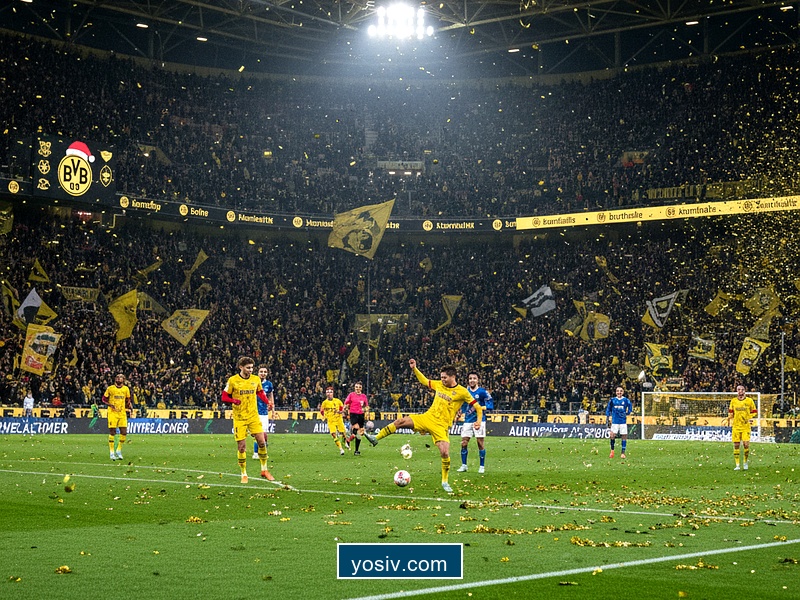
The Westfalenstadion in December is a sensory overload. The gluhwein vapor rising from the Südtribüne, the cacophony of "Heja BVB," and the pervasive sense of holiday cheer can easily seduce the casual observer. But up here in the press box, wearing the hat of a scout rather than a cheerleader, the "festive vibes" reported in the headlines are irrelevant. In fact, they are dangerous. Atmosphere doesn't win titles; biomechanics and spatial geometry do.
Watching Dortmund’s final Bundesliga fixture of 2025, I stripped away the narrative of a team enjoying their football. instead, I watched the hips, the eyes, and the shadow runs of a squad that sits at a fascinating tactical crossroads. What the casual fan saw as fluid attacking play, the trained eye recognizes as a high-risk structural gamble relying heavily on specific, individual movement patterns.
The Deception of the "Free" Eight
The headline-grabbers will focus on the goals, but the real story of this match—and BVB’s trajectory into 2026—was written in the half-spaces. We need to talk about the body orientation of Julian Brandt. In modern scouting, we track "scanning frequency"—the number of times a midfielder checks their shoulder in the ten seconds prior to receiving possession. Elite orchestrators like Xavi or De Bruyne hit 0.6 to 0.8 scans per second.
Throughout the first half, Brandt was operating at an elite scanning frequency. This isn't just about vision; it's about pre-orientation. Before the ball left the center-back's foot, Brandt had already opened his hips to the field. This subtle biomechanical adjustment—receiving across the body rather than with a closed stance—shaved 0.5 seconds off every transition.
Scout's Note: Watch the "unseen" movement when the ball is on the opposite flank. Brandt doesn't just drift; he creates a "blind-side" run behind the opposition pivot. He steps into the defender's peripheral vision dead-zone, forcing them to turn their head. That split-second of hesitation creates the passing lane.
This is a distinct evolution from the Dortmund of the early 2020s, which relied on the chaotic verticality of Jude Bellingham or Erling Haaland. This 2025 iteration is slower in buildup but more lethal in possession retention. The "festive vibe" was actually a clinic in La Pausa—the tactical art of waiting for the press to commit before releasing the ball.
Rest Defense and the Schlotterbeck Protocol
While the attack flowed, the defensive structure provided the most anxiety for a seasoned analyst. The concept of Restverteidigung (rest defense) is the bedrock of German football theory, dictating how many players stay behind the ball while attacking to prevent counter-attacks.
Dortmund played with fire. Nico Schlotterbeck’s positioning wasn't just aggressive; it was borderline reckless. A scout looks at a center-back's weight distribution when their team is in possession. Schlotterbeck spent the match on his toes, leaning forward, effectively acting as a deep-lying playmaker. This provides numerical superiority in midfield but leaves the channels exposed.
There were three distinct moments where the opposition transition triggered a 2v2 situation at the back. In 2011, under Jürgen Klopp, the intense counter-press would have suffocated this at the source. In 2025, the press was often bypassed. Schlotterbeck’s recovery sprints—characterized by his unique, long-striding gait—were the only fail-safe. Reliance on individual athleticism to fix structural deficits is not a strategy; it’s a coin flip. The body language of the backline after these scares was telling: hands on hips, finger-pointing. That’s not festive; that’s fragmentation.
The Winger's Isolation: Gravity vs. Production
Jamie Gittens offers a case study in what scouts call "gravity." Even without the ball, his wide positioning forces the opposition fullback to widen their stance and the center-back to shuffle over, stretching the defensive chain. This creates the "underlap" zones for the fullbacks to exploit.
However, watching Gittens in isolation reveals a frustrating pattern in his deceleration mechanics. Elite dribblers change pace violently. They go from 0 to 100, but more importantly, from 100 to 0 to freeze the defender. In this match, Gittens struggled to arrest his momentum, often running into cul-de-sacs. The headlines will praise his energy, but the tape shows a player who initiates contact rather than evading it.
Furthermore, look at his reaction to possession loss. The "five-second rule" (immediate pressure after losing the ball) was inconsistent. There were moments where, following a failed dribble, the shoulders dropped. In a high-pressing system, that moment of self-pity is a broken link in the chain. A scout marks that down in red ink. Talent gets you on the pitch; defensive transition keeps you there.
The Number 9: Shadow Cover and Physical Leverage
Serhou Guirassy’s contribution is perhaps the most misunderstood element of this squad. The box score might show goals or assists, but his value lies in "shadow cover." When the opposition center-backs have the ball, Guirassy rarely runs in a straight line. He arcs his runs to block the passing lane into the number six (the defensive midfielder).
This is the unseen work. By curving his run, he cuts the pitch in half, forcing the opponent to play wide where the touchline acts as an extra defender for Dortmund. Physically, his hold-up play utilizes a technique known as "shielding with the glutes." He lowers his center of gravity, backs into the defender, and creates a separation of two feet simply by using his posterior chain. This allows the midfield runners to join the attack.
Compared to the mobile, channel-running style of previous BVB strikers like Aubameyang, Guirassy acts as a fulcrum. He is the wall off which the creative midfielders bounce passes. If you watched the game simply following the ball, you missed Guirassy pinning two center-backs to allow Brandt the space to operate.
The Verdict: Process Over Party
The danger of a comfortable win in the final game of the year is the false positive. The "festive vibes" were facilitated by an opponent that allowed Dortmund time on the ball. When BVB faced a low block, their circulation was crisp. But when the game became chaotic, the structural integrity of the rest defense wavered.
A scout’s job is to project future performance based on current evidence. The evidence suggests that while Dortmund has mastered the art of possession in the middle third, their transition defense relies too heavily on individual heroism rather than systemic compactness. The "vibes" are good because the technical ceiling of these players is astronomical. But in the knockout stages of the Champions League, or against the pressing machines of Leipzig or Bayern, vibes vanish.
This winter break needs to be less about celebration and more about drilling the negative transition. The spacing between the double pivot and the center-backs is too large. The recovery runs are reactive, not proactive. Enjoy the three points and the holiday cheer, but do not mistake this performance for perfection. The tape never lies, and right now, the tape shows a team that is beautiful to watch but frighteningly open when the music stops.