
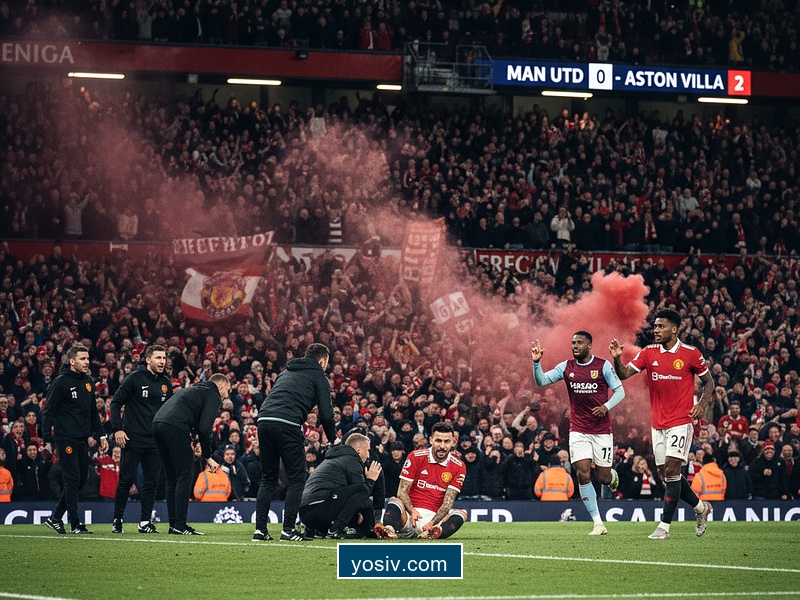
The headline will read that Manchester United were unlucky to lose Bruno Fernandes to injury. It will suggest that Aston Villa’s surge toward a genuine title challenge is a result of momentum. Both narratives are lazy. What we witnessed this weekend was not a fluctuation of luck, but a collision of two diverging footballing ideologies: one rooted in geometric precision, the other in improvisational chaos.
As a scout, you stop watching the ball after five minutes. You watch the space between the lines. You watch the rotation of the double pivot. You watch the shoulders of the weak-side winger. When you strip away the noise and apply a forensic lens to these two sides, the disparity is terrifying. Unai Emery has built a machine designed to manipulate space; Erik ten Hag is presiding over a side that seemingly hopes space will accidentally open up.
The Anatomy of the Villa Trap
Aston Villa’s ascension isn't about passion; it is about the weaponization of the "artificial transition." Most teams wait for a turnover to counter-attack. Emery’s Villa manufactures them from goal kicks.
Watch Emi Martinez. When he has the ball, he isn’t looking for a quick release. He puts his studs on the leather and waits. This is a tactical pause—La Pausa—designed to bait the opposition press. Villa invites pressure into their own six-yard box, condensing the field effectively to a 30-meter strip. The moment the opponent commits the extra man, Villa executes a rehearsed vertical pattern: usually a bounce pass into a dropping midfielder (Tielemans or Kamara) who plays a first-time ball into the vacated channels.
"The beauty of Emery’s 4-2-2-2 out of possession is that it morphs into a 2-4-4 in attack within three seconds. It is a masterclass in verticality."
The "unseen" work here is done by Ollie Watkins and Morgan Rogers. While Martinez holds the ball, watch their heads. They are scanning for the opposition center-backs' blind spots. They aren't just running forward; they are making diverging runs to stretch the defensive line horizontally. This creates the "pockets" in the half-spaces that McGinn thrives in. It is drilled, repetitive, and devastatingly effective.
The Body Language of Collapse
Contrast this with Manchester United. The injury to Bruno Fernandes is catastrophic not just because of his quality, but because he is the only player in the squad who understands how to mask the team's structural deficiencies. Without him, the tactical anarchy is laid bare.
Scouting United off the ball is an exercise in frustration. There is a distinct lack of "scanning" in their midfield pivot. When the ball is turned over, look at the reaction of the wingers. In a functional high-pressing system, the immediate reaction to losing the ball is a sprint toward the carrier (the 5-second rule). United’s wide players frequently drop their heads or throw their arms up before engaging. This delay, often less than a second, destroys the integrity of the press.
Furthermore, the vertical distance between United’s center-backs and their center-forward often stretches to 50 or 60 meters. In modern coaching terms, the team is "broken." This leaves the midfield—Casemiro, Mainoo, or Eriksen—stranded in acres of space, forced to cover ground rather than control zones. When Fernandes is on the pitch, his manic energy bridges these gaps. He sprints 40 yards to press a goalkeeper, then 40 yards back to receive a pass. It is unsustainable "Hero Ball," and his injury was a physiological inevitability.
The Red Zone and Structural Negligence
Fernandes’ injury falls into what sports scientists call the "Red Zone" of loading. He has played more minutes than almost any elite midfielder in Europe over the last three years. But the tactical context makes those minutes heavier. Because United lacks "automatisms"—pre-programmed passing patterns—Fernandes plays every game on high cognitive alert. He has to invent solutions in real-time.
Compare this to Villa’s midfielders. They know where their teammates are without looking. Tielemans plays passes to spots, not people, trusting the structure. Fernandes plays to people, hoping they move. The mental fatigue of carrying a team’s entire creative burden leads to sloppy mechanics, which leads to injury. His hamstring didn't just fail; the system failed him.
Comparative Analysis: The Pivot Function
To understand the chasm between these clubs, look at the metrics defining midfield control and defensive solidity.
| Metric | Aston Villa (Emery Structure) | Man Utd (Ten Hag Structure) |
|---|---|---|
| defensive Line Height | High (Offside Trap Specialists) | Deep/Variable (Reactive) |
| Rest Defense Structure | 3-1 or 2-2 Box | Disconnected / Man-for-Man |
| Trigger Press | Ball entry to specific zones | Individual (often disorganized) |
| Build-up Tempo | Slow-Slow-FAST | Erratic |
The Rogers Factor: Finding the Half-Space
A specific note on Aston Villa's Morgan Rogers, who is rapidly becoming the prototype for the modern "connector." Physically, he resembles a classic No. 9, but his movement patterns are those of an elite No. 10. He operates almost exclusively in the "half-spaces"—the vertical corridors between the wing and the center.
Against United, or any disjointed midfield, Rogers is lethal. He receives the ball on the "half-turn"—body open to the goal, back shielded from the defender. This allows him to drive immediately. United’s midfielders often receive the ball facing their own goal, forcing a backward pass. This subtle difference in body orientation is the difference between progressive football and sterile possession.
Historical Echoes
We are witnessing a shift in the Premier League’s tectonic plates similar to the 2008/09 season, where Martin O'Neill’s Villa briefly threatened the "Big Four" hegemony. However, Emery’s project feels more sustainable. It is rooted in the same principles that allowed Arrigo Sacchi’s AC Milan to dominate: compression of space and synchronization of movement.
United, conversely, are mimicking the decline of late-era Arsène Wenger at Arsenal, but without the technical grace. They rely on moments of individual brilliance to paper over cracks in the collective architecture. When you remove the creator of those moments—Fernandes—you are left with expensive individuals standing in a field, waiting for instructions that never arrive.
The Verdict
The result of this weekend acts as a litmus test. Villa’s title chances are real not because they have the best players, but because they have the clearest identity. They have mastered the "dark arts" of game management and the geometric arts of positional play. Every player knows the trigger.
For Manchester United, losing Fernandes exposes the inconvenient truth: they are not a team in transition; they are a team in stasis. A collection of assets without a portfolio. Without the frantic, duct-tape energy of their captain holding the lines together, the disconnect between defense and attack is not just a gap—it is a canyon. Unless Ten Hag can instill the kind of rigid, off-ball discipline that Emery demands, United will continue to be a highlight reel of individual errors, while Villa marches methodically toward the summit.